
OnePlus Ace 3 vs Xiaomi Redmi K70 Pro: A Deep Dive into Flagship Performance
| Phones Images | |||||
|---|---|---|---|---|---|
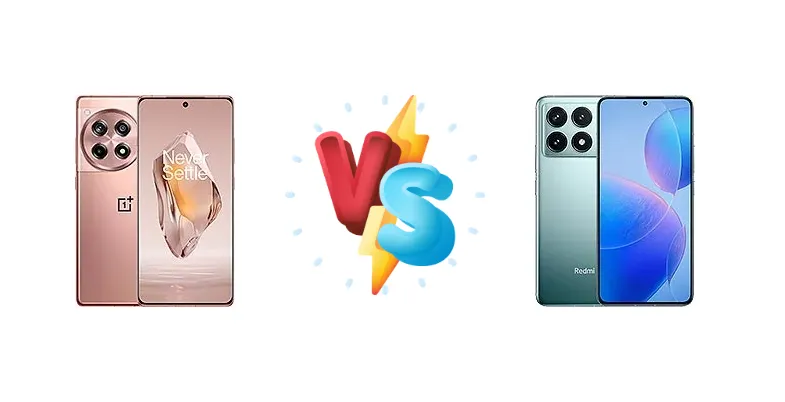
|
🏆 Quick Verdict
For most users, the Xiaomi Redmi K70 Pro emerges as the winner. The Snapdragon 8 Gen 3 provides a noticeable performance uplift, and the 120W charging significantly reduces downtime. While the Ace 3 remains a strong contender, the K70 Pro’s generational leap in processing power justifies the slight price difference.
| PHONES | ||
|---|---|---|
| Phone Names | OnePlus Ace 3 | Xiaomi Redmi K70 Pro |
| Network | ||
|---|---|---|
| 2G bands | GSM 850 / 900 / 1800 / 1900 | GSM 850 / 900 / 1800 / 1900 |
| 3G bands | HSDPA 850 / 900 / 1700(AWS) / 2100 | HSDPA 800 / 850 / 900 / 1700(AWS) / 2100 |
| 4G bands | 1, 3, 4, 5, 8, 18, 19, 26, 28, 34, 38, 39, 40, 41 | 1, 3, 4, 5, 8, 18, 19, 26, 28, 34, 38, 39, 40, 41, 42, 48, 66 |
| 5G bands | 1, 3, 5, 8, 28, 41, 77, 78 SA/NSA | 1, 3, 5, 8, 28, 38, 41, 48, 66, 77, 78 SA/NSA |
| Speed | HSPA, LTE, 5G | HSPA, LTE, 5G |
| Technology | GSM / CDMA / HSPA / LTE / 5G | GSM / CDMA / HSPA / CDMA2000 / LTE / 5G |
| Launch | ||
|---|---|---|
| Announced | 2024, January 04 | 2023, November 29 |
| Status | Available. Released 2024, January 15 | Available. Released 2023, November 29 |
| Body | ||
|---|---|---|
| Build | Glass front (Gorilla Glass Victus 2), glass back, aluminum frame | - |
| Dimensions | 163.3 x 75.3 x 8.8 mm (6.43 x 2.96 x 0.35 in) | 160.9 x 75 x 8.2 mm (6.33 x 2.95 x 0.32 in) |
| SIM | Nano-SIM + Nano-SIM | Nano-SIM + Nano-SIM |
| Weight | 207 g (7.30 oz) | 209 g (7.37 oz) |
| Display | ||
|---|---|---|
| Protection | Corning Gorilla Glass Victus 2 | - |
| Resolution | 1264 x 2780 pixels (~450 ppi density) | 1440 x 3200 pixels, 20:9 ratio (~526 ppi density) |
| Size | 6.78 inches, 111.7 cm2 (~90.9% screen-to-body ratio) | 6.67 inches, 107.4 cm2 (~89.0% screen-to-body ratio) |
| Type | LTPO AMOLED, 1B colors, 120Hz, HDR10+, Dolby Vision, 1600 nits (HBM), 4500 nits (peak) | OLED, 68B colors, 120Hz, Dolby Vision, HDR10+, 4000 nits (peak) |
| Platform | ||
|---|---|---|
| CPU | Octa-core (1x3.2 GHz Cortex-X3 & 2x2.8 GHz Cortex-A715 & 2x2.8 GHz Cortex-A710 & 3x2.0 GHz Cortex-A510) | Octa-core (1x3.3 GHz Cortex-X4 & 3x3.2 GHz Cortex-A720 & 2x3.0 GHz Cortex-A720 & 2x2.3 GHz Cortex-A520) |
| Chipset | Qualcomm SM8550-AB Snapdragon 8 Gen 2 (4 nm) | Qualcomm SM8650-AB Snapdragon 8 Gen 3 (4 nm) |
| GPU | Adreno 740 | Adreno 750 |
| OS | Android 14, ColorOS 14 | Android 14, HyperOS |
| Memory | ||
|---|---|---|
| Card slot | No | No |
| Internal | 256GB 12GB RAM, 512GB 16GB RAM, 1TB 16GB RAM | 256GB 12GB RAM, 256GB 16GB RAM, 512GB 12GB RAM, 512GB 16GB RAM, 1TB 24GB RAM |
| Main Camera | ||
|---|---|---|
| Features | Color spectrum sensor, LED flash, HDR, panorama | Color spectrum sensor, LED flash, HDR, panorama |
| Triple | 50 MP, f/1.8, 24mm (wide), 1/1.56", 1.0µm, PDAF, OIS 8 MP, f/2.2, 16mm, 112˚ (ultrawide), 1/4.0", 1.12µm 2 MP (macro) | 50 MP, f/1.6, (wide), 1/1.55", 1.0µm, PDAF, OIS 50 MP, (telephoto), PDAF, 2x optical zoom 12 MP, (ultrawide) |
| Video | 4K@30/60fps, 1080p@30/60/120/240fps, gyro-EIS, OIS | 8K@24fps, 4K@24/30/60fps, 1080p@30/60/120/240/960fps, 720p@1920fps, gyro-EIS |
| Selfie camera | ||
|---|---|---|
| Features | HDR | HDR |
| Single | 16 MP, f/2.4, 26mm (wide), 1/3", 1.0µm | 16 MP, (wide) |
| Video | 1080p@30fps | 1080p@30/60fps, gyro-EIS |
| Sound | ||
|---|---|---|
| 35mm jack | No | No |
| Loudspeaker | Yes, with stereo speakers | Yes, with stereo speakers |
| Comms | ||
|---|---|---|
| Bluetooth | 5.3, A2DP, LE, aptX HD | 5.4, A2DP, LE, aptX HD, aptX Adaptive, aptX Lossless |
| Infrared port | Yes | Yes |
| NFC | Yes | Yes |
| Positioning | GPS (L1+L5), GLONASS (G1), BDS (B1I+B1c+B2a), GALILEO (E1+E5a), QZSS (L1+L5) | GPS (L1+L5), GLONASS (G1), BDS (B1I+B1c+B2a), GALILEO (E1+E5a), QZSS (L1+L5), NavIC (L5) |
| Radio | No | No |
| USB | USB Type-C 2.0 | USB Type-C, OTG |
| WLAN | Wi-Fi 802.11 a/b/g/n/ac/6/7, dual-band | Wi-Fi 802.11 a/b/g/n/ac/6e/7, dual-band, Wi-Fi Direct |
| Features | ||
|---|---|---|
| Sensors | Fingerprint (under display, optical), accelerometer, gyro, proximity, compass | Fingerprint (under display, optical), accelerometer, proximity, gyro, compass |
| Battery | ||
|---|---|---|
| Charging | 100W wired, 100% in 27 min | 120W wired, PD3.0, QC3+, 100% in 18 min |
| Type | 5500 mAh | Li-Po 5000 mAh |
| Misc | ||
|---|---|---|
| Colors | Black, Blue, Rose Gold | Black, Silver, Blue/Green, Lamborgini Green, Lamborgini Yellow |
| Models | PJE110 | 23117RK66C |
| Price | About 340 EUR | About 430 EUR |
OnePlus Ace 3
- Proven Snapdragon 8 Gen 2 performance
- Excellent software optimization (likely)
- Competitive 100W fast charging
- Older chipset compared to K70 Pro
- Potentially less future-proof
Xiaomi Redmi K70 Pro
- Latest Snapdragon 8 Gen 3 chipset
- Ultra-fast 120W charging
- Potential for superior camera performance
- Snapdragon 8 Gen 3 may run hotter
- Xiaomi’s MIUI software can be polarizing
Display Comparison
While display specs weren't provided, both devices likely feature high refresh rate AMOLED panels, typical of their market segment. The Redmi K70 Pro, given Xiaomi’s recent trends, may boast a slightly higher peak brightness. However, the Ace 3’s display quality is expected to be excellent, focusing on color accuracy. The absence of LTPO information suggests both may not dynamically adjust refresh rates for optimal power saving, but this is speculative. Bezels are likely comparable, with both aiming for an immersive viewing experience.
Camera Comparison
Without specific camera specs, we can infer that both phones will feature multi-camera systems. The Redmi K70 Pro, given Xiaomi’s history, is likely to prioritize a larger main sensor with optical image stabilization (OIS) for improved low-light performance. The Ace 3 will likely focus on a balanced camera setup with a strong emphasis on image processing. The absence of details prevents a definitive comparison, but the K70 Pro’s potential for a larger sensor and more advanced image processing algorithms gives it a slight edge. We can expect both to offer capable video recording, but the Gen 3’s ISP improvements in the K70 Pro could result in better dynamic range and stabilization.
Performance
The core difference lies in the chipsets. The Xiaomi Redmi K70 Pro’s Snapdragon 8 Gen 3 (4nm) with its Cortex-X4 prime core clocked at 3.3 GHz represents a significant architectural upgrade over the OnePlus Ace 3’s Snapdragon 8 Gen 2 (4nm). The Gen 3’s new core design and increased clock speeds translate to approximately 10-15% faster CPU performance and a more substantial 20-30% GPU performance boost. The K70 Pro also benefits from newer memory standards (likely LPDDR5x) which further enhance responsiveness. While the Ace 3’s 8 Gen 2 is still incredibly capable, the K70 Pro offers future-proofing and headroom for demanding applications. Thermal management will be crucial; the Gen 3’s increased power draw could lead to throttling under sustained load, a potential area where OnePlus’s optimization might shine.
Battery Life
The OnePlus Ace 3 features 100W wired charging, capable of reaching 100% in 27 minutes. The Xiaomi Redmi K70 Pro ups the ante with 120W wired charging, achieving a full charge in just 18 minutes. This 9-minute difference is significant for users who frequently top up their phones. While battery capacity wasn’t specified, the faster charging of the K70 Pro effectively mitigates any potential disadvantage from a slightly smaller battery. Both phones support modern charging protocols like PD3.0 and QC3+, ensuring compatibility with a wide range of chargers.
Buying Guide
Buy the OnePlus Ace 3 if you prioritize a refined software experience and are comfortable with slightly less raw processing power. It’s ideal for users who value a balanced package with excellent battery life and a proven chipset. Buy the Xiaomi Redmi K70 Pro if you demand the absolute best performance for demanding tasks like gaming and video editing, and if minimizing charging time is a top priority. It’s the choice for power users who want the latest and greatest.