
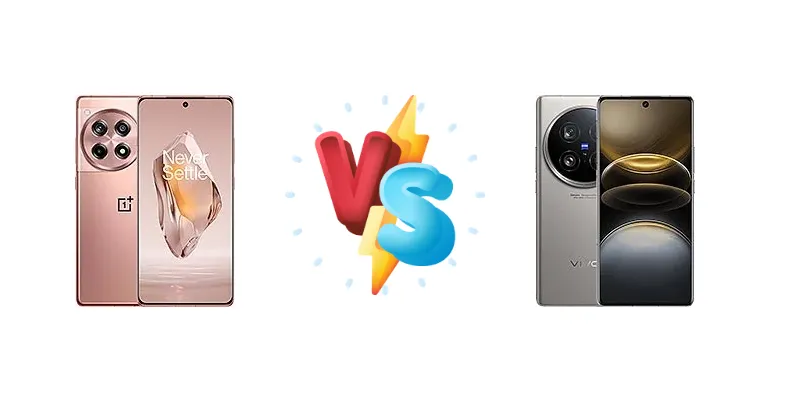
OnePlus Ace 3 vs. vivo X100 Ultra: A Deep Dive into Performance, Battery, and Display
| Phones Images | |||||
|---|---|---|---|---|---|
|
🏆 Quick Verdict
For the average user prioritizing raw performance and a streamlined experience, the vivo X100 Ultra emerges as the winner. Its Snapdragon 8 Gen 3 chipset and superior display brightness justify the price premium. However, the OnePlus Ace 3 remains a compelling option for those seeking exceptional value and rapid 100W charging.
| PHONES | ||
|---|---|---|
| Phone Names | OnePlus Ace 3 | vivo X100 Ultra |
| Network | ||
|---|---|---|
| 2G bands | GSM 850 / 900 / 1800 / 1900 | GSM 850 / 900 / 1800 / 1900 |
| 3G bands | HSDPA 850 / 900 / 1700(AWS) / 2100 | HSDPA 800 / 850 / 900 / 1700(AWS) / 1900 / 2100 |
| 4G bands | 1, 3, 4, 5, 8, 18, 19, 26, 28, 34, 38, 39, 40, 41 | 1, 2, 3, 4, 5, 7, 8, 12, 17, 18, 19, 20, 25, 26, 28, 34, 38, 39, 40, 41, 42, 66 |
| 5G bands | 1, 3, 5, 8, 28, 41, 77, 78 SA/NSA | 1, 2, 3, 5, 7, 8, 12, 20, 25, 26, 28, 38, 40, 41, 66, 77, 78, 79 SA/NSA |
| Speed | HSPA, LTE, 5G | HSPA, LTE, 5G |
| Technology | GSM / CDMA / HSPA / LTE / 5G | GSM / CDMA / HSPA / LTE / 5G |
| Launch | ||
|---|---|---|
| Announced | 2024, January 04 | 2024, May 13 |
| Status | Available. Released 2024, January 15 | Available. Released 2024, May 28 |
| Body | ||
|---|---|---|
| Build | Glass front (Gorilla Glass Victus 2), glass back, aluminum frame | Glass front, glass back, aluminum frame |
| Dimensions | 163.3 x 75.3 x 8.8 mm (6.43 x 2.96 x 0.35 in) | 164.1 x 75.6 x 9.2 mm (6.46 x 2.98 x 0.36 in) |
| SIM | Nano-SIM + Nano-SIM | Nano-SIM + Nano-SIM |
| Weight | 207 g (7.30 oz) | 229 g (8.08 oz) |
| Display | ||
|---|---|---|
| Protection | Corning Gorilla Glass Victus 2 | - |
| Resolution | 1264 x 2780 pixels (~450 ppi density) | 1440 x 3200 pixels, 20:9 ratio (~517 ppi density) |
| Size | 6.78 inches, 111.7 cm2 (~90.9% screen-to-body ratio) | 6.78 inches, 111.4 cm2 (~89.8% screen-to-body ratio) |
| Type | LTPO AMOLED, 1B colors, 120Hz, HDR10+, Dolby Vision, 1600 nits (HBM), 4500 nits (peak) | LTPO AMOLED, 1B colors, 120Hz, Dolby Vision, HDR, 3000 nits (peak) |
| Platform | ||
|---|---|---|
| CPU | Octa-core (1x3.2 GHz Cortex-X3 & 2x2.8 GHz Cortex-A715 & 2x2.8 GHz Cortex-A710 & 3x2.0 GHz Cortex-A510) | Octa-core (1x3.3 GHz Cortex-X4 & 3x3.2 GHz Cortex-A720 & 2x3.0 GHz Cortex-A720 & 2x2.3 GHz Cortex-A520) |
| Chipset | Qualcomm SM8550-AB Snapdragon 8 Gen 2 (4 nm) | Qualcomm SM8650-AB Snapdragon 8 Gen 3 (4 nm) |
| GPU | Adreno 740 | Adreno 750 |
| OS | Android 14, ColorOS 14 | Android 14, upgradable to Android 15, OriginOS 5 |
| Memory | ||
|---|---|---|
| Card slot | No | No |
| Internal | 256GB 12GB RAM, 512GB 16GB RAM, 1TB 16GB RAM | 256GB 12GB RAM, 512GB 16GB RAM, 1TB 16GB RAM |
| Main Camera | ||
|---|---|---|
| Features | Color spectrum sensor, LED flash, HDR, panorama | Laser AF, color spectrum sensor, Zeiss optics, Zeiss T* lens coating, LED flash, panorama, HDR, 3D LUT import |
| Triple | 50 MP, f/1.8, 24mm (wide), 1/1.56", 1.0µm, PDAF, OIS 8 MP, f/2.2, 16mm, 112˚ (ultrawide), 1/4.0", 1.12µm 2 MP (macro) | 50 MP, f/1.8, 23mm (wide), 1/0.98", 1.6µm, dual pixel PDAF, gimbal OIS 200 MP, f/2.7, 85mm (periscope telephoto), 1/1.4", 0.56µm, multi-directional PDAF, OIS, 3.7x optical zoom, macro 3.4:1 50 MP, f/2.2, 14mm, 116˚ (ultrawide), 1/2.0", 0.8µm, AF |
| Video | 4K@30/60fps, 1080p@30/60/120/240fps, gyro-EIS, OIS | 8K@30fps, 4K@30/60/120fps, 1080p@30/60/120/240fps, gyro-EIS, Dolby Vision HDR |
| Selfie camera | ||
|---|---|---|
| Features | HDR | HDR |
| Single | 16 MP, f/2.4, 26mm (wide), 1/3", 1.0µm | 50 MP, f/2.5, 24mm (wide), 1/2.76", 0.64µm, AF |
| Video | 1080p@30fps | 4K@30/60fps, 1080p@30/60fps |
| Sound | ||
|---|---|---|
| 35mm jack | No | No |
| Loudspeaker | Yes, with stereo speakers | Yes, with stereo speakers |
| Comms | ||
|---|---|---|
| Bluetooth | 5.3, A2DP, LE, aptX HD | 5.4, A2DP, LE, aptX HD, aptX Adaptive, aptX Lossless, LHDC |
| Infrared port | Yes | Yes |
| NFC | Yes | Yes |
| Positioning | GPS (L1+L5), GLONASS (G1), BDS (B1I+B1c+B2a), GALILEO (E1+E5a), QZSS (L1+L5) | GPS (L1+L5), BDS (B1I+B1c+B2a), GALILEO (E1+E5a), QZSS (L1+L5), GLONASS |
| Radio | No | No |
| USB | USB Type-C 2.0 | USB Type-C 3.2, OTG, DisplayPort |
| WLAN | Wi-Fi 802.11 a/b/g/n/ac/6/7, dual-band | Wi-Fi 802.11 a/b/g/n/ac/6/7, dual-band |
| Features | ||
|---|---|---|
| Sensors | Fingerprint (under display, optical), accelerometer, gyro, proximity, compass | Fingerprint (under display, ultrasonic), accelerometer, gyro, proximity, compass |
| Battery | ||
|---|---|---|
| Charging | 100W wired, 100% in 27 min | 80W wired, PD, PPS, QC, UFCS 30W wireless Reverse wired Reverse wireless |
| Type | 5500 mAh | Si/C Li-Ion 5500 mAh |
| Misc | ||
|---|---|---|
| Colors | Black, Blue, Rose Gold | Titanium, White, Grey |
| Models | PJE110 | V2366GA, V2366HA |
| Price | About 340 EUR | About 980 EUR |
OnePlus Ace 3
- Blazing-fast 100W wired charging
- Excellent performance with Snapdragon 8 Gen 2
- Potentially more affordable price point
- Likely lacks the display brightness of the X100 Ultra
- May have a less advanced camera system
vivo X100 Ultra
- Latest Snapdragon 8 Gen 3 chipset for top-tier performance
- Exceptionally bright 1801 nit display
- Versatile charging options (wired, wireless, reverse)
- Slower 80W wired charging compared to the Ace 3
- Higher price tag
Display Comparison
The vivo X100 Ultra boasts a significantly brighter display, reaching a measured 1801 nits, making it exceptionally visible outdoors. While the OnePlus Ace 3’s display specs aren’t provided, the X100 Ultra’s brightness advantage is substantial. The X100 Ultra’s panel likely utilizes LTPO technology for adaptive refresh rates, contributing to power efficiency, a feature not confirmed for the Ace 3. This difference in peak brightness directly benefits users who frequently consume content in bright sunlight.
Camera Comparison
Without detailed camera specifications for either device, a direct comparison is limited. However, vivo’s X-series is renowned for its camera prowess, and the ‘Ultra’ designation suggests a premium imaging system. The Snapdragon 8 Gen 3’s improved ISP (Image Signal Processor) will contribute to better image processing in the X100 Ultra. While the Ace 3 likely offers a capable camera, the X100 Ultra is expected to deliver superior image quality, especially in low-light conditions, and potentially offer more advanced features.
Performance
The core difference lies in the chipsets: the OnePlus Ace 3 utilizes the Snapdragon 8 Gen 2 (4nm), while the vivo X100 Ultra features the newer Snapdragon 8 Gen 3 (4nm). The Gen 3’s CPU architecture – Cortex-X4 prime core clocked at 3.3 GHz versus the Ace 3’s 3.2 GHz Cortex-X3 – offers a noticeable performance uplift, particularly in demanding tasks. The X100 Ultra’s CPU also benefits from a more efficient Cortex-A720 configuration. Both phones utilize 4nm fabrication, but the architectural improvements in the Gen 3 translate to better sustained performance and thermal management, benefiting gamers and power users.
Battery Life
The vivo X100 Ultra demonstrates impressive battery endurance, achieving 12:55h of active use. The OnePlus Ace 3’s battery capacity is unknown, but its 100W wired charging is significantly faster than the X100 Ultra’s 80W wired charging, achieving a full charge in just 27 minutes. The X100 Ultra compensates with 30W wireless and reverse wireless charging, offering greater versatility. Users prioritizing minimal downtime will favor the Ace 3’s faster wired charging, while those valuing convenience and wireless options will appreciate the X100 Ultra’s broader charging ecosystem.
Buying Guide
Buy the OnePlus Ace 3 if you need a powerful gaming phone that won't break the bank, and value incredibly fast wired charging. It's ideal for users who prioritize performance-per-dollar. Buy the vivo X100 Ultra if you prefer a no-compromise flagship experience with the latest processor, a stunningly bright display, and the convenience of wireless charging and reverse wireless capabilities. It caters to users who demand the best and are willing to pay for it.