
OnePlus Ace 3 vs. vivo iQOO 12 Pro: A Deep Dive into Snapdragon Power and Charging Speed
| Phones Images | |||||
|---|---|---|---|---|---|
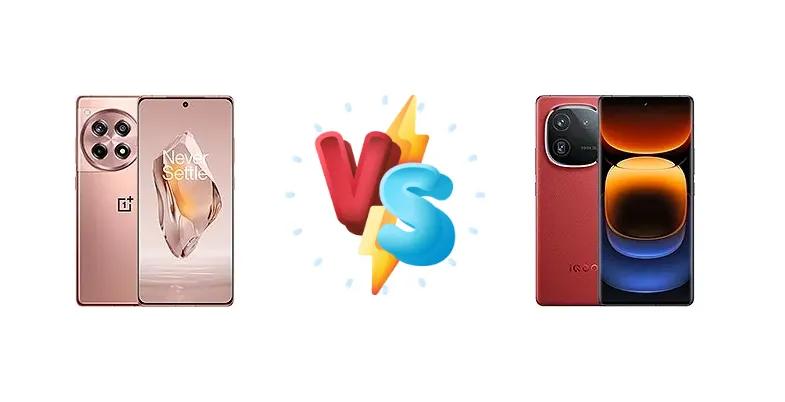
|
🏆 Quick Verdict
For most users, the vivo iQOO 12 Pro emerges as the superior choice. The Snapdragon 8 Gen 3 provides a noticeable performance uplift, and the inclusion of 120W wired and 50W wireless charging offers significantly faster replenishment than the Ace 3’s 100W wired solution. However, the Ace 3 remains a strong contender for budget-conscious gamers.
| PHONES | ||
|---|---|---|
| Phone Names | OnePlus Ace 3 | vivo iQOO 12 Pro |
| Network | ||
|---|---|---|
| 2G bands | GSM 850 / 900 / 1800 / 1900 | GSM 850 / 900 / 1800 / 1900 |
| 3G bands | HSDPA 850 / 900 / 1700(AWS) / 2100 | HSDPA 800 / 850 / 900 / 1700(AWS) / 1900 / 2100 |
| 4G bands | 1, 3, 4, 5, 8, 18, 19, 26, 28, 34, 38, 39, 40, 41 | 1, 2, 3, 4, 5, 7, 8, 12, 17, 18, 19, 20, 25, 26, 28, 34, 38, 39, 40, 41, 42, 66 |
| 5G bands | 1, 3, 5, 8, 28, 41, 77, 78 SA/NSA | 1, 2, 3, 5, 7, 8, 12, 20, 25, 26, 28, 66, 38, 40, 41, 77, 78 SA/NSA |
| Speed | HSPA, LTE, 5G | HSPA, LTE, 5G |
| Technology | GSM / CDMA / HSPA / LTE / 5G | GSM / CDMA / HSPA / CDMA2000 / LTE / 5G |
| Launch | ||
|---|---|---|
| Announced | 2024, January 04 | 2023, November 07 |
| Status | Available. Released 2024, January 15 | Available. Released 2023, November 14 |
| Body | ||
|---|---|---|
| Build | Glass front (Gorilla Glass Victus 2), glass back, aluminum frame | - |
| Dimensions | 163.3 x 75.3 x 8.8 mm (6.43 x 2.96 x 0.35 in) | 164.6 x 75.4 x 8.6 mm or 8.8 mm |
| SIM | Nano-SIM + Nano-SIM | Nano-SIM + Nano-SIM |
| Weight | 207 g (7.30 oz) | 205 g or 210 g (7.23 oz) |
| Display | ||
|---|---|---|
| Protection | Corning Gorilla Glass Victus 2 | - |
| Resolution | 1264 x 2780 pixels (~450 ppi density) | 1440 x 3200 pixels, 20:9 ratio (~518 ppi density) |
| Size | 6.78 inches, 111.7 cm2 (~90.9% screen-to-body ratio) | 6.78 inches, 111.0 cm2 (~89.4% screen-to-body ratio) |
| Type | LTPO AMOLED, 1B colors, 120Hz, HDR10+, Dolby Vision, 1600 nits (HBM), 4500 nits (peak) | LTPO AMOLED, 1B colors, 144Hz, HDR10+, 1600 nits (HBM), 3000 nits (peak) |
| Platform | ||
|---|---|---|
| CPU | Octa-core (1x3.2 GHz Cortex-X3 & 2x2.8 GHz Cortex-A715 & 2x2.8 GHz Cortex-A710 & 3x2.0 GHz Cortex-A510) | Octa-core (1x3.3 GHz Cortex-X4 & 3x3.2 GHz Cortex-A720 & 2x3.0 GHz Cortex-A720 & 2x2.3 GHz Cortex-A520) |
| Chipset | Qualcomm SM8550-AB Snapdragon 8 Gen 2 (4 nm) | Qualcomm SM8650-AB Snapdragon 8 Gen 3 (4 nm) |
| GPU | Adreno 740 | Adreno 750 |
| OS | Android 14, ColorOS 14 | Android 14, up to 2 major Android upgrades, Funtouch 14 (International), OriginOS 4 (China) |
| Memory | ||
|---|---|---|
| Card slot | No | No |
| Internal | 256GB 12GB RAM, 512GB 16GB RAM, 1TB 16GB RAM | 256GB 16GB RAM, 512GB 16GB RAM, 1TB 16GB RAM |
| Main Camera | ||
|---|---|---|
| Features | Color spectrum sensor, LED flash, HDR, panorama | Color spectrum sensor, Dual-LED flash, HDR, panorama |
| Triple | 50 MP, f/1.8, 24mm (wide), 1/1.56", 1.0µm, PDAF, OIS 8 MP, f/2.2, 16mm, 112˚ (ultrawide), 1/4.0", 1.12µm 2 MP (macro) | 50 MP, f/1.7, 23mm (wide), 1/1.3", 1.2µm, ulti-directional PDAF, OIS 64 MP, f/2.6, 70mm (periscope telephoto), 1/2.0", PDAF, OIS, 3x optical zoom 50 MP, f/2.0, 15mm, 119˚ (ultrawide), AF |
| Video | 4K@30/60fps, 1080p@30/60/120/240fps, gyro-EIS, OIS | 8K@30fps, 4K@24/30/60fps, 1080p@30/60/120/240fps, gyro-EIS |
| Selfie camera | ||
|---|---|---|
| Features | HDR | HDR |
| Single | 16 MP, f/2.4, 26mm (wide), 1/3", 1.0µm | 16 MP, f/2.5, (wide) |
| Video | 1080p@30fps | 1080p@30fps, gyro-EIS |
| Sound | ||
|---|---|---|
| 35mm jack | No | No |
| Loudspeaker | Yes, with stereo speakers | Yes, with stereo speakers |
| Comms | ||
|---|---|---|
| Bluetooth | 5.3, A2DP, LE, aptX HD | 5.4, A2DP, LE, aptX HD, aptX Adaptive, aptX Lossless |
| Infrared port | Yes | Yes |
| NFC | Yes | Yes |
| Positioning | GPS (L1+L5), GLONASS (G1), BDS (B1I+B1c+B2a), GALILEO (E1+E5a), QZSS (L1+L5) | GPS (L1+L5), GLONASS (G1), BDS (B1I+B1c+B2a), GALILEO (E1+E5a), QZSS (L1+L5) |
| Radio | No | No |
| USB | USB Type-C 2.0 | USB Type-C 2.0, OTG |
| WLAN | Wi-Fi 802.11 a/b/g/n/ac/6/7, dual-band | Wi-Fi 802.11 a/b/g/n/ac/6/7, tri-band, Wi-Fi Direct |
| Features | ||
|---|---|---|
| Sensors | Fingerprint (under display, optical), accelerometer, gyro, proximity, compass | Fingerprint (under display, ultrasonic), accelerometer, gyro, proximity, compass |
| Battery | ||
|---|---|---|
| Charging | 100W wired, 100% in 27 min | 120W wired 50W wireless 10W reverse wireless |
| Type | 5500 mAh | 5100 mAh |
| Misc | ||
|---|---|---|
| Colors | Black, Blue, Rose Gold | Black, Red, White (BMW M branding) |
| Models | PJE110 | V2329A |
| Price | About 340 EUR | About 650 EUR |
OnePlus Ace 3
- Excellent value for the Snapdragon 8 Gen 2
- Fast 100W wired charging
- Refined OnePlus software experience
- Older Snapdragon 8 Gen 2 chipset
- Lacks wireless charging
vivo iQOO 12 Pro
- Latest Snapdragon 8 Gen 3 for peak performance
- Ultra-fast 120W wired and 50W wireless charging
- Potentially superior camera processing
- Higher price point
- vivo’s Funtouch OS may not appeal to all users
Display Comparison
While both devices likely feature high-refresh-rate AMOLED displays (data not provided), the core difference lies in the processing power driving them. The iQOO 12 Pro’s Snapdragon 8 Gen 3 will handle graphically intensive tasks with greater ease, potentially resulting in smoother animations and higher sustained frame rates in games. The Ace 3’s Snapdragon 8 Gen 2 is still exceptionally capable, but the Gen 3 offers architectural improvements in GPU performance. Without specific display specs, it's difficult to compare brightness or color accuracy, but iQOO phones often prioritize vibrant, saturated colors.
Camera Comparison
Without detailed camera specifications, a direct comparison is limited. However, iQOO typically focuses on delivering versatile camera systems with strong low-light performance. The Snapdragon 8 Gen 3’s improved ISP (Image Signal Processor) will contribute to better image processing, potentially resulting in more detailed photos and videos. The Ace 3’s camera will still be capable, but the iQOO 12 Pro is likely to offer a more refined and feature-rich photography experience. We can assume both phones will have a primary wide-angle camera, but the iQOO 12 Pro may feature a larger sensor for improved light gathering.
Performance
The iQOO 12 Pro’s Snapdragon 8 Gen 3 (4nm) represents a significant leap over the Ace 3’s Snapdragon 8 Gen 2 (4nm). The Gen 3 features a new CPU architecture with the Cortex-X4 prime core clocked at 3.3 GHz, compared to the Ace 3’s 3.2 GHz Cortex-X3. This, coupled with the improved Cortex-A720 performance cores in the iQOO 12 Pro, translates to faster application loading times and more responsive multitasking. The iQOO 12 Pro’s GPU also benefits from architectural enhancements, offering a substantial advantage in gaming performance. Both utilize LPDDR5x RAM, but the Gen 3’s improved memory controller will likely yield better bandwidth.
Battery Life
The iQOO 12 Pro’s 120W wired charging is a clear advantage over the Ace 3’s 100W. The iQOO 12 Pro can reach 100% charge in approximately 25 minutes (estimated), while the Ace 3 takes 27 minutes. The addition of 50W wireless charging and 10W reverse wireless charging on the iQOO 12 Pro further enhances its convenience. While battery capacity isn’t specified, the faster charging speeds of the iQOO 12 Pro mitigate any potential disadvantage from a slightly smaller battery size.
Buying Guide
Buy the OnePlus Ace 3 if you prioritize a refined user experience with a proven chipset and are seeking a flagship-level device without the top-tier price tag. Buy the vivo iQOO 12 Pro if you demand the absolute fastest performance, cutting-edge charging capabilities, and are willing to invest in the latest Snapdragon technology. The iQOO 12 Pro is geared towards power users and mobile gamers.