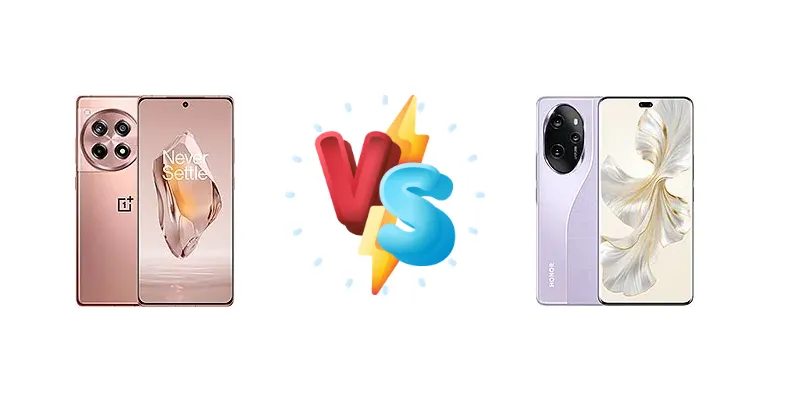
The OnePlus Ace 3 and Honor 100 Pro represent a fascinating intersection in the Android market. Both devices are positioned as flagship killers, leveraging the powerful Snapdragon 8 Gen 2 chipset. However, they diverge in their approach to charging technology and overall feature set, creating a compelling choice for consumers seeking high performance without the ultra-premium price tag.
🏆 Quick Verdict
For the average user prioritizing rapid charging and wireless convenience, the Honor 100 Pro emerges as the winner. Its 66W wireless charging and faster initial wired charging (50% in 10 minutes) provide a tangible advantage. However, the OnePlus Ace 3 remains a strong contender, particularly for those who prioritize a potentially cleaner software experience.
| Network |
|---|
| 2G bands | GSM 850 / 900 / 1800 / 1900 | GSM 850 / 900 / 1800 / 1900 |
| 3G bands | HSDPA 850 / 900 / 1700(AWS) / 2100 | HSDPA 800 / 850 / 900 / 1700(AWS) / 1900 / 2100 |
| 4G bands | 1, 3, 4, 5, 8, 18, 19, 26, 28, 34, 38, 39, 40, 41 | LTE |
| 5G bands | 1, 3, 5, 8, 28, 41, 77, 78 SA/NSA | SA/NSA |
| Speed | HSPA, LTE, 5G | HSPA, LTE, 5G |
| Technology | GSM / CDMA / HSPA / LTE / 5G | GSM / CDMA / HSPA / CDMA2000 / LTE / 5G |
| Launch |
|---|
| Announced | 2024, January 04 | 2023, November 23 |
| Status | Available. Released 2024, January 15 | Available. Released 2023, November 23 |
| Body |
|---|
| Build | Glass front (Gorilla Glass Victus 2), glass back, aluminum frame | - |
| Dimensions | 163.3 x 75.3 x 8.8 mm (6.43 x 2.96 x 0.35 in) | 163.7 x 74.7 x 8.2 mm or 8.5 mm |
| SIM | Nano-SIM + Nano-SIM | Nano-SIM + Nano-SIM |
| Weight | 207 g (7.30 oz) | 195 g (6.88 oz) |
| Display |
|---|
| Protection | Corning Gorilla Glass Victus 2 | - |
| Resolution | 1264 x 2780 pixels (~450 ppi density) | 1224 x 2700 pixels (~437 ppi density) |
| Size | 6.78 inches, 111.7 cm2 (~90.9% screen-to-body ratio) | 6.78 inches, 111.5 cm2 (~91.2% screen-to-body ratio) |
| Type | LTPO AMOLED, 1B colors, 120Hz, HDR10+, Dolby Vision, 1600 nits (HBM), 4500 nits (peak) | OLED, 1B colors, 120Hz, HDR, 2600 nits (peak) |
| Platform |
|---|
| CPU | Octa-core (1x3.2 GHz Cortex-X3 & 2x2.8 GHz Cortex-A715 & 2x2.8 GHz Cortex-A710 & 3x2.0 GHz Cortex-A510) | Octa-core (1x3.2 GHz Cortex-X3 & 2x2.8 GHz Cortex-A715 & 2x2.8 GHz Cortex-A710 & 3x2.0 GHz Cortex-A510) |
| Chipset | Qualcomm SM8550-AB Snapdragon 8 Gen 2 (4 nm) | Qualcomm SM8550-AB Snapdragon 8 Gen 2 (4 nm) |
| GPU | Adreno 740 | Adreno 740 |
| OS | Android 14, ColorOS 14 | Android 13, MagicOS 7.2 |
| Memory |
|---|
| Card slot | No | No |
| Internal | 256GB 12GB RAM, 512GB 16GB RAM, 1TB 16GB RAM | 256GB 12GB RAM, 256GB 16GB RAM, 512GB 16GB RAM, 1TB 16GB RAM |
| Main Camera |
|---|
| Features | Color spectrum sensor, LED flash, HDR, panorama | LED flash, HDR, panorama |
| Triple | 50 MP, f/1.8, 24mm (wide), 1/1.56", 1.0µm, PDAF, OIS
8 MP, f/2.2, 16mm, 112˚ (ultrawide), 1/4.0", 1.12µm
2 MP (macro) | 50 MP, f/2.0, 27mm (wide), 1/1.56", 1.0µm, PDAF, OIS
32 MP, f/2.4, (telephoto), PDAF, OIS, 2.5x optical zoom
12 MP, f/2.2, 112˚ (ultrawide), AF |
| Video | 4K@30/60fps, 1080p@30/60/120/240fps, gyro-EIS, OIS | 4K@30fps, 1080p@30/60fps, gyro-EIS, OIS |
| Selfie camera |
|---|
| Dual | - | 50 MP, f/2.0
2 MP, f/2.4, (depth) |
| Features | HDR | HDR |
| Single | 16 MP, f/2.4, 26mm (wide), 1/3", 1.0µm | - |
| Video | 1080p@30fps | 4K@30fps, 1080p@30fps, gyro-EIS |
| Sound |
|---|
| 35mm jack | No | No |
| Loudspeaker | Yes, with stereo speakers | Yes, with stereo speakers |
| Comms |
|---|
| Bluetooth | 5.3, A2DP, LE, aptX HD | 5.3, A2DP, LE, aptX HD |
| Infrared port | Yes | - |
| NFC | Yes | Yes |
| Positioning | GPS (L1+L5), GLONASS (G1), BDS (B1I+B1c+B2a), GALILEO (E1+E5a), QZSS (L1+L5) | GPS, GALILEO, GLONASS, BDS, QZSS |
| Radio | No | No |
| USB | USB Type-C 2.0 | USB Type-C 2.0, OTG |
| WLAN | Wi-Fi 802.11 a/b/g/n/ac/6/7, dual-band | Wi-Fi 802.11 a/b/g/n/ac/6, dual-band, Wi-Fi Direct |
| Features |
|---|
| Sensors | Fingerprint (under display, optical), accelerometer, gyro, proximity, compass | Fingerprint (under display, optical), accelerometer, gyro, compass, ultrasound proximity |
| Battery |
|---|
| Charging | 100W wired, 100% in 27 min | 100W wired, 50% in 10 min
66W wireless, 100% in 42 min
5W reverse wired
Reverse wireless |
| Type | 5500 mAh | Li-Po 5000 mAh |
| Misc |
|---|
| Colors | Black, Blue, Rose Gold | Black, Silver, Blue, Violet |
| Models | PJE110 | MAA-AN10 |
| Price | About 340 EUR | About 440 EUR |
OnePlus Ace 3
- Potentially cleaner software experience (OnePlus)
- Fast 100W wired charging
- Powerful Snapdragon 8 Gen 2 performance
- Lacks wireless charging
- Slower initial charging compared to Honor 100 Pro
Honor 100 Pro
- 66W wireless charging
- Faster initial 100W wired charging (50% in 10 min)
- Reverse wireless charging capability
- Potentially more customized software (Honor)
- May prioritize features over raw performance
Display Comparison
While both devices are expected to feature high-quality AMOLED displays, specific details like peak brightness and refresh rate are missing. However, given the flagship positioning, both are likely to offer vibrant colors and smooth scrolling. The absence of LTPO information suggests potential differences in power efficiency depending on the display technology used. Bezels are likely to be minimal on both, reflecting current design trends. Color accuracy will be a key differentiator, and independent testing will be needed to determine which device offers more accurate color reproduction.
Camera Comparison
Camera specifications are currently unavailable beyond the chipsets. Given the competitive landscape, both devices are expected to feature multi-camera systems. However, the quality of the image sensors, lens apertures, and image processing algorithms will be crucial. Larger sensors generally capture more light, resulting in better low-light performance. Optical Image Stabilization (OIS) is essential for sharp photos and stable videos. The absence of information regarding sensor sizes and OIS makes it impossible to definitively assess camera performance at this stage. We can expect both to offer a range of shooting modes, but the Honor brand historically emphasizes camera features.
Performance
Both the OnePlus Ace 3 and Honor 100 Pro are powered by the Qualcomm SM8550-AB Snapdragon 8 Gen 2 (4 nm) chipset, featuring the same Octa-core CPU configuration (1x3.2 GHz Cortex-X3, 2x2.8 GHz Cortex-A715, 2x2.8 GHz Cortex-A710, and 3x2.0 GHz Cortex-A510). This means raw processing power will be virtually identical. Performance differences will likely stem from thermal management and RAM optimization. The 4nm process node ensures relatively good thermal efficiency, minimizing throttling during sustained workloads. The type and speed of RAM (likely LPDDR5x) will also play a role, but without specific details, it's difficult to predict a significant advantage for either device.
Battery Life
The OnePlus Ace 3 boasts 100W wired charging, achieving a full charge in 27 minutes. The Honor 100 Pro also supports 100W wired charging, but notably reaches 50% charge in just 10 minutes, suggesting a more aggressive charging curve initially. Furthermore, the Honor 100 Pro adds 66W wireless charging (full charge in 42 minutes) and both 5W reverse wired and wireless charging. This provides significantly more versatility. While battery capacity isn't specified, the Honor 100 Pro's charging capabilities offer a clear advantage for users who frequently top up their devices or rely on wireless charging.
Buying Guide
Buy the OnePlus Ace 3 if you need a streamlined Android experience with a focus on raw performance and don't heavily rely on wireless charging. It's ideal for gamers and power users who prioritize sustained performance. Buy the Honor 100 Pro if you prefer the convenience of fast wireless charging, a quicker initial wired charge, and a more feature-rich software experience, even if it means a potentially more customized UI.
Frequently Asked Questions
❓ Does the Honor 100 Pro's 66W wireless charging significantly impact battery health over time?
While faster wireless charging can theoretically generate more heat, modern smartphones employ sophisticated battery management systems to mitigate potential damage. The Honor 100 Pro's charging circuitry is designed to optimize charging speed while protecting battery health. However, long-term battery degradation is inevitable with any rechargeable battery, regardless of charging method.
❓ Is the 100W charging on both phones compatible with all USB-PD chargers?
While both phones utilize USB-PD standards, achieving the full 100W charging speed requires a compatible charger that specifically supports the Power Delivery protocol and delivers sufficient wattage. Using a lower-wattage charger will result in slower charging times. It's recommended to use the charger included with the device or a certified 100W USB-PD charger.
❓ Will the Snapdragon 8 Gen 2 in either phone struggle with sustained gaming performance?
The Snapdragon 8 Gen 2 is a highly capable chipset, and both the OnePlus Ace 3 and Honor 100 Pro benefit from its thermal efficiency. However, sustained gaming will inevitably generate heat. The effectiveness of each phone's cooling system (vapor chamber, heat pipes) will determine how well it manages thermal throttling. Independent testing is needed to assess real-world gaming performance under prolonged load.