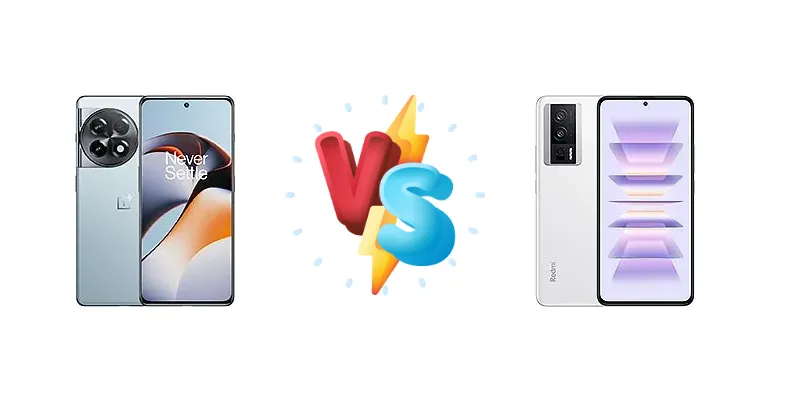
The OnePlus Ace 2 and Xiaomi Redmi K60 Pro represent compelling options in the increasingly competitive upper-midrange and flagship smartphone space. Both devices prioritize performance and fast charging, but they achieve this through different approaches. The Ace 2 leverages the refined Snapdragon 8+ Gen 1, while the K60 Pro boasts the newer, more powerful Snapdragon 8 Gen 2. This comparison will dissect the key differences to help you determine which phone best suits your needs.
🏆 Quick Verdict
For most users, the Xiaomi Redmi K60 Pro emerges as the superior choice. The Snapdragon 8 Gen 2 provides a noticeable performance uplift over the Snapdragon 8+ Gen 1 in the Ace 2, and the faster 120W charging with wireless charging support adds significant convenience. While the Ace 2 remains a strong contender, the K60 Pro offers a more future-proof and well-rounded experience.
| Network |
|---|
| 2G bands | GSM 850 / 900 / 1800 / 1900 | GSM 850 / 900 / 1800 / 1900 |
| 3G bands | HSDPA 850 / 900 / 1700(AWS) / 2100 | HSDPA 800 / 850 / 900 / 1700(AWS) / 2100 |
| 4G bands | 1, 3, 4, 5, 8, 28, 34, 38, 39, 40, 41 | 1, 3, 4, 5, 8, 18, 19, 26, 34, 38, 39, 40, 41, 42 |
| 5G bands | 1, 3, 5, 8, 28, 40, 41, 77, 78 SA/NSA | 1, 3, 5, 8, 28, 38, 41, 77, 78 SA/NSA |
| Speed | HSPA, LTE, 5G | HSPA, LTE, 5G |
| Technology | GSM / CDMA / HSPA / LTE / 5G | GSM / CDMA / HSPA / CDMA2000 / LTE / 5G |
| | CDMA 800 | CDMA2000 1x |
| Launch |
|---|
| Announced | 2023, February 07 | 2022, December 27 |
| Status | Available. Released 2023, February 13 | Available. Released 2023, January 01 |
| Body |
|---|
| Build | Glass front (Asahi Glass), aluminum frame, glass back (Gorilla Glass 5) | - |
| Dimensions | 163.4 x 74.3 x 8.7 mm (6.43 x 2.93 x 0.34 in) | 162.8 x 75.4 x 8.6 mm or 8.9 mm |
| SIM | Nano-SIM + Nano-SIM | Nano-SIM + Nano-SIM |
| Weight | 204 g (7.20 oz) | 201 g or 205 g (7.09 oz) |
| Display |
|---|
| Protection | Asahi Glass | - |
| Resolution | 1240 x 2772 pixels, 20:9 ratio (~451 ppi density) | 1440 x 3200 pixels, 20:9 ratio (~526 ppi density) |
| Size | 6.74 inches, 109.2 cm2 (~90.0% screen-to-body ratio) | 6.67 inches, 107.4 cm2 (~87.5% screen-to-body ratio) |
| Type | AMOLED, 1B colors, 120Hz, HDR10+ | OLED, 68B colors, 120Hz, Dolby Vision, HDR10+, 1400 nits (peak) |
| Platform |
|---|
| CPU | Octa-core (1x3.19 GHz Cortex-X2 & 3x2.75 GHz Cortex-A710 & 4x1.80 GHz Cortex-A510) | Octa-core (1x3.2 GHz Cortex-X3 & 2x2.8 GHz Cortex-A715 & 2x2.8 GHz Cortex-A710 & 3x2.0 GHz Cortex-A510) |
| Chipset | Qualcomm SM8475 Snapdragon 8+ Gen 1 (4 nm) | Qualcomm SM8550-AB Snapdragon 8 Gen 2 (4 nm) |
| GPU | Adreno 730 | Adreno 740 |
| OS | Android 13, ColorOS 13 | Android 13, MIUI 14 |
| Memory |
|---|
| Card slot | No | No |
| Internal | 256GB 12GB RAM, 256GB 16GB RAM, 512GB 16GB RAM, 512GB 18GB RAM | 128GB 8GB RAM, 256GB 8GB RAM, 256GB 12GB RAM, 512GB 12GB RAM, 512GB 16GB RAM |
| | UFS 3.1 | UFS 4.0
UFS 3.1 - 128GB only |
| Main Camera |
|---|
| Features | Color spectrum sensor, LED flash, HDR, panorama | Color spectrum sensor, Dual-LED dual-tone flash, HDR, panorama |
| Single | 16 MP, f/2.4, 26mm (wide), 1/3.09", 1.0µm | - |
| Triple | 50 MP, f/1.8, 24mm (wide), 1/1.56", 1.0µm, PDAF, OIS
8 MP, f/2.2, 16mm, 120˚ (ultrawide), 1/4.0", 1.12µm
2 MP (macro) | 54 MP, f/1.9, (wide), 1/1.49", 1.0µm, PDAF, OIS
8 MP, 118˚ (ultrawide), 1/4.0", 1.12µm
2 MP (macro) |
| Video | 4K@30/60fps, 1080p@30/60/120/240fps, gyro-EIS | 8K@24fps, 4K@30/60fps, 1080p@30/60/120/240/960fps, 720p@1920fps, gyro-EIS |
| Selfie camera |
|---|
| Features | HDR | HDR |
| Single | 16 MP, f/2.4, 26mm (wide), 1/3.09", 1.0µm | 16 MP, (wide), 1/3.06", 1.0µm |
| Video | 1080p@30fps | 1080p@30/60/120fps |
| Sound |
|---|
| 3.5mm jack | No | No |
| 35mm jack | No | No |
| Loudspeaker | Yes, with stereo speakers | Yes, with stereo speakers |
| | 24-bit/192kHz audio | 24-bit/192kHz audio |
| Comms |
|---|
| Bluetooth | 5.3, A2DP, LE | 5.3, A2DP, LE |
| Infrared port | Yes | Yes |
| NFC | Yes | Yes |
| Positioning | GPS (L1+L5), GLONASS (G1), BDS (B1I+B1c+B2a), GALILEO (E1+E5a), QZSS (L1+L5) | GPS (L1+L5), GLONASS (G1), BDS (B1I+B2a+Bc), GALILEO (E1+E5a), QZSS (L1+L5), NavIC |
| Radio | No | Unspecified |
| USB | USB Type-C 2.0 | USB Type-C 2.0, OTG |
| WLAN | Wi-Fi 802.11 a/b/g/n/ac/6, dual-band | Wi-Fi 802.11 a/b/g/n/ac/6e, dual-band, Wi-Fi Direct |
| Features |
|---|
| Sensors | Fingerprint (under display, optical), accelerometer, gyro, proximity, compass | Fingerprint (under display, optical), accelerometer, gyro, proximity, compass |
| Battery |
|---|
| Charging | 100W wired, 100% in 25 min | 120W wired, PD3.0, QC3+, 100% in 19 min
30W wireless |
| Type | Li-Po 5000 mAh | Li-Po 5000 mAh |
| Misc |
|---|
| Colors | Black, Glacier Blue, Red | Black, White, Mint, Champion Black |
| Models | PHK110 | 22127RK46C |
| Price | About 390 EUR | About 460 EUR |
OnePlus Ace 2
- Potentially more affordable price point
- Slightly more compact design (assumed)
- Excellent Snapdragon 8+ Gen 1 performance
- Slower 100W charging
- No wireless charging support
- Older Snapdragon chipset
Xiaomi Redmi K60 Pro
- Superior Snapdragon 8 Gen 2 performance
- Faster 120W wired charging
- 30W wireless charging support
- Potentially higher price
- May be slightly larger and heavier
- Software bloat (typical of Xiaomi)
Display Comparison
While both phones likely feature high-quality AMOLED displays (data not provided), the core difference lies in the processing power driving them. The Redmi K60 Pro’s Snapdragon 8 Gen 2 will handle graphically intensive tasks with greater ease, potentially resulting in smoother animations and higher sustained frame rates in games. The Ace 2’s Snapdragon 8+ Gen 1 is still very capable, but the Gen 2 offers architectural improvements in GPU performance. Without specific display specs like peak brightness or refresh rate, it’s difficult to definitively declare a winner, but the chipset advantage leans towards the K60 Pro.
Camera Comparison
Without detailed camera specifications, a direct comparison is challenging. However, the Redmi K60 Pro, being a more recent flagship, likely incorporates a more advanced image signal processor (ISP) within the Snapdragon 8 Gen 2, leading to improved image processing capabilities. The Ace 2’s ISP is still excellent, but the Gen 2 offers advancements in noise reduction, dynamic range, and low-light performance. The absence of information regarding sensor sizes and optical image stabilization (OIS) prevents a conclusive assessment, but the K60 Pro’s newer chipset provides a likely advantage in image quality.
Performance
The Xiaomi Redmi K60 Pro’s Snapdragon 8 Gen 2 (4nm) represents a significant leap over the OnePlus Ace 2’s Snapdragon 8+ Gen 1 (4nm). The Gen 2 features a new CPU architecture with a Cortex-X3 prime core clocked at 3.2 GHz, compared to the Ace 2’s Cortex-X2 at 3.19 GHz. This translates to faster single-core performance. Furthermore, the Gen 2’s improved Adreno GPU delivers a substantial boost in graphics processing. The K60 Pro also benefits from potentially faster LPDDR5x RAM, further enhancing overall system responsiveness. The 4nm process node on both chips contributes to thermal efficiency, but the Gen 2’s architectural improvements should result in less throttling under sustained load, benefiting gamers and power users.
Battery Life
The Redmi K60 Pro’s 120W wired charging is significantly faster than the OnePlus Ace 2’s 100W charging, achieving a full charge in 19 minutes versus 25 minutes. This difference is substantial for users who prioritize quick top-ups. The K60 Pro also adds 30W wireless charging, a feature absent on the Ace 2, offering added convenience. While battery capacity isn’t specified, the faster charging speeds of the K60 Pro effectively mitigate any potential disadvantage from a slightly smaller battery size. The inclusion of PD3.0 and QC3+ support on the K60 Pro also ensures broader compatibility with various chargers.
Buying Guide
Buy the OnePlus Ace 2 if you prioritize a slightly more compact form factor and are seeking excellent performance at a potentially lower price point. It's ideal for users who enjoy gaming but don't necessarily need the absolute latest and greatest chipset. Buy the Xiaomi Redmi K60 Pro if you demand the best possible performance, fastest charging speeds (including wireless), and a more comprehensive feature set. This phone is geared towards power users and those who want a device that will remain competitive for years to come.
Frequently Asked Questions
❓ Will the Snapdragon 8+ Gen 1 in the OnePlus Ace 2 struggle with demanding games like Genshin Impact?
While the Snapdragon 8+ Gen 1 is a powerful chip, it may exhibit some throttling during extended Genshin Impact sessions at maximum settings. The Redmi K60 Pro’s Snapdragon 8 Gen 2, with its improved thermal efficiency and GPU, will provide a smoother and more consistent gaming experience.
❓ Does the Xiaomi Redmi K60 Pro’s 120W charging degrade the battery health over time?
Xiaomi employs battery health management technologies to mitigate the potential for degradation from fast charging. While all batteries degrade over time, the K60 Pro’s charging system is designed to optimize charging speed while minimizing long-term battery wear. The inclusion of multiple charging profiles allows users to prioritize battery health over speed when desired.
❓ Is the difference in performance between the Snapdragon 8+ Gen 1 and Snapdragon 8 Gen 2 noticeable in everyday tasks?
For basic tasks like browsing, social media, and video playback, the difference will be minimal. However, when launching demanding apps, multitasking, or editing videos, the Snapdragon 8 Gen 2 in the Redmi K60 Pro will demonstrate a clear advantage in responsiveness and speed.