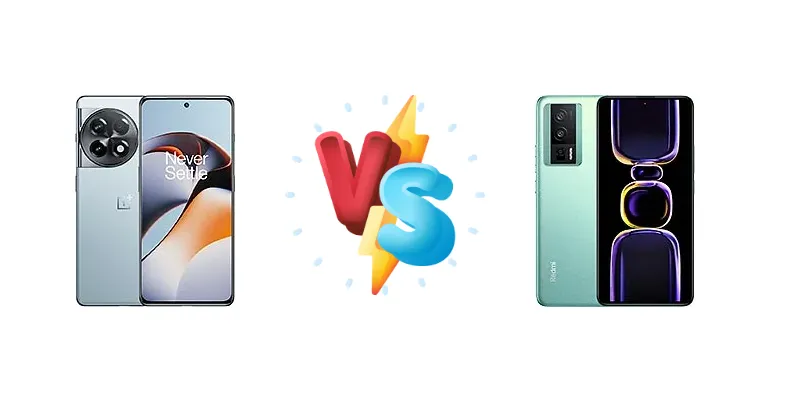
The OnePlus Ace 2 and Xiaomi Redmi K60 are both formidable contenders in the flagship smartphone arena, packing powerful processors and impressive features. But which one truly comes out on top? This comprehensive comparison will break down every aspect, from display quality to charging speed, to help you make an informed decision.
🏆 Quick Verdict
The OnePlus Ace 2 takes the lead with its significantly faster 100W charging and slightly more powerful CPU. However, the Redmi K60 offers a compelling package with wireless charging and potentially a more refined software experience, making it a strong value proposition. Ultimately, it depends on your priorities.
| Network |
|---|
| 2G bands | GSM 850 / 900 / 1800 / 1900 | GSM 850 / 900 / 1800 / 1900 |
| 3G bands | HSDPA 850 / 900 / 1700(AWS) / 2100 | HSDPA 800 / 850 / 900 / 1700(AWS) / 2100 |
| 4G bands | 1, 3, 4, 5, 8, 28, 34, 38, 39, 40, 41 | 1, 3, 4, 5, 8, 18, 19, 26, 34, 38, 39, 40, 41, 42 |
| 5G bands | 1, 3, 5, 8, 28, 40, 41, 77, 78 SA/NSA | 1, 3, 5, 8, 28, 38, 41, 77, 78 SA/NSA |
| Speed | HSPA, LTE, 5G | HSPA, LTE, 5G |
| Technology | GSM / CDMA / HSPA / LTE / 5G | GSM / CDMA / HSPA / CDMA2000 / LTE / 5G |
| | CDMA 800 | CDMA2000 1x |
| Launch |
|---|
| Announced | 2023, February 07 | 2022, December 27 |
| Status | Available. Released 2023, February 13 | Available. Released 2023, January 01 |
| Body |
|---|
| Build | Glass front (Asahi Glass), aluminum frame, glass back (Gorilla Glass 5) | - |
| Dimensions | 163.4 x 74.3 x 8.7 mm (6.43 x 2.93 x 0.34 in) | 162.8 x 75.4 x 8.6 mm or 8.8 mm |
| SIM | Nano-SIM + Nano-SIM | Nano-SIM + Nano-SIM |
| Weight | 204 g (7.20 oz) | 199 g or 204 g (7.02 oz) |
| Display |
|---|
| Protection | Asahi Glass | - |
| Resolution | 1240 x 2772 pixels, 20:9 ratio (~451 ppi density) | 1440 x 3200 pixels, 20:9 ratio (~526 ppi density) |
| Size | 6.74 inches, 109.2 cm2 (~90.0% screen-to-body ratio) | 6.67 inches, 107.4 cm2 (~87.5% screen-to-body ratio) |
| Type | AMOLED, 1B colors, 120Hz, HDR10+ | OLED, 68B colors, 120Hz, Dolby Vision, HDR10+, 1400 nits (peak) |
| Platform |
|---|
| CPU | Octa-core (1x3.19 GHz Cortex-X2 & 3x2.75 GHz Cortex-A710 & 4x1.80 GHz Cortex-A510) | Octa-core (1x3.0 GHz Cortex-X2 & 3x2.5 GHz Cortex-A710 & 4x1.80 GHz Cortex-A510) |
| Chipset | Qualcomm SM8475 Snapdragon 8+ Gen 1 (4 nm) | Qualcomm SM8475 Snapdragon 8+ Gen 1 (4 nm) |
| GPU | Adreno 730 | Adreno 730 |
| OS | Android 13, ColorOS 13 | Android 13, MIUI 14 |
| Memory |
|---|
| Card slot | No | No |
| Internal | 256GB 12GB RAM, 256GB 16GB RAM, 512GB 16GB RAM, 512GB 18GB RAM | 128GB 8GB RAM, 256GB 8GB RAM, 256GB 12GB RAM, 256GB 16GB RAM, 512GB 12GB RAM, 512GB 16GB RAM, 1TB 16GB RAM |
| | UFS 3.1 | UFS 3.1 |
| Main Camera |
|---|
| Features | Color spectrum sensor, LED flash, HDR, panorama | Color spectrum sensor, Dual-LED dual-tone flash, HDR, panorama |
| Single | 16 MP, f/2.4, 26mm (wide), 1/3.09", 1.0µm | - |
| Triple | 50 MP, f/1.8, 24mm (wide), 1/1.56", 1.0µm, PDAF, OIS
8 MP, f/2.2, 16mm, 120˚ (ultrawide), 1/4.0", 1.12µm
2 MP (macro) | 64 MP, f/1.8, (wide), 1/2.0", 0.7µm, PDAF, OIS
8 MP, f/2.2, 120˚ (ultrawide), 1/4.0", 1.12µm
2 MP (macro) |
| Video | 4K@30/60fps, 1080p@30/60/120/240fps, gyro-EIS | 8K@24fps, 4K@30/60fps, 1080p@30/60/120/240/960fps, 720p@1920fps, gyro-EIS |
| Selfie camera |
|---|
| Features | HDR | HDR |
| Single | 16 MP, f/2.4, 26mm (wide), 1/3.09", 1.0µm | 16 MP, f/2.5, (wide), 1/3.06", 1.0µm |
| Video | 1080p@30fps | 1080p@30/60/120fps |
| Sound |
|---|
| 3.5mm jack | No | No |
| 35mm jack | No | No |
| Loudspeaker | Yes, with stereo speakers | Yes, with stereo speakers |
| | 24-bit/192kHz audio | 24-bit/192kHz audio |
| Comms |
|---|
| Bluetooth | 5.3, A2DP, LE | 5.3, A2DP, LE |
| Infrared port | Yes | Yes |
| NFC | Yes | Yes |
| Positioning | GPS (L1+L5), GLONASS (G1), BDS (B1I+B1c+B2a), GALILEO (E1+E5a), QZSS (L1+L5) | GPS (L1), GLONASS (G1), BDS (B1I+B1c), GALILEO (E1), QZSS (L1) |
| Radio | No | Unspecified |
| USB | USB Type-C 2.0 | USB Type-C 2.0, OTG |
| WLAN | Wi-Fi 802.11 a/b/g/n/ac/6, dual-band | Wi-Fi 802.11 a/b/g/n/ac/6e, dual-band, Wi-Fi Direct |
| Features |
|---|
| Sensors | Fingerprint (under display, optical), accelerometer, gyro, proximity, compass | Fingerprint (under display, optical), accelerometer, gyro, proximity, compass |
| Battery |
|---|
| Charging | 100W wired, 100% in 25 min | 67W wired, PD3.0, QC3+
30W wireless |
| Type | Li-Po 5000 mAh | Li-Po 5500 mAh |
| Misc |
|---|
| Colors | Black, Glacier Blue, Red | Black, White, Blue, Green |
| Models | PHK110 | - |
| Price | About 390 EUR | About 350 EUR |
OnePlus Ace 2
- Blazing-fast 100W charging
- Slightly faster CPU
- OnePlus's OxygenOS (potentially cleaner UI)
- Premium build quality (likely)
- Camera potentially not as versatile as Redmi K60
- Wireless charging absent
- Price may be higher
Xiaomi Redmi K60
- Wireless charging support
- Potentially more versatile camera system
- Competitive price
- MIUI software (feature-rich)
- Slower 67W wired charging
- Slightly slower CPU
- MIUI software (can be bloated)
Display Comparison
Both phones feature AMOLED displays with 120Hz refresh rates, promising smooth visuals. The Ace 2 likely has slightly better color accuracy and brightness due to OnePlus's display tuning, but the Redmi K60's display is still excellent. Expect vibrant colors and sharp details on both.
Camera Comparison
The Redmi K60 is expected to have a more versatile camera system, potentially including a higher resolution main sensor and improved image processing algorithms. While the Ace 2's camera is capable, the Redmi K60 likely offers better low-light performance and more detailed photos. Specific sensor details are needed for a definitive comparison.
Performance
Both devices utilize the Snapdragon 8+ Gen 1, ensuring flagship-level performance. However, the Ace 2's CPU has a slightly higher clock speed on the prime core (3.19 GHz vs 3.0 GHz) and slightly higher clock speeds on the A710 cores (2.75 GHz vs 2.5 GHz), potentially translating to a marginal performance advantage in demanding tasks. Real-world usage will likely feel very similar.
Battery Life
The OnePlus Ace 2 boasts a significant advantage with its 100W wired charging, allowing for incredibly fast top-ups. The Redmi K60 offers 67W wired charging and 30W wireless charging, providing more flexibility but slower overall charging speeds.
Buying Guide
The OnePlus Ace 2 is ideal for power users who prioritize blazing-fast charging and raw performance. The Xiaomi Redmi K60 is a great choice for those seeking a well-rounded flagship experience with wireless charging and a potentially more polished MIUI interface, all at a competitive price.
Frequently Asked Questions
❓ Which phone has better battery life?
While both have decent battery life, the OnePlus Ace 2's faster charging means you'll spend less time plugged in. Battery capacity is likely similar, so real-world usage will be comparable.
❓ Is the OnePlus Ace 2 worth the extra money?
If you prioritize charging speed and a potentially cleaner software experience, the Ace 2 is worth the premium. If you value wireless charging and a more versatile camera, the Redmi K60 offers excellent value.