
OnePlus Ace 2 vs. vivo iQOO 11S: A Deep Dive into Performance and Charging
| Phones Images | |||||
|---|---|---|---|---|---|
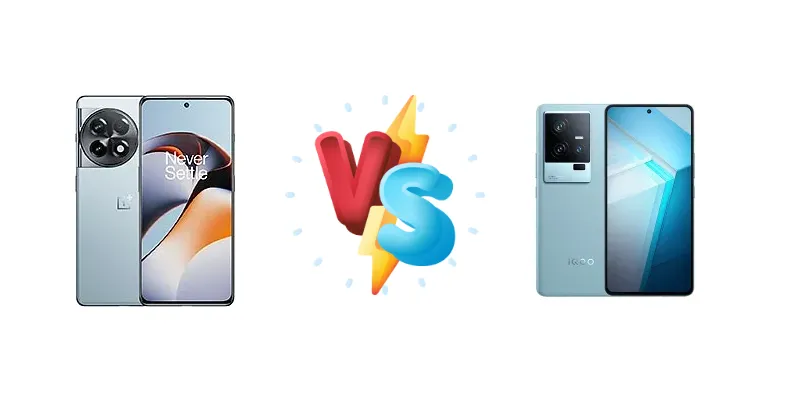
|
🏆 Quick Verdict
For most users, the vivo iQOO 11S emerges as the superior choice. The Snapdragon 8 Gen 2 provides a noticeable performance uplift over the 8+ Gen 1 in the Ace 2, and the 200W charging dramatically reduces downtime. While the Ace 2 remains a capable device, the iQOO 11S offers a more future-proof and convenient experience.
| PHONES | ||
|---|---|---|
| Phone Names | OnePlus Ace 2 | vivo iQOO 11S |
| Network | ||
|---|---|---|
| 2G bands | GSM 850 / 900 / 1800 / 1900 | GSM 850 / 900 / 1800 / 1900 |
| 3G bands | HSDPA 850 / 900 / 1700(AWS) / 2100 | HSDPA 800 / 850 / 900 / 1700(AWS) / 1900 / 2100 |
| 4G bands | 1, 3, 4, 5, 8, 28, 34, 38, 39, 40, 41 | 1, 2, 3, 4, 5, 7, 8, 12, 17, 18, 19, 20, 26, 28, 34, 38, 39, 40, 41 |
| 5G bands | 1, 3, 5, 8, 28, 40, 41, 77, 78 SA/NSA | 1, 3, 5, 8, 28, 40, 41, 77, 78 SA/NSA |
| Speed | HSPA, LTE, 5G | HSPA, LTE, 5G |
| Technology | GSM / CDMA / HSPA / LTE / 5G | GSM / CDMA / HSPA / CDMA2000 / LTE / 5G |
| CDMA 800 | - | |
| Launch | ||
|---|---|---|
| Announced | 2023, February 07 | 2023, July 04 |
| Status | Available. Released 2023, February 13 | Available. Released 2023, July 10 |
| Body | ||
|---|---|---|
| Build | Glass front (Asahi Glass), aluminum frame, glass back (Gorilla Glass 5) | - |
| Dimensions | 163.4 x 74.3 x 8.7 mm (6.43 x 2.93 x 0.34 in) | 164.9 x 77.1 x 8.4 mm or 8.7 mm |
| SIM | Nano-SIM + Nano-SIM | Nano-SIM + Nano-SIM |
| Weight | 204 g (7.20 oz) | 207 g or 210 g (7.30 oz) |
| Display | ||
|---|---|---|
| Protection | Asahi Glass | Corning Gorilla Glass Victus |
| Resolution | 1240 x 2772 pixels, 20:9 ratio (~451 ppi density) | 1440 x 3200 pixels, 20:9 ratio (~518 ppi density) |
| Size | 6.74 inches, 109.2 cm2 (~90.0% screen-to-body ratio) | 6.78 inches, 111.0 cm2 (~87.3% screen-to-body ratio) |
| Type | AMOLED, 1B colors, 120Hz, HDR10+ | LTPO4 AMOLED, 1B colors, 144Hz, HDR10+, 1800 nits (peak) |
| Platform | ||
|---|---|---|
| CPU | Octa-core (1x3.19 GHz Cortex-X2 & 3x2.75 GHz Cortex-A710 & 4x1.80 GHz Cortex-A510) | Octa-core (1x3.2 GHz Cortex-X3 & 2x2.8 GHz Cortex-A715 & 2x2.8 GHz Cortex-A710 & 3x2.0 GHz Cortex-A510) |
| Chipset | Qualcomm SM8475 Snapdragon 8+ Gen 1 (4 nm) | Qualcomm SM8550-AB Snapdragon 8 Gen 2 (4 nm) |
| GPU | Adreno 730 | Adreno 740 |
| OS | Android 13, ColorOS 13 | Android 13, OriginOS 3 (China) |
| Memory | ||
|---|---|---|
| Card slot | No | No |
| Internal | 256GB 12GB RAM, 256GB 16GB RAM, 512GB 16GB RAM, 512GB 18GB RAM | 256GB 12GB RAM, 256GB 16GB RAM, 512GB 16GB RAM, 1TB 16GB RAM |
| UFS 3.1 | - | |
| Main Camera | ||
|---|---|---|
| Features | Color spectrum sensor, LED flash, HDR, panorama | Dual-LED flash, HDR, panorama |
| Single | 16 MP, f/2.4, 26mm (wide), 1/3.09", 1.0µm | - |
| Triple | 50 MP, f/1.8, 24mm (wide), 1/1.56", 1.0µm, PDAF, OIS 8 MP, f/2.2, 16mm, 120˚ (ultrawide), 1/4.0", 1.12µm 2 MP (macro) | 50 MP, f/1.9, 23mm (wide), 1/1.49", 1.0µm, PDAF, OIS 13 MP, f/2.5, 47mm (telephoto), PDAF, 2x optical zoom 8 MP, f/2.2, 16mm (ultrawide) |
| Video | 4K@30/60fps, 1080p@30/60/120/240fps, gyro-EIS | 8K@30fps, 4K@30/60fps, 1080p@30/60/120/240fps, gyro-EIS |
| Selfie camera | ||
|---|---|---|
| Features | HDR | HDR |
| Single | 16 MP, f/2.4, 26mm (wide), 1/3.09", 1.0µm | 16 MP, f/2.5, (wide) |
| Video | 1080p@30fps | 1080p@30fps, gyro-EIS |
| Sound | ||
|---|---|---|
| 3.5mm jack | No | - |
| 35mm jack | No | No |
| Loudspeaker | Yes, with stereo speakers | Yes, with stereo speakers |
| 24-bit/192kHz audio | - | |
| Comms | ||
|---|---|---|
| Bluetooth | 5.3, A2DP, LE | 5.3, A2DP, LE, aptX HD, aptX Adaptive, aptX Lossless |
| Infrared port | Yes | Yes |
| NFC | Yes | Yes |
| Positioning | GPS (L1+L5), GLONASS (G1), BDS (B1I+B1c+B2a), GALILEO (E1+E5a), QZSS (L1+L5) | GPS, GLONASS, GALILEO, BDS, NavIC |
| Radio | No | No |
| USB | USB Type-C 2.0 | USB Type-C 2.0, OTG |
| WLAN | Wi-Fi 802.11 a/b/g/n/ac/6, dual-band | Wi-Fi 802.11 a/b/g/n/ac/6, dual-band, Wi-Fi Direct |
| Features | ||
|---|---|---|
| Sensors | Fingerprint (under display, optical), accelerometer, gyro, proximity, compass | Fingerprint (under display, optical), accelerometer, gyro, proximity, compass |
| Battery | ||
|---|---|---|
| Charging | 100W wired, 100% in 25 min | 200W wired, PD3.0, UFCS |
| Type | Li-Po 5000 mAh | 4700 mAh |
| Misc | ||
|---|---|---|
| Colors | Black, Glacier Blue, Red | Black, Sky Blue, Legendary White (BMW M branding) |
| Models | PHK110 | V2304A |
| Price | About 390 EUR | About 500 EUR |
OnePlus Ace 2
- Potentially lower price point
- Proven Snapdragon 8+ Gen 1 performance
- Reliable brand reputation
- Older chipset compared to the iQOO 11S
- Slower 100W charging
- May exhibit more thermal throttling
vivo iQOO 11S
- Latest Snapdragon 8 Gen 2 chipset
- Blazing-fast 200W charging
- Superior performance and efficiency
- Potentially higher price
- vivo's software experience may not appeal to all
- May run slightly warmer under extreme load
Display Comparison
While specific display specs aren't provided, both devices likely feature high refresh rate AMOLED panels. However, the iQOO 11S, given its flagship positioning, is expected to have a higher peak brightness and potentially a more advanced LTPO implementation for variable refresh rate control, leading to improved power efficiency. The Ace 2, while still excellent, may exhibit slightly lower peak brightness and a less granular refresh rate adjustment range.
Camera Comparison
Without detailed camera specs, it's difficult to make definitive claims. However, iQOO phones often prioritize camera performance, suggesting the 11S likely features a larger main sensor and more advanced image processing algorithms. The Snapdragon 8 Gen 2’s ISP (Image Signal Processor) is also more capable than the 8+ Gen 1’s, resulting in better dynamic range, noise reduction, and overall image quality. The Ace 2 will still deliver respectable photos, but the iQOO 11S is expected to excel in challenging lighting conditions.
Performance
The core difference lies in the chipsets. The iQOO 11S’s Snapdragon 8 Gen 2 (4nm) represents a significant architectural leap over the Ace 2’s Snapdragon 8+ Gen 1 (4nm). The Gen 2 features the newer Cortex-X3 prime core clocked at 3.2 GHz versus the X2 in the 8+ Gen 1 at 3.19 GHz, alongside improved Cortex-A715 and A710 cores. This translates to approximately 10-15% better CPU performance and a more substantial 20-30% GPU performance gain for the iQOO 11S. Both utilize LPDDR5x RAM, but the Gen 2’s improved memory controller further enhances data throughput. The iQOO 11S will exhibit less thermal throttling under sustained loads.
Battery Life
The iQOO 11S’s 200W charging is a game-changer. While the Ace 2’s 100W charging is already fast (reaching 100% in 25 minutes), the iQOO 11S can likely achieve a full charge in under 20 minutes. This difference is substantial for users who frequently top up their phones throughout the day. While battery capacity isn't specified, the iQOO 11S’s more efficient Snapdragon 8 Gen 2 and optimized power management will likely offset any potential capacity disadvantage.
Buying Guide
Buy the OnePlus Ace 2 if you prioritize a slightly more established brand reputation and are comfortable with a 100W charging solution, potentially finding it at a lower price point. Buy the vivo iQOO 11S if you demand the latest processor technology, crave the fastest possible charging speeds, and are willing to embrace a brand known for aggressive performance optimization.