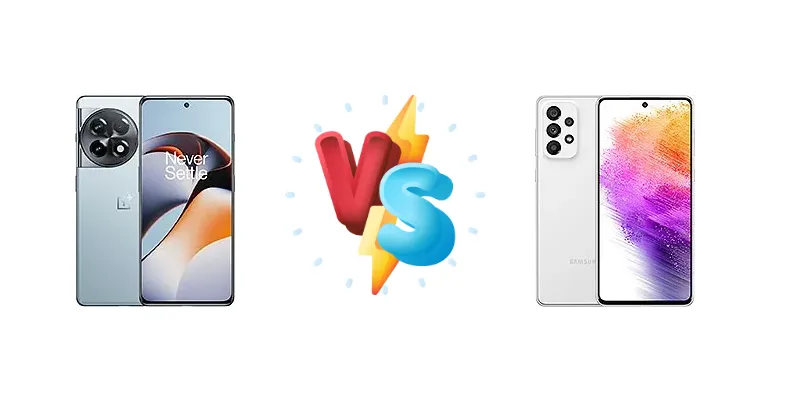
The OnePlus Ace 2 and Samsung Galaxy A73 5G represent distinct approaches to the mid-to-high range smartphone market. The Ace 2 prioritizes raw performance with a flagship-tier chipset, while the A73 5G focuses on a well-rounded experience with a more efficient processor and Samsung’s established software ecosystem. This comparison dissects their key differences to help you determine which device best suits your needs.
🏆 Quick Verdict
For users prioritizing gaming and demanding tasks, the OnePlus Ace 2 is the clear winner thanks to its Snapdragon 8+ Gen 1. However, the Samsung Galaxy A73 5G offers a more balanced package with solid efficiency and Samsung’s software features, making it ideal for everyday users who don't need extreme power.
| Network |
|---|
| 2G bands | GSM 850 / 900 / 1800 / 1900 | GSM 850 / 900 / 1800 / 1900 |
| 3G bands | HSDPA 850 / 900 / 1700(AWS) / 2100 | HSDPA 850 / 900 / 1700(AWS) / 1900 / 2100 |
| 4G bands | 1, 3, 4, 5, 8, 28, 34, 38, 39, 40, 41 | 1, 2, 3, 4, 5, 7, 8, 12, 13, 17, 20, 26, 28, 32, 38, 40, 41, 66 |
| 5G bands | 1, 3, 5, 8, 28, 40, 41, 77, 78 SA/NSA | 1, 3, 5, 7, 28, 40, 41, 66, 78 SA/NSA/Sub6 |
| Speed | HSPA, LTE, 5G | HSPA, LTE, 5G |
| Technology | GSM / CDMA / HSPA / LTE / 5G | GSM / HSPA / LTE / 5G |
| | CDMA 800 | - |
| Launch |
|---|
| Announced | 2023, February 07 | 2022, March 17 |
| Status | Available. Released 2023, February 13 | Available. Released 2022, April 22 |
| Body |
|---|
| Build | Glass front (Asahi Glass), aluminum frame, glass back (Gorilla Glass 5) | - |
| Dimensions | 163.4 x 74.3 x 8.7 mm (6.43 x 2.93 x 0.34 in) | 163.7 x 76.1 x 7.6 mm (6.44 x 3.00 x 0.30 in) |
| SIM | Nano-SIM + Nano-SIM | · Nano-SIM· Nano-SIM + Nano-SIM |
| Weight | 204 g (7.20 oz) | 181 g (6.38 oz) |
| | - | IP67 dust/water resistant (up to 1m for 30 min) |
| Display |
|---|
| Protection | Asahi Glass | Corning Gorilla Glass 5 |
| Resolution | 1240 x 2772 pixels, 20:9 ratio (~451 ppi density) | 1080 x 2400 pixels, 20:9 ratio (~393 ppi density) |
| Size | 6.74 inches, 109.2 cm2 (~90.0% screen-to-body ratio) | 6.7 inches, 108.4 cm2 (~87.0% screen-to-body ratio) |
| Type | AMOLED, 1B colors, 120Hz, HDR10+ | Super AMOLED Plus, 120Hz, 800 nits (HBM) |
| Platform |
|---|
| CPU | Octa-core (1x3.19 GHz Cortex-X2 & 3x2.75 GHz Cortex-A710 & 4x1.80 GHz Cortex-A510) | Octa-core (1x2.4 GHz Cortex-A78 & 3x2.2 GHz Cortex-A78 & 4x1.9 GHz Cortex-A55) |
| Chipset | Qualcomm SM8475 Snapdragon 8+ Gen 1 (4 nm) | Qualcomm SM7325 Snapdragon 778G 5G (6 nm) |
| GPU | Adreno 730 | Adreno 642L |
| OS | Android 13, ColorOS 13 | Android 12, up to 4 major Android upgrades, One UI 6.1 |
| Memory |
|---|
| Card slot | No | microSDXC (uses shared SIM slot) |
| Internal | 256GB 12GB RAM, 256GB 16GB RAM, 512GB 16GB RAM, 512GB 18GB RAM | 128GB 6GB RAM, 128GB 8GB RAM, 256GB 8GB RAM |
| | UFS 3.1 | - |
| Main Camera |
|---|
| Features | Color spectrum sensor, LED flash, HDR, panorama | LED flash, panorama, HDR |
| Quad | - | 108 MP, f/1.8, (wide), PDAF, OIS
12 MP, f/2.2, (ultrawide)
5 MP (macro)
Auxiliary lens |
| Single | 16 MP, f/2.4, 26mm (wide), 1/3.09", 1.0µm | 32 MP, f/2.2, 26mm (wide), 1/2.8", 0.8µm |
| Triple | 50 MP, f/1.8, 24mm (wide), 1/1.56", 1.0µm, PDAF, OIS
8 MP, f/2.2, 16mm, 120˚ (ultrawide), 1/4.0", 1.12µm
2 MP (macro) | - |
| Video | 4K@30/60fps, 1080p@30/60/120/240fps, gyro-EIS | 4K@30fps, 1080p@30/60fps; gyro-EIS |
| Selfie camera |
|---|
| Features | HDR | HDR |
| Single | 16 MP, f/2.4, 26mm (wide), 1/3.09", 1.0µm | 32 MP, f/2.2, 26mm (wide), 1/2.8", 0.8µm |
| Video | 1080p@30fps | 4K@30fps, 1080p@30fps |
| Sound |
|---|
| 3.5mm jack | No | No |
| 35mm jack | No | No |
| Loudspeaker | Yes, with stereo speakers | Yes, with stereo speakers |
| | 24-bit/192kHz audio | - |
| Comms |
|---|
| Bluetooth | 5.3, A2DP, LE | 5.0, A2DP, LE |
| Infrared port | Yes | - |
| NFC | Yes | Yes (market/region dependent) |
| Positioning | GPS (L1+L5), GLONASS (G1), BDS (B1I+B1c+B2a), GALILEO (E1+E5a), QZSS (L1+L5) | GPS, GLONASS, GALILEO, BDS, QZSS |
| Radio | No | Unspecified |
| USB | USB Type-C 2.0 | USB Type-C 2.0, OTG |
| WLAN | Wi-Fi 802.11 a/b/g/n/ac/6, dual-band | Wi-Fi 802.11 a/b/g/n/ac/6, dual-band, Wi-Fi Direct |
| Features |
|---|
| Sensors | Fingerprint (under display, optical), accelerometer, gyro, proximity, compass | Fingerprint (under display, optical), accelerometer, gyro, proximity, compass |
| Battery |
|---|
| Charging | 100W wired, 100% in 25 min | 25W wired |
| Type | Li-Po 5000 mAh | Li-Po 5000 mAh |
| Misc |
|---|
| Colors | Black, Glacier Blue, Red | Gray, Mint, White |
| Models | PHK110 | SM-A736B, SM-A736B/DS |
| Price | About 390 EUR | About 600 EUR |
| SAR | - | 1.14 W/kg (head) |
| SAR EU | - | 1.28 W/kg (head) 1.42 W/kg (body) |
OnePlus Ace 2
- Exceptional performance with Snapdragon 8+ Gen 1
- Ultra-fast 100W charging
- Likely optimized for gaming
- Potentially shorter battery life compared to A73 5G
- May run hotter under sustained load
Samsung Galaxy A73 5G
- Balanced performance and efficiency with Snapdragon 778G
- Likely longer battery life
- Samsung’s established software ecosystem
- Significantly slower charging speed
- Less capable for demanding games and applications
Display Comparison
While both phones likely feature AMOLED panels (based on brand history), the specifics are missing. The A73 5G’s display is expected to prioritize color accuracy and viewing angles, typical of Samsung’s displays. The Ace 2, geared towards gaming, may prioritize a higher refresh rate (likely 120Hz) for smoother visuals. The absence of LTPO information suggests neither phone dynamically adjusts refresh rates for optimal power saving. Bezels are likely comparable, but the Ace 2’s focus on a streamlined gaming experience might result in slightly thinner bezels.
Camera Comparison
Without detailed sensor information, a direct comparison is difficult. However, the Ace 2, positioned as a performance-focused device, may prioritize image processing speed and low-light performance. The A73 5G, leveraging Samsung’s image processing expertise, will likely deliver vibrant, color-accurate photos. The Snapdragon 778G’s ISP is capable, but the 8+ Gen 1’s ISP in the Ace 2 offers more advanced features and faster processing. We can expect the Ace 2 to excel in video recording capabilities. The inclusion of OIS (Optical Image Stabilization) on the main sensor of either device is probable, but unconfirmed.
Performance
The core difference lies in the chipsets. The OnePlus Ace 2’s Snapdragon 8+ Gen 1 (4nm) is a significant leap over the Galaxy A73 5G’s Snapdragon 778G 5G (6nm). The 8+ Gen 1’s Cortex-X2 prime core, clocked at 3.19 GHz, provides substantially higher peak performance. The 778G, while capable, relies on Cortex-A78 cores and a less efficient 6nm process. This translates to faster app loading, smoother multitasking, and significantly better gaming performance on the Ace 2. The 4nm process of the 8+ Gen 1 also contributes to better thermal efficiency, potentially mitigating throttling during extended gaming sessions. The Ace 2 likely benefits from faster LPDDR5x RAM, further enhancing performance.
Battery Life
The Galaxy A73 5G’s battery capacity is likely around 5000mAh (typical for Samsung A-series), while the Ace 2’s capacity is unknown but likely smaller to accommodate the faster charging. However, the Ace 2’s 100W wired charging is a game-changer, achieving a full charge in approximately 25 minutes. The A73 5G’s 25W charging is significantly slower. While the A73 5G may offer longer screen-on time due to its more efficient chipset and potentially larger battery, the Ace 2’s rapid charging mitigates range anxiety and allows for quick top-ups.
Buying Guide
Buy the OnePlus Ace 2 if you need uncompromising performance for gaming, video editing, or other resource-intensive applications, and value incredibly fast 100W charging. Buy the Samsung Galaxy A73 5G if you prefer a more balanced smartphone experience with a focus on battery life, a refined software experience, and a generally lower price point, accepting a performance trade-off.
Frequently Asked Questions
❓ Will the Snapdragon 8+ Gen 1 in the OnePlus Ace 2 overheat during prolonged gaming sessions?
While the Snapdragon 8+ Gen 1 is a powerful chip, the 4nm process helps mitigate thermal throttling. However, sustained gaming at maximum settings will likely generate heat. The Ace 2 likely incorporates cooling solutions to manage temperatures, but some performance reduction is possible during extended play.
❓ Is the 25W charging on the Samsung Galaxy A73 5G slow compared to other phones?
Yes, 25W charging is relatively slow compared to the 100W charging on the OnePlus Ace 2 and even some other phones in this price range. Expect a full charge to take well over an hour, potentially closer to two hours depending on battery level.
❓ Does the Snapdragon 778G in the Galaxy A73 5G support high frame rates in popular games like PUBG?
The Snapdragon 778G is capable of running PUBG, but achieving consistently high frame rates (90fps or higher) will likely require lowering graphics settings. It's not designed for the same level of graphical fidelity as the Snapdragon 8+ Gen 1.
❓ What are the software update commitments for both the OnePlus Ace 2 and the Samsung Galaxy A73 5G?
Samsung typically offers longer software support for its A-series devices, promising several years of Android updates and security patches. OnePlus's update policy is less consistent, but the Ace 2 should receive at least two major Android updates.