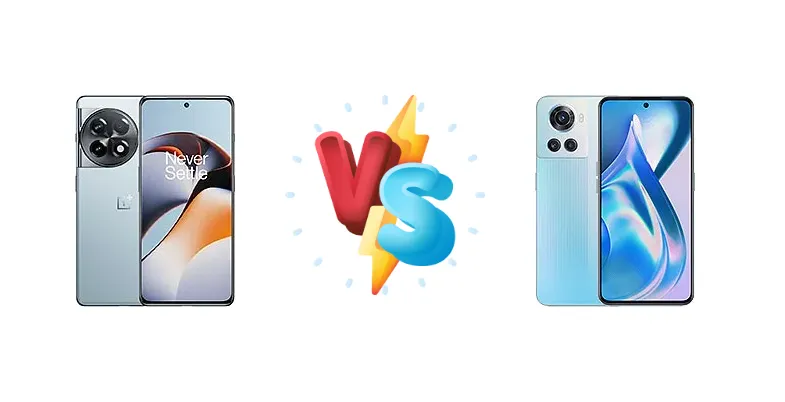
The OnePlus Ace and Ace 2 both offer impressive specs and features, but cater to slightly different users. Choosing between them can be tricky. This comprehensive comparison will dissect every aspect, from performance and camera to battery and display, to help you make the right decision.
🏆 Quick Verdict
The OnePlus Ace 2 takes the crown thanks to its significantly more powerful Snapdragon 8+ Gen 1 chipset, offering superior performance. While the Ace boasts incredibly fast 150W charging, the Ace 2's overall package, including a better processor and refined design, makes it the better choice for most.
| Network |
|---|
| 2G bands | GSM 850 / 900 / 1800 / 1900 | GSM 850 / 900 / 1800 / 1900 |
| 3G bands | HSDPA 850 / 900 / 1700(AWS) / 2100 | HSDPA 800 / 850 / 900 / 1700(AWS) / 1900 / 2100 |
| 4G bands | 1, 3, 4, 5, 8, 28, 34, 38, 39, 40, 41 | 1, 2, 3, 4, 5, 7, 8, 18, 19, 26, 28, 34, 38, 39, 40, 41 |
| 5G bands | 1, 3, 5, 8, 28, 40, 41, 77, 78 SA/NSA | 1, 3, 5, 8, 28, 40, 41, 77, 78 SA/NSA |
| Speed | HSPA, LTE, 5G | HSPA, LTE, 5G |
| Technology | GSM / CDMA / HSPA / LTE / 5G | GSM / CDMA / HSPA / EVDO / LTE / 5G |
| | CDMA 800 | CDMA2000 1xEV-DO |
| Launch |
|---|
| Announced | 2023, February 07 | 2022, April 21 |
| Status | Available. Released 2023, February 13 | Available. Released 2022, April 26 |
| Body |
|---|
| Build | Glass front (Asahi Glass), aluminum frame, glass back (Gorilla Glass 5) | Glass front (Gorilla Glass 5), plastic frame |
| Dimensions | 163.4 x 74.3 x 8.7 mm (6.43 x 2.93 x 0.34 in) | 163.3 x 75.5 x 8.2 mm (6.43 x 2.97 x 0.32 in) |
| SIM | Nano-SIM + Nano-SIM | Nano-SIM + Nano-SIM |
| Weight | 204 g (7.20 oz) | 186 g (6.56 oz) |
| Display |
|---|
| Protection | Asahi Glass | Corning Gorilla Glass 5 |
| Resolution | 1240 x 2772 pixels, 20:9 ratio (~451 ppi density) | 1080 x 2412 pixels, 20:9 ratio (~394 ppi density) |
| Size | 6.74 inches, 109.2 cm2 (~90.0% screen-to-body ratio) | 6.7 inches, 108.0 cm2 (~87.6% screen-to-body ratio) |
| Type | AMOLED, 1B colors, 120Hz, HDR10+ | OLED, 1B colors, 120Hz, HDR10+, 500 nits (typ), 800 nits (HBM), 950 nits (peak) |
| Platform |
|---|
| CPU | Octa-core (1x3.19 GHz Cortex-X2 & 3x2.75 GHz Cortex-A710 & 4x1.80 GHz Cortex-A510) | Octa-core (4x2.85 GHz Cortex-A78 & 4x2.0 GHz Cortex-A55) |
| Chipset | Qualcomm SM8475 Snapdragon 8+ Gen 1 (4 nm) | Mediatek Dimensity 8100 Max (5 nm) |
| GPU | Adreno 730 | Mali-G610 MC6 |
| OS | Android 13, ColorOS 13 | Android 12, ColorOS 12.1 |
| Memory |
|---|
| Card slot | No | No |
| Internal | 256GB 12GB RAM, 256GB 16GB RAM, 512GB 16GB RAM, 512GB 18GB RAM | 128GB 8GB RAM, 256GB 8GB RAM, 256GB 12GB RAM, 512GB 12GB RAM |
| | UFS 3.1 | UFS 3.1 |
| Main Camera |
|---|
| Features | Color spectrum sensor, LED flash, HDR, panorama | Color spectrum sensor, LED flash, HDR, panorama |
| Single | 16 MP, f/2.4, 26mm (wide), 1/3.09", 1.0µm | 16 MP, f/2.4, 26mm (wide), 1/3.09", 1.0µm |
| Triple | 50 MP, f/1.8, 24mm (wide), 1/1.56", 1.0µm, PDAF, OIS
8 MP, f/2.2, 16mm, 120˚ (ultrawide), 1/4.0", 1.12µm
2 MP (macro) | 50 MP, f/1.9, 24mm (wide), 1/1.56", 1.0µm, PDAF, OIS
8 MP, f/2.2, 15mm, 120˚ (ultrawide), 1/4.0", 1.12µm
2 MP (macro) |
| Video | 4K@30/60fps, 1080p@30/60/120/240fps, gyro-EIS | 4K@30/60fps, 1080p@30/60/240fps, gyro-EIS |
| Selfie camera |
|---|
| Features | HDR | HDR |
| Single | 16 MP, f/2.4, 26mm (wide), 1/3.09", 1.0µm | 16 MP, f/2.4, 26mm (wide), 1/3.09", 1.0µm |
| Video | 1080p@30fps | 1080p@30fps, gyro-EIS |
| Sound |
|---|
| 3.5mm jack | No | No |
| 35mm jack | No | No |
| Loudspeaker | Yes, with stereo speakers | Yes, with stereo speakers |
| | 24-bit/192kHz audio | - |
| Comms |
|---|
| Bluetooth | 5.3, A2DP, LE | 5.2, A2DP, LE |
| Infrared port | Yes | - |
| NFC | Yes | Yes |
| Positioning | GPS (L1+L5), GLONASS (G1), BDS (B1I+B1c+B2a), GALILEO (E1+E5a), QZSS (L1+L5) | GPS, GLONASS, GALILEO, BDS |
| Radio | No | No |
| USB | USB Type-C 2.0 | USB Type-C 2.0 |
| WLAN | Wi-Fi 802.11 a/b/g/n/ac/6, dual-band | Wi-Fi 802.11 a/b/g/n/ac/6, dual-band, Wi-Fi Direct |
| Features |
|---|
| Sensors | Fingerprint (under display, optical), accelerometer, gyro, proximity, compass | Fingerprint (under display, optical), accelerometer, gyro, proximity, compass |
| Battery |
|---|
| Charging | 100W wired, 100% in 25 min | 150W wired, 50% in 5 min |
| Type | Li-Po 5000 mAh | Li-Po 4500 mAh |
| Misc |
|---|
| Colors | Black, Glacier Blue, Red | Black, Blue |
| Models | PHK110 | PGKM10 |
| Price | About 390 EUR | About 360 EUR |
OnePlus Ace 2
- Superior Performance (Snapdragon 8+ Gen 1)
- Refined Design
- Excellent Display
- Good Camera
- Slower Charging (100W)
- Potentially Higher Price
OnePlus Ace
- Blazing-Fast Charging (150W)
- More Affordable
- Capable Performance
- Good Display
- Less Powerful Chipset (Dimensity 8100 Max)
- Older Design
- Potentially Less Optimized Software
Display Comparison
Both phones feature AMOLED displays with a 120Hz refresh rate, offering smooth visuals. The Ace 2 likely has slightly improved color accuracy and brightness due to newer panel technology, but the difference is subtle. Expect vibrant colors and sharp details on both.
Camera Comparison
The OnePlus Ace features a 50MP main camera, an 8MP ultrawide, and a 2MP macro lens. The Ace 2 is expected to have a similar camera setup, potentially with improved image processing and low-light performance due to the newer chipset and software optimizations. Both offer decent image quality, but the Ace 2 should have a slight edge.
Performance
This is where the Ace 2 truly shines. The Snapdragon 8+ Gen 1 is a substantial upgrade over the Dimensity 8100 Max. Expect noticeably faster app loading, smoother multitasking, and significantly better gaming performance on the Ace 2. The Ace is still capable, but struggles under heavy loads compared to its successor.
Battery Life
The Ace's 150W charging is a standout feature, allowing for incredibly fast top-ups. The Ace 2's 100W charging is still very fast, but not as revolutionary. Both phones likely have similar battery capacities (around 5000mAh), so battery life should be comparable between the two, with charging speed being the key differentiator.
Buying Guide
The OnePlus Ace 2 is ideal for gamers, power users, and anyone demanding top-tier performance. The OnePlus Ace remains a compelling option for budget-conscious buyers who prioritize blazing-fast charging and still want a capable smartphone experience.
Frequently Asked Questions
❓ Is the OnePlus Ace 2 worth the upgrade from the OnePlus Ace?
If you prioritize performance and are willing to pay a bit more, then yes. The Snapdragon 8+ Gen 1 offers a significant upgrade. If you're happy with the Ace's performance and value its incredibly fast charging, the upgrade might not be necessary.
❓ Which phone has better gaming performance?
The OnePlus Ace 2, hands down. The Snapdragon 8+ Gen 1 is a much more powerful chipset and will handle demanding games with ease.