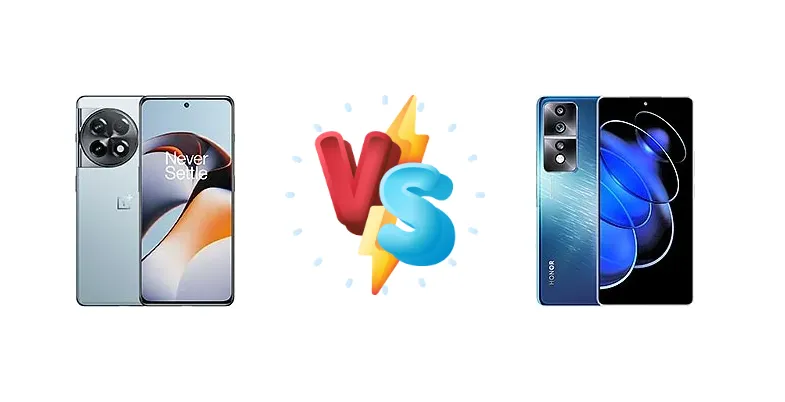
The OnePlus Ace 2 and Honor 80 GT represent a fascinating intersection in the Android market. Both devices leverage the proven Qualcomm Snapdragon 8+ Gen 1 chipset, offering flagship-level performance at competitive price points. However, subtle differences in CPU clock speeds and, crucially, charging technology create distinct user experiences. This comparison dissects these nuances to determine which phone delivers the best value.
🏆 Quick Verdict
For users prioritizing the fastest possible charging and consistently high performance under sustained load, the OnePlus Ace 2 emerges as the winner. Its 100W charging significantly reduces downtime, and the slightly higher CPU clock speeds offer a marginal, but measurable, performance edge. However, the Honor 80 GT remains a compelling option for those seeking a balanced experience with respectable charging speeds.
| Network |
|---|
| 2G bands | GSM 850 / 900 / 1800 / 1900 | GSM 850 / 900 / 1800 / 1900 |
| 3G bands | HSDPA 850 / 900 / 1700(AWS) / 2100 | HSDPA 800 / 850 / 900 / 1700(AWS) / 2100 |
| 4G bands | 1, 3, 4, 5, 8, 28, 34, 38, 39, 40, 41 | 1, 3, 4, 5, 8, 19, 28, 34, 38, 39, 40, 41 |
| 5G bands | 1, 3, 5, 8, 28, 40, 41, 77, 78 SA/NSA | 1, 5, 8, 28, 41, 77, 78 SA/NSA |
| Speed | HSPA, LTE, 5G | HSPA, LTE, 5G |
| Technology | GSM / CDMA / HSPA / LTE / 5G | GSM / CDMA / HSPA / CDMA2000 / LTE / 5G |
| | CDMA 800 | CDMA2000 1x |
| Launch |
|---|
| Announced | 2023, February 07 | 2022, December 26 |
| Status | Available. Released 2023, February 13 | Available. Released 2022, December 26 |
| Body |
|---|
| Build | Glass front (Asahi Glass), aluminum frame, glass back (Gorilla Glass 5) | - |
| Dimensions | 163.4 x 74.3 x 8.7 mm (6.43 x 2.93 x 0.34 in) | 162.5 x 75.3 x 7.9 mm (6.40 x 2.96 x 0.31 in) |
| SIM | Nano-SIM + Nano-SIM | Nano-SIM + Nano-SIM |
| Weight | 204 g (7.20 oz) | 187 g or 195 g (6.60 oz) |
| Display |
|---|
| Protection | Asahi Glass | - |
| Resolution | 1240 x 2772 pixels, 20:9 ratio (~451 ppi density) | 1080 x 2400 pixels, 20:9 ratio (~395 ppi density) |
| Size | 6.74 inches, 109.2 cm2 (~90.0% screen-to-body ratio) | 6.67 inches, 107.4 cm2 (~87.8% screen-to-body ratio) |
| Type | AMOLED, 1B colors, 120Hz, HDR10+ | AMOLED, 1B colors, 120Hz, HDR10, 1400 nits (peak) |
| Platform |
|---|
| CPU | Octa-core (1x3.19 GHz Cortex-X2 & 3x2.75 GHz Cortex-A710 & 4x1.80 GHz Cortex-A510) | Octa-core (1x3.0 GHz Cortex-X2 & 3x2.5 GHz Cortex-A710 & 4x1.80 GHz Cortex-A510) |
| Chipset | Qualcomm SM8475 Snapdragon 8+ Gen 1 (4 nm) | Qualcomm SM8475 Snapdragon 8+ Gen 1 (4 nm) |
| GPU | Adreno 730 | Adreno 730 |
| OS | Android 13, ColorOS 13 | Android 12, MagicOS 7 |
| Memory |
|---|
| Card slot | No | No |
| Internal | 256GB 12GB RAM, 256GB 16GB RAM, 512GB 16GB RAM, 512GB 18GB RAM | 256GB 12GB RAM, 256GB 16GB RAM, 512GB 12GB RAM |
| | UFS 3.1 | - |
| Main Camera |
|---|
| Features | Color spectrum sensor, LED flash, HDR, panorama | LED flash, HDR, panorama |
| Single | 16 MP, f/2.4, 26mm (wide), 1/3.09", 1.0µm | 16 MP, f/2.4, (wide) |
| Triple | 50 MP, f/1.8, 24mm (wide), 1/1.56", 1.0µm, PDAF, OIS
8 MP, f/2.2, 16mm, 120˚ (ultrawide), 1/4.0", 1.12µm
2 MP (macro) | 54 MP, f/1.9, (wide), 1/1.49", PDAF
8 MP, f/2.2, (ultrawide)
2 MP (macro) |
| Video | 4K@30/60fps, 1080p@30/60/120/240fps, gyro-EIS | 4K@30fps, 1080p@30/60fps, gyro-EIS |
| Selfie camera |
|---|
| Features | HDR | - |
| Single | 16 MP, f/2.4, 26mm (wide), 1/3.09", 1.0µm | 16 MP, f/2.4, (wide) |
| Video | 1080p@30fps | 1080p@30fps, gyro-EIS |
| Sound |
|---|
| 3.5mm jack | No | No |
| 35mm jack | No | No |
| Loudspeaker | Yes, with stereo speakers | Yes |
| | 24-bit/192kHz audio | - |
| Comms |
|---|
| Bluetooth | 5.3, A2DP, LE | 5.2, A2DP, LE, aptX HD |
| Infrared port | Yes | Yes |
| NFC | Yes | Yes |
| Positioning | GPS (L1+L5), GLONASS (G1), BDS (B1I+B1c+B2a), GALILEO (E1+E5a), QZSS (L1+L5) | GPS, GALILEO, GLONASS, BDS, QZSS |
| Radio | No | No |
| USB | USB Type-C 2.0 | USB Type-C 2.0, OTG |
| WLAN | Wi-Fi 802.11 a/b/g/n/ac/6, dual-band | Wi-Fi 802.11 a/b/g/n/ac/6, dual-band, Wi-Fi Direct |
| Features |
|---|
| Sensors | Fingerprint (under display, optical), accelerometer, gyro, proximity, compass | Fingerprint (under display, optical), accelerometer, gyro, compass |
| | - | Virtual proximity sensing |
| Battery |
|---|
| Charging | 100W wired, 100% in 25 min | 66W wired, 3-50% in 15 min
5W reverse wired |
| Type | Li-Po 5000 mAh | Li-Po 4800 mAh |
| Misc |
|---|
| Colors | Black, Glacier Blue, Red | Black, Blue, White |
| Models | PHK110 | AGT-AN00 |
| Price | About 390 EUR | About 450 EUR |
OnePlus Ace 2
- Significantly faster 100W charging
- Slightly higher CPU clock speed for improved performance
- Potentially more vibrant display (based on brand history)
- Lacks reverse wireless charging
- May run hotter under sustained load due to higher clock speeds
Honor 80 GT
- Includes 5W reverse wired charging
- Potentially more refined software experience (region dependent)
- May offer better value for money
- Slower 66W charging
- Lower CPU clock speed resulting in slightly reduced performance
Display Comparison
Both devices are expected to feature high-refresh-rate AMOLED displays, though specific details like peak brightness and color accuracy are not provided. The absence of LTPO technology in either device suggests a less adaptive refresh rate, potentially impacting battery life during static content viewing. Bezels are likely comparable given the similar overall design philosophies of both brands. Without specific display specs, it's difficult to definitively declare a winner; however, the Ace 2's brand history suggests a focus on vibrant, color-accurate displays.
Camera Comparison
Detailed camera specifications are absent, making a direct comparison challenging. Both brands typically employ multi-camera systems, but the quality hinges on sensor size, lens aperture, and image processing algorithms. Without knowing the main sensor resolution or aperture, it's difficult to assess low-light performance. The presence of Optical Image Stabilization (OIS) would be a significant advantage for video recording and reducing blur in low-light photos. We can assume both phones will include standard wide, ultrawide, and potentially macro lenses, but the quality of these auxiliary lenses is often secondary. Image processing style will likely differ – OnePlus tends towards more saturated colors, while Honor often aims for a more natural look.
Performance
The core of both phones is the Qualcomm SM8475 Snapdragon 8+ Gen 1 (4nm). However, the OnePlus Ace 2 boasts a slightly higher peak CPU clock speed of 3.19 GHz on its Cortex-X2 core, compared to the Honor 80 GT’s 3.0 GHz. While this 0.19 GHz difference may seem minor, it can translate to marginally faster single-core performance in benchmarks and responsive application launches. Both phones utilize a tri-cluster configuration with 3x Cortex-A710 cores at 2.75 GHz (Honor: 2.5 GHz) and 4x Cortex-A510 cores at 1.80 GHz. The Honor 80 GT's lower A710 clock speed will likely result in slightly lower multi-core performance. Both are expected to utilize LPDDR5X RAM, ensuring ample memory bandwidth for demanding applications. Thermal management will be crucial; the 4nm process helps, but sustained performance will depend on the cooling solutions employed.
Battery Life
The OnePlus Ace 2 features 100W wired charging, capable of fully charging the device in approximately 25 minutes. The Honor 80 GT, in contrast, offers 66W wired charging, taking 3-50% to reach 50% charge in 15 minutes. This difference is substantial; the Ace 2’s faster charging is a significant convenience for users who frequently need to top up their battery. The Honor 80 GT also includes 5W reverse wired charging, a feature absent on the Ace 2, allowing it to charge other devices. While battery capacity isn't specified, the faster charging of the Ace 2 mitigates the impact of a potentially smaller battery.
Buying Guide
Buy the OnePlus Ace 2 if you need blazing-fast charging, frequently engage in demanding tasks like gaming, and value every ounce of performance. Buy the Honor 80 GT if you prefer a more balanced approach, appreciate a potentially more refined software experience (depending on region), and don't mind a slightly slower charging speed in exchange for potential cost savings.
Frequently Asked Questions
❓ Will the Snapdragon 8+ Gen 1 in the Honor 80 GT throttle during extended gaming sessions?
The Snapdragon 8+ Gen 1 is a capable chipset, but throttling can occur under sustained load. The Honor 80 GT's thermal management system will be critical. While the 4nm process helps, the slightly lower CPU clock speed compared to the Ace 2 might result in slightly less heat generation, potentially mitigating throttling, but real-world testing is needed to confirm.
❓ How much faster is the 100W charging on the OnePlus Ace 2 compared to the 66W charging on the Honor 80 GT in real-world use?
The 100W charging on the Ace 2 is demonstrably faster. While the Honor 80 GT can reach 50% charge in 15 minutes, the Ace 2 can fully charge in 25 minutes. This means a significantly shorter time plugged into the wall, especially for users who need quick top-ups throughout the day. The difference is particularly noticeable when charging from a low battery percentage.
❓ Does either phone support expandable storage via microSD card?
Neither OnePlus nor Honor typically include microSD card slots in their flagship or near-flagship devices. Users should carefully consider their storage needs when purchasing, as internal storage is likely the only option.
❓ What software experience can I expect on each device?
The OnePlus Ace 2 runs OxygenOS (based on Android), known for its clean interface and customization options. The Honor 80 GT runs MagicUI (also based on Android), which offers a different aesthetic and feature set. Software experience can vary significantly by region, so it's important to research the specific version available in your location.