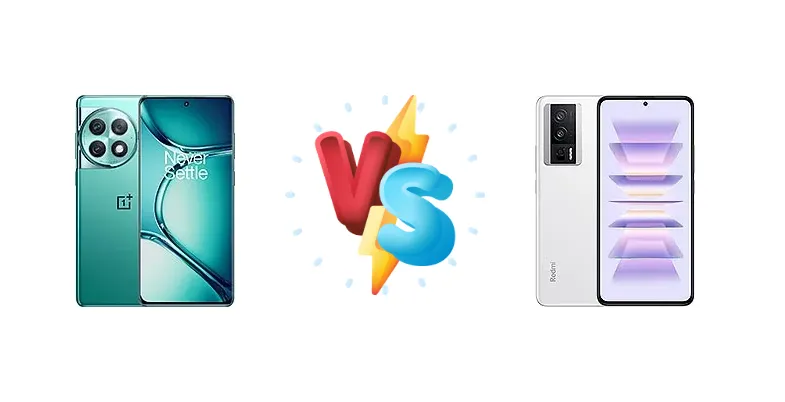
Both the OnePlus Ace 2 Pro and Xiaomi Redmi K60 Pro represent the pinnacle of value-focused flagship performance, powered by the Qualcomm Snapdragon 8 Gen 2. This comparison dissects their similarities and differences, focusing on charging technology, potential thermal performance, and which phone best suits your needs.
🏆 Quick Verdict
For users prioritizing the absolute fastest charging and potentially slightly better sustained performance, the OnePlus Ace 2 Pro is the winner. However, the Xiaomi Redmi K60 Pro offers a compelling package with 30W wireless charging and a competitive price, making it a strong contender for budget-conscious enthusiasts.
| Network |
|---|
| 2G bands | GSM 850 / 900 / 1800 / 1900 | GSM 850 / 900 / 1800 / 1900 |
| 3G bands | HSDPA 850 / 900 / 1700(AWS) / 2100 | HSDPA 800 / 850 / 900 / 1700(AWS) / 2100 |
| 4G bands | 1, 3, 4, 5, 7, 8, 18, 19, 26, 28, 34, 38, 39, 40, 41 | 1, 3, 4, 5, 8, 18, 19, 26, 34, 38, 39, 40, 41, 42 |
| 5G bands | 1, 3, 5, 8, 28, 41, 77, 78 SA/NSA | 1, 3, 5, 8, 28, 38, 41, 77, 78 SA/NSA |
| Speed | HSPA, LTE, 5G | HSPA, LTE, 5G |
| Technology | GSM / CDMA / HSPA / LTE / 5G | GSM / CDMA / HSPA / CDMA2000 / LTE / 5G |
| | - | CDMA2000 1x |
| Launch |
|---|
| Announced | 2023, August 16 | 2022, December 27 |
| Status | Available. Released 2023, August 23 | Available. Released 2023, January 01 |
| Body |
|---|
| Build | Glass front (Asahi Glass), plastic frame, glass back (Gorilla Glass 5) | - |
| Dimensions | 163.1 x 74.2 x 9 mm (6.42 x 2.92 x 0.35 in) | 162.8 x 75.4 x 8.6 mm or 8.9 mm |
| SIM | Nano-SIM + Nano-SIM | Nano-SIM + Nano-SIM |
| Weight | 210 g (7.41 oz) | 201 g or 205 g (7.09 oz) |
| Display |
|---|
| Protection | Asahi Glass | - |
| Resolution | 1240 x 2772 pixels, 20:9 ratio (~451 ppi density) | 1440 x 3200 pixels, 20:9 ratio (~526 ppi density) |
| Size | 6.74 inches, 109.2 cm2 (~90.3% screen-to-body ratio) | 6.67 inches, 107.4 cm2 (~87.5% screen-to-body ratio) |
| Type | AMOLED, 1B colors, 120Hz, HDR10+, 550 nits (typ), 1200 nits (HBM), 1600 nits (peak) | OLED, 68B colors, 120Hz, Dolby Vision, HDR10+, 1400 nits (peak) |
| Platform |
|---|
| CPU | Octa-core (1x3.2 GHz Cortex-X3 & 2x2.8 GHz Cortex-A715 & 2x2.8 GHz Cortex-A710 & 3x2.0 GHz Cortex-A510) | Octa-core (1x3.2 GHz Cortex-X3 & 2x2.8 GHz Cortex-A715 & 2x2.8 GHz Cortex-A710 & 3x2.0 GHz Cortex-A510) |
| Chipset | Qualcomm SM8550-AB Snapdragon 8 Gen 2 (4 nm) | Qualcomm SM8550-AB Snapdragon 8 Gen 2 (4 nm) |
| GPU | Adreno 740 | Adreno 740 |
| OS | Android 13, ColorOS 13.1 | Android 13, MIUI 14 |
| Memory |
|---|
| Card slot | No | No |
| Internal | 256GB 12GB RAM, 512GB 16GB RAM, 1TB 24GB RAM | 128GB 8GB RAM, 256GB 8GB RAM, 256GB 12GB RAM, 512GB 12GB RAM, 512GB 16GB RAM |
| | - | UFS 4.0
UFS 3.1 - 128GB only |
| Main Camera |
|---|
| Features | Color spectrum sensor, LED flash, HDR, panorama | Color spectrum sensor, Dual-LED dual-tone flash, HDR, panorama |
| Triple | 50 MP, f/1.8, 24mm (wide), 1/1.56", 1.0µm, PDAF, OIS
8 MP, f/2.2, 16mm, 112˚ (ultrawide), 1/4.0", 1.12µm
2 MP (macro) | 54 MP, f/1.9, (wide), 1/1.49", 1.0µm, PDAF, OIS
8 MP, 118˚ (ultrawide), 1/4.0", 1.12µm
2 MP (macro) |
| Video | 4K@30/60fps, 1080p@30/60/120/240fps, gyro-EIS, OIS | 8K@24fps, 4K@30/60fps, 1080p@30/60/120/240/960fps, 720p@1920fps, gyro-EIS |
| Selfie camera |
|---|
| Features | HDR | HDR |
| Single | 16 MP, f/2.4, 26mm (wide), 1/3.09", 1.0µm | 16 MP, (wide), 1/3.06", 1.0µm |
| Video | 1080p@30fps | 1080p@30/60/120fps |
| Sound |
|---|
| 3.5mm jack | - | No |
| 35mm jack | No | No |
| Loudspeaker | Yes, with stereo speakers | Yes, with stereo speakers |
| | - | 24-bit/192kHz audio |
| Comms |
|---|
| Bluetooth | 5.3, A2DP, LE, aptX HD | 5.3, A2DP, LE |
| Infrared port | Yes | Yes |
| NFC | Yes | Yes |
| Positioning | GPS (L1+L5), GLONASS (G1), BDS (B1I+B1c+B2a), GALILEO (E1+E5a), QZSS (L1+L5) | GPS (L1+L5), GLONASS (G1), BDS (B1I+B2a+Bc), GALILEO (E1+E5a), QZSS (L1+L5), NavIC |
| Radio | No | Unspecified |
| USB | USB Type-C 2.0 | USB Type-C 2.0, OTG |
| WLAN | Wi-Fi 802.11 a/b/g/n/ac/6/7, dual-band | Wi-Fi 802.11 a/b/g/n/ac/6e, dual-band, Wi-Fi Direct |
| Features |
|---|
| Sensors | Fingerprint (under display, optical), accelerometer, gyro, proximity, compass | Fingerprint (under display, optical), accelerometer, gyro, proximity, compass |
| Battery |
|---|
| Charging | 150W wired | 120W wired, PD3.0, QC3+, 100% in 19 min
30W wireless |
| Type | Li-Po 5000 mAh | Li-Po 5000 mAh |
| Misc |
|---|
| Colors | Aurora Green, Titanium Gray | Black, White, Mint, Champion Black |
| Models | PJA110 | 22127RK46C |
| Price | About 380 EUR | About 460 EUR |
OnePlus Ace 2 Pro
- Industry-leading 150W wired charging
- Potentially superior sustained performance due to cooling
- Snapdragon 8 Gen 2 provides top-tier processing power
- No wireless charging support
- Camera specifications unknown, potential weakness
Xiaomi Redmi K60 Pro
- 30W wireless charging for added convenience
- Competitive 120W wired charging speed
- Snapdragon 8 Gen 2 delivers flagship performance
- Slower wired charging compared to the Ace 2 Pro
- Potential for more thermal throttling under sustained load
Display Comparison
While both devices are expected to feature high-quality AMOLED displays, specific details like peak brightness and PWM dimming rates are not provided. However, given the flagship positioning, both will likely offer vibrant colors and excellent viewing angles. The absence of LTPO information suggests both may not dynamically adjust refresh rates for optimal power efficiency, though this is speculative. Bezels are likely comparable, focusing on maximizing screen real estate.
Camera Comparison
Context data lacks camera specifications. Based on market trends, both phones will likely feature multi-camera systems. However, without sensor size, aperture, or OIS details, a direct comparison is impossible. Xiaomi often emphasizes camera capabilities, potentially giving the K60 Pro an edge in image processing and low-light performance. The inclusion of a 2MP macro lens on either device is likely a marketing tactic with limited real-world benefit.
Performance
Both the OnePlus Ace 2 Pro and Xiaomi Redmi K60 Pro utilize the Qualcomm SM8550-AB Snapdragon 8 Gen 2 (4nm). Critically, the CPU configuration is identical – 1x3.2 GHz Cortex-X3, 2x2.8 GHz Cortex-A715, 2x2.8 GHz Cortex-A710, and 3x2.0 GHz Cortex-A510. This means raw processing power will be nearly indistinguishable. The key differentiator will be thermal management. The 4nm process node inherently offers better efficiency, but OnePlus historically prioritizes aggressive cooling solutions, potentially allowing the Ace 2 Pro to sustain peak performance for longer durations. RAM speed (likely LPDDR5x on both) is not specified, but will contribute to overall system responsiveness.
Battery Life
The OnePlus Ace 2 Pro boasts 150W wired charging, significantly faster than the Xiaomi Redmi K60 Pro’s 120W. Xiaomi compensates with 30W wireless charging, a feature absent on the Ace 2 Pro. The Redmi K60 Pro’s charging is still rapid, completing a full charge in approximately 19 minutes. While battery capacity isn’t specified, the faster wired charging of the Ace 2 Pro is ideal for users who frequently need to top up quickly, while the K60 Pro offers more versatile charging options.
Buying Guide
Buy the OnePlus Ace 2 Pro if you need the quickest possible charging speeds and anticipate extended gaming sessions where sustained performance is critical. Buy the Xiaomi Redmi K60 Pro if you prefer the convenience of wireless charging, value a more balanced feature set, and are looking for a flagship experience without the premium price tag.
Frequently Asked Questions
❓ Will the 150W charging of the OnePlus Ace 2 Pro degrade the battery health faster?
While extremely fast charging generates more heat, OnePlus implements battery health management algorithms to mitigate degradation. These algorithms dynamically adjust charging speed and voltage to protect the battery, though long-term effects require further testing.
❓ Does the Xiaomi Redmi K60 Pro support Power Delivery (PD) for faster charging with third-party chargers?
Yes, the Redmi K60 Pro supports PD3.0, allowing it to leverage compatible chargers for faster wired charging speeds. This provides flexibility and convenience for users who already own PD chargers.
❓ Is the lack of a dedicated telephoto lens a significant drawback on either device?
Without knowing the main sensor's capabilities, it's hard to say. However, a dedicated telephoto lens is generally preferred for high-quality zoomed photos. If photography is a priority, investigate sample images from both phones before making a decision.
❓ How does the thermal performance of the Redmi K60 Pro compare to other Snapdragon 8 Gen 2 phones?
The Redmi K60 Pro's thermal performance will depend on Xiaomi's cooling solution. While the Snapdragon 8 Gen 2 is efficient, sustained high loads can still cause throttling. Reviews will be crucial to determine how well the K60 Pro manages heat during extended gaming or video recording.