
OnePlus Ace 2 Pro vs vivo X90 Pro+: Which Snapdragon 8 Gen 2 Flagship Reigns Supreme?
| Phones Images | |||||
|---|---|---|---|---|---|
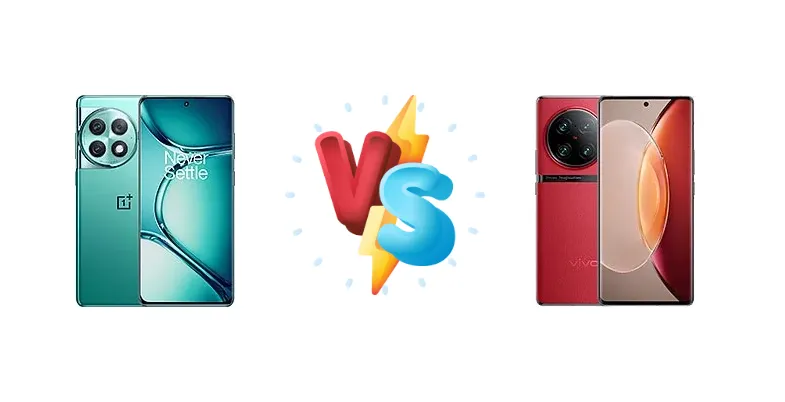
|
🏆 Quick Verdict
For the average user prioritizing blazing-fast charging and a more aggressive performance profile, the OnePlus Ace 2 Pro is the clear winner. Its 150W charging dramatically reduces downtime. However, the vivo X90 Pro+ offers a more refined, balanced experience with wireless charging and potentially superior camera image processing.
| PHONES | ||
|---|---|---|
| Phone Names | OnePlus Ace 2 Pro | vivo X90 Pro+ |
| Network | ||
|---|---|---|
| 2G bands | GSM 850 / 900 / 1800 / 1900 | GSM 850 / 900 / 1800 / 1900 - SIM 1 & SIM 2 |
| 3G bands | HSDPA 850 / 900 / 1700(AWS) / 2100 | HSDPA 800 / 850 / 900 / 1700(AWS) / 1900 / 2100 |
| 4G bands | 1, 3, 4, 5, 7, 8, 18, 19, 26, 28, 34, 38, 39, 40, 41 | 1, 2, 3, 4, 5, 7, 8, 12, 17, 18, 19, 20, 25, 26, 28, 34, 38, 39, 40, 41, 42, 66 |
| 5G bands | 1, 3, 5, 8, 28, 41, 77, 78 SA/NSA | 1, 2, 3, 5, 7, 8, 12, 20, 28, 38, 40, 41, 66, 77, 78, 79 SA/NSA |
| Speed | HSPA, LTE, 5G | HSPA, LTE-A, 5G |
| Technology | GSM / CDMA / HSPA / LTE / 5G | GSM / CDMA / HSPA / EVDO / LTE / 5G |
| - | CDMA2000 1xEV-DO | |
| Launch | ||
|---|---|---|
| Announced | 2023, August 16 | 2022, November 22 |
| Status | Available. Released 2023, August 23 | Available. Released 2022, December 06 |
| Body | ||
|---|---|---|
| Build | Glass front (Asahi Glass), plastic frame, glass back (Gorilla Glass 5) | Glass front, aluminum frame, eco leather back |
| Dimensions | 163.1 x 74.2 x 9 mm (6.42 x 2.92 x 0.35 in) | 164.4 x 75.3 x 9.7 mm (6.47 x 2.96 x 0.38 in) |
| SIM | Nano-SIM + Nano-SIM | Dual SIM (Nano-SIM, dual stand-by) |
| Weight | 210 g (7.41 oz) | 221 g (7.80 oz) |
| - | IP68 dust/water resistant (up to 1.5m for 30 min) | |
| Display | ||
|---|---|---|
| Protection | Asahi Glass | - |
| Resolution | 1240 x 2772 pixels, 20:9 ratio (~451 ppi density) | 1440 x 3200 pixels, 20:9 ratio (~517 ppi density) |
| Size | 6.74 inches, 109.2 cm2 (~90.3% screen-to-body ratio) | 6.78 inches, 111.4 cm2 (~90.0% screen-to-body ratio) |
| Type | AMOLED, 1B colors, 120Hz, HDR10+, 550 nits (typ), 1200 nits (HBM), 1600 nits (peak) | LTPO4 AMOLED, 1B colors, 120Hz, Dolby Vision, HDR10+, 1800 nits (peak) |
| Platform | ||
|---|---|---|
| CPU | Octa-core (1x3.2 GHz Cortex-X3 & 2x2.8 GHz Cortex-A715 & 2x2.8 GHz Cortex-A710 & 3x2.0 GHz Cortex-A510) | Octa-core (1x3.2 GHz Cortex-X3 & 2x2.8 GHz Cortex-A715 & 2x2.8 GHz Cortex-A710 & 3x2.0 GHz Cortex-A510) |
| Chipset | Qualcomm SM8550-AB Snapdragon 8 Gen 2 (4 nm) | Qualcomm SM8550-AB Snapdragon 8 Gen 2 (4 nm) |
| GPU | Adreno 740 | Adreno 740 |
| OS | Android 13, ColorOS 13.1 | Android 13, Funtouch (Global), Origin OS 3 (China) |
| Memory | ||
|---|---|---|
| Card slot | No | No |
| Internal | 256GB 12GB RAM, 512GB 16GB RAM, 1TB 24GB RAM | 256GB 12GB RAM, 512GB 12GB RAM |
| - | UFS 4.0 | |
| Main Camera | ||
|---|---|---|
| Features | Color spectrum sensor, LED flash, HDR, panorama | Zeiss optics, Zeiss T* lens coating, Pixel Shift, dual-LED dual-tone flash, HDR, panorama |
| Quad | - | 50.3 MP, f/1.8, 23mm (wide), 1.0"-type, 1.6µm, Dual Pixel PDAF, Laser AF, OIS 64 MP, f/3.5, 90mm (periscope telephoto), 1/2.0", 0.7µm, PDAF, OIS, 3.5x optical zoom 50 MP, f/1.6, 50mm (telephoto), 1/2.4", 0.7µm, AF, 2x optical zoom, OIS 48 MP, f/2.2, 14mm, 114˚ (ultrawide), 1/2.0", 0.8µm, AF |
| Single | - | 32 MP, f/2.5, 24mm (wide), 1/2.8", 0.8µm |
| Triple | 50 MP, f/1.8, 24mm (wide), 1/1.56", 1.0µm, PDAF, OIS 8 MP, f/2.2, 16mm, 112˚ (ultrawide), 1/4.0", 1.12µm 2 MP (macro) | - |
| Video | 4K@30/60fps, 1080p@30/60/120/240fps, gyro-EIS, OIS | 8K@30fps, 4K@30/60fps, 1080p@30/60fps, gyro-EIS, 14-bit RAW video |
| Selfie camera | ||
|---|---|---|
| Features | HDR | HDR |
| Single | 16 MP, f/2.4, 26mm (wide), 1/3.09", 1.0µm | 32 MP, f/2.5, 24mm (wide), 1/2.8", 0.8µm |
| Video | 1080p@30fps | 1080p@30/60fps |
| Sound | ||
|---|---|---|
| 3.5mm jack | - | No |
| 35mm jack | No | - |
| Loudspeaker | Yes, with stereo speakers | Yes, with stereo speakers |
| - | 32-bit/192kHz audio | |
| Comms | ||
|---|---|---|
| Bluetooth | 5.3, A2DP, LE, aptX HD | 5.3, A2DP, LE, aptX HD |
| Infrared port | Yes | Yes |
| NFC | Yes | Yes |
| Positioning | GPS (L1+L5), GLONASS (G1), BDS (B1I+B1c+B2a), GALILEO (E1+E5a), QZSS (L1+L5) | GPS (L1+L5), GLONASS, BDS, GALILEO, QZSS |
| Radio | No | No |
| USB | USB Type-C 2.0 | USB Type-C 3.2, OTG |
| WLAN | Wi-Fi 802.11 a/b/g/n/ac/6/7, dual-band | Wi-Fi 802.11 a/b/g/n/ac/6, dual-band, Wi-Fi Direct |
| Features | ||
|---|---|---|
| Sensors | Fingerprint (under display, optical), accelerometer, gyro, proximity, compass | Fingerprint (under display, ultrasonic), accelerometer, gyro, proximity, compass, color spectrum |
| Battery | ||
|---|---|---|
| Charging | 150W wired | 80W wired, 100% in 33 min (advertised) 50W wireless Reverse wired |
| Type | Li-Po 5000 mAh | Li-Po 4700 mAh, non-removable |
| Misc | ||
|---|---|---|
| Colors | Aurora Green, Titanium Gray | Black, Red |
| Models | PJA110 | V2227A |
| Price | About 380 EUR | About 1030 EUR |
OnePlus Ace 2 Pro
- Industry-leading 150W wired charging
- Aggressive performance tuning for gaming
- Potentially more affordable price point
- May experience more thermal throttling
- Lacks wireless charging
vivo X90 Pro+
- 50W wireless charging and reverse wired charging
- Potentially superior camera image quality
- More balanced thermal management
- Slower 80W wired charging
- Likely a higher price tag
Display Comparison
Both devices utilize panels capable of displaying vibrant colors and sharp details, but specific details like peak brightness and PWM dimming rates are missing. Given vivo’s history with high-quality displays, the X90 Pro+ likely boasts a slightly more color-accurate panel. However, without concrete data, it’s difficult to definitively state a winner. Both benefit from the efficiency of the Snapdragon 8 Gen 2, minimizing power draw and maximizing display-on time.
Camera Comparison
While both phones utilize the Snapdragon 8 Gen 2’s ISP, the camera systems are where they truly diverge. The vivo X90 Pro+ is expected to feature a more sophisticated camera array, potentially including a larger main sensor and more advanced image processing algorithms. The absence of specific sensor details for the Ace 2 Pro makes a direct comparison difficult, but vivo’s history suggests a focus on image quality and detail. The X90 Pro+’s image processing is likely tuned for more natural colors, while OnePlus often favors a more vibrant, punchy look. The inclusion of 50W wireless charging on the X90 Pro+ also suggests a more complete camera-focused user experience, allowing for convenient power top-ups while on the go.
Performance
The core performance is identical: both the OnePlus Ace 2 Pro and the vivo X90 Pro+ are equipped with the Qualcomm SM8550-AB Snapdragon 8 Gen 2 (4 nm) chipset, featuring the same Octa-core CPU configuration. The real difference lies in thermal management and sustained performance. OnePlus typically tunes its devices for aggressive performance, potentially leading to higher peak clocks but also more noticeable throttling under prolonged load. vivo often prioritizes thermal stability, resulting in slightly lower peak performance but more consistent frame rates during extended gaming sessions. The LPDDR5x RAM standard is common to both, ensuring fast data access.
Battery Life
The OnePlus Ace 2 Pro’s 150W wired charging is its standout feature, promising incredibly fast top-ups. While the vivo X90 Pro+ offers a respectable 80W wired charging (advertised 33 minutes for a full charge), it’s significantly slower. The X90 Pro+ compensates with 50W wireless charging and reverse wired charging, offering greater versatility. The actual battery capacity of both devices is unknown, but the charging speed difference will be the most noticeable factor for users who frequently deplete their battery.
Buying Guide
Buy the OnePlus Ace 2 Pro if you need the absolute fastest charging speeds available and prioritize sustained gaming performance. Its 150W charging is a game-changer for power users. Buy the vivo X90 Pro+ if you prefer a more holistic flagship experience with the added convenience of wireless charging, potentially superior camera image quality, and a more polished software experience, even if it means sacrificing some charging speed.