
OnePlus Ace 2 Pro vs. vivo iQOO 11S: A Deep Dive into Performance and Charging
| Phones Images | |||||
|---|---|---|---|---|---|
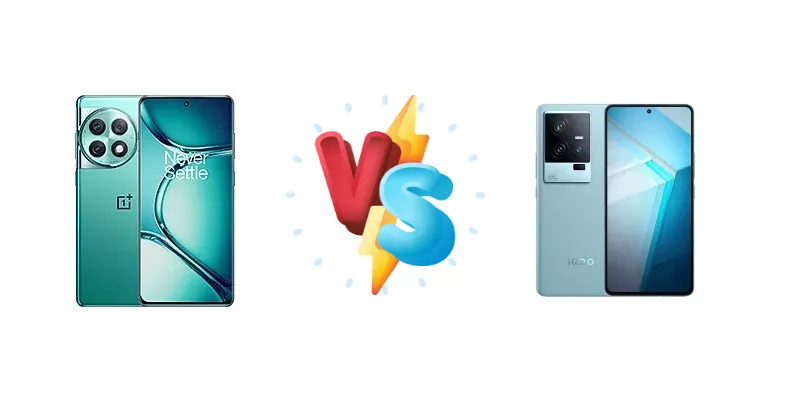
|
🏆 Quick Verdict
For most users, the vivo iQOO 11S emerges as the winner. Its 200W charging, supported by PD3.0 and UFCS, dramatically reduces downtime, a key advantage for demanding users. While both phones share the same core chipset, the iQOO’s charging speed and potential software optimizations give it a slight edge.
| PHONES | ||
|---|---|---|
| Phone Names | OnePlus Ace 2 Pro | vivo iQOO 11S |
| Network | ||
|---|---|---|
| 2G bands | GSM 850 / 900 / 1800 / 1900 | GSM 850 / 900 / 1800 / 1900 |
| 3G bands | HSDPA 850 / 900 / 1700(AWS) / 2100 | HSDPA 800 / 850 / 900 / 1700(AWS) / 1900 / 2100 |
| 4G bands | 1, 3, 4, 5, 7, 8, 18, 19, 26, 28, 34, 38, 39, 40, 41 | 1, 2, 3, 4, 5, 7, 8, 12, 17, 18, 19, 20, 26, 28, 34, 38, 39, 40, 41 |
| 5G bands | 1, 3, 5, 8, 28, 41, 77, 78 SA/NSA | 1, 3, 5, 8, 28, 40, 41, 77, 78 SA/NSA |
| Speed | HSPA, LTE, 5G | HSPA, LTE, 5G |
| Technology | GSM / CDMA / HSPA / LTE / 5G | GSM / CDMA / HSPA / CDMA2000 / LTE / 5G |
| Launch | ||
|---|---|---|
| Announced | 2023, August 16 | 2023, July 04 |
| Status | Available. Released 2023, August 23 | Available. Released 2023, July 10 |
| Body | ||
|---|---|---|
| Build | Glass front (Asahi Glass), plastic frame, glass back (Gorilla Glass 5) | - |
| Dimensions | 163.1 x 74.2 x 9 mm (6.42 x 2.92 x 0.35 in) | 164.9 x 77.1 x 8.4 mm or 8.7 mm |
| SIM | Nano-SIM + Nano-SIM | Nano-SIM + Nano-SIM |
| Weight | 210 g (7.41 oz) | 207 g or 210 g (7.30 oz) |
| Display | ||
|---|---|---|
| Protection | Asahi Glass | Corning Gorilla Glass Victus |
| Resolution | 1240 x 2772 pixels, 20:9 ratio (~451 ppi density) | 1440 x 3200 pixels, 20:9 ratio (~518 ppi density) |
| Size | 6.74 inches, 109.2 cm2 (~90.3% screen-to-body ratio) | 6.78 inches, 111.0 cm2 (~87.3% screen-to-body ratio) |
| Type | AMOLED, 1B colors, 120Hz, HDR10+, 550 nits (typ), 1200 nits (HBM), 1600 nits (peak) | LTPO4 AMOLED, 1B colors, 144Hz, HDR10+, 1800 nits (peak) |
| Platform | ||
|---|---|---|
| CPU | Octa-core (1x3.2 GHz Cortex-X3 & 2x2.8 GHz Cortex-A715 & 2x2.8 GHz Cortex-A710 & 3x2.0 GHz Cortex-A510) | Octa-core (1x3.2 GHz Cortex-X3 & 2x2.8 GHz Cortex-A715 & 2x2.8 GHz Cortex-A710 & 3x2.0 GHz Cortex-A510) |
| Chipset | Qualcomm SM8550-AB Snapdragon 8 Gen 2 (4 nm) | Qualcomm SM8550-AB Snapdragon 8 Gen 2 (4 nm) |
| GPU | Adreno 740 | Adreno 740 |
| OS | Android 13, ColorOS 13.1 | Android 13, OriginOS 3 (China) |
| Memory | ||
|---|---|---|
| Card slot | No | No |
| Internal | 256GB 12GB RAM, 512GB 16GB RAM, 1TB 24GB RAM | 256GB 12GB RAM, 256GB 16GB RAM, 512GB 16GB RAM, 1TB 16GB RAM |
| Main Camera | ||
|---|---|---|
| Features | Color spectrum sensor, LED flash, HDR, panorama | Dual-LED flash, HDR, panorama |
| Triple | 50 MP, f/1.8, 24mm (wide), 1/1.56", 1.0µm, PDAF, OIS 8 MP, f/2.2, 16mm, 112˚ (ultrawide), 1/4.0", 1.12µm 2 MP (macro) | 50 MP, f/1.9, 23mm (wide), 1/1.49", 1.0µm, PDAF, OIS 13 MP, f/2.5, 47mm (telephoto), PDAF, 2x optical zoom 8 MP, f/2.2, 16mm (ultrawide) |
| Video | 4K@30/60fps, 1080p@30/60/120/240fps, gyro-EIS, OIS | 8K@30fps, 4K@30/60fps, 1080p@30/60/120/240fps, gyro-EIS |
| Selfie camera | ||
|---|---|---|
| Features | HDR | HDR |
| Single | 16 MP, f/2.4, 26mm (wide), 1/3.09", 1.0µm | 16 MP, f/2.5, (wide) |
| Video | 1080p@30fps | 1080p@30fps, gyro-EIS |
| Sound | ||
|---|---|---|
| 35mm jack | No | No |
| Loudspeaker | Yes, with stereo speakers | Yes, with stereo speakers |
| Comms | ||
|---|---|---|
| Bluetooth | 5.3, A2DP, LE, aptX HD | 5.3, A2DP, LE, aptX HD, aptX Adaptive, aptX Lossless |
| Infrared port | Yes | Yes |
| NFC | Yes | Yes |
| Positioning | GPS (L1+L5), GLONASS (G1), BDS (B1I+B1c+B2a), GALILEO (E1+E5a), QZSS (L1+L5) | GPS, GLONASS, GALILEO, BDS, NavIC |
| Radio | No | No |
| USB | USB Type-C 2.0 | USB Type-C 2.0, OTG |
| WLAN | Wi-Fi 802.11 a/b/g/n/ac/6/7, dual-band | Wi-Fi 802.11 a/b/g/n/ac/6, dual-band, Wi-Fi Direct |
| Features | ||
|---|---|---|
| Sensors | Fingerprint (under display, optical), accelerometer, gyro, proximity, compass | Fingerprint (under display, optical), accelerometer, gyro, proximity, compass |
| Battery | ||
|---|---|---|
| Charging | 150W wired | 200W wired, PD3.0, UFCS |
| Type | Li-Po 5000 mAh | 4700 mAh |
| Misc | ||
|---|---|---|
| Colors | Aurora Green, Titanium Gray | Black, Sky Blue, Legendary White (BMW M branding) |
| Models | PJA110 | V2304A |
| Price | About 380 EUR | About 500 EUR |
OnePlus Ace 2 Pro
- Refined OxygenOS software experience
- Balanced performance and features
- Potentially more subtle design
- Slower 150W charging compared to iQOO 11S
- May lack the aggressive thermal management of iQOO
vivo iQOO 11S
- Industry-leading 200W charging speed
- Potential for optimized gaming performance
- PD3.0 and UFCS charging compatibility
- Funtouch OS may not appeal to all users
- Aggressive styling might be polarizing
Display Comparison
While both devices likely feature high-refresh-rate AMOLED displays, specific details like peak brightness and PWM dimming rates are missing. However, given iQOO’s focus on gaming, it’s reasonable to expect a display optimized for color accuracy and responsiveness. The absence of LTPO information suggests both may not dynamically adjust refresh rates to the fullest extent, potentially impacting battery life during static content viewing. Bezels are likely comparable, given both brands’ focus on maximizing screen real estate.
Camera Comparison
Without detailed camera specifications, a direct comparison is difficult. However, both brands typically employ high-resolution main sensors. The iQOO 11S, given its positioning, might prioritize computational photography and image stabilization for gaming-focused video recording. The absence of information regarding OIS suggests it may be present on one or both devices, but its effectiveness remains unknown. The inclusion of a 2MP macro camera on either device is likely a marketing feature with limited practical utility.
Performance
Both the OnePlus Ace 2 Pro and the vivo iQOO 11S utilize the Qualcomm SM8550-AB Snapdragon 8 Gen 2 (4nm). This means identical CPU core configurations – 1x3.2 GHz Cortex-X3, 2x2.8 GHz Cortex-A715, 2x2.8 GHz Cortex-A710, and 3x2.0 GHz Cortex-A510. Performance will be largely dictated by thermal management and software optimization. iQOO often prioritizes sustained performance through aggressive cooling solutions, potentially allowing the Snapdragon 8 Gen 2 to maintain peak clock speeds for longer durations during intensive tasks. The LPDDR5x RAM speed is also likely similar, contributing to fast app loading and multitasking.
Battery Life
The core difference lies in charging. The iQOO 11S boasts 200W wired charging with PD3.0 and UFCS support, promising significantly faster charging times than the Ace 2 Pro’s 150W. While battery capacity isn’t specified, the iQOO’s charging speed effectively mitigates concerns about a potentially smaller battery. The 200W charging will likely deliver a 0-100% charge in under 30 minutes, while the Ace 2 Pro will take longer. The inclusion of PD3.0 and UFCS on the iQOO 11S also provides broader compatibility with various chargers and accessories.
Buying Guide
Buy the OnePlus Ace 2 Pro if you prioritize a refined software experience with OxygenOS and a slightly more understated design. It’s ideal for users who want flagship performance without the aggressive styling or hyper-fast charging of the iQOO. Buy the vivo iQOO 11S if you absolutely need the fastest possible charging speeds and are comfortable with vivo’s Funtouch OS. This phone is geared towards gamers and power users who demand minimal downtime and maximum performance.