
OnePlus Ace 2 Pro vs Oppo Find X6 Pro: A Deep Dive into Performance and Value
| Phones Images | |||||
|---|---|---|---|---|---|
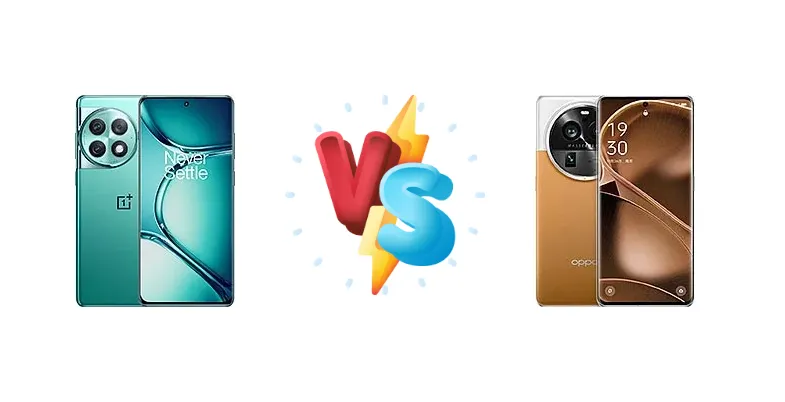
|
🏆 Quick Verdict
For users prioritizing ultimate charging speed and raw power, the OnePlus Ace 2 Pro is the clear winner. Its 150W wired charging dramatically reduces downtime. However, the Oppo Find X6 Pro counters with a more refined wireless charging experience and potentially superior camera capabilities, making it ideal for photography enthusiasts.
| PHONES | ||
|---|---|---|
| Phone Names | OnePlus Ace 2 Pro | Oppo Find X6 Pro |
| Network | ||
|---|---|---|
| 2G bands | GSM 850 / 900 / 1800 / 1900 | GSM 850 / 900 / 1800 / 1900 |
| 3G bands | HSDPA 850 / 900 / 1700(AWS) / 2100 | HSDPA 800 / 850 / 900 / 1700(AWS) / 1900 / 2100 |
| 4G bands | 1, 3, 4, 5, 7, 8, 18, 19, 26, 28, 34, 38, 39, 40, 41 | 1, 2, 3, 4, 5, 7, 8, 12, 17, 18, 19, 20, 26, 28, 34, 38, 39, 40, 41, 66 |
| 5G bands | 1, 3, 5, 8, 28, 41, 77, 78 SA/NSA | 1, 3, 5, 7, 8, 20, 28, 38, 40, 41, 66, 77, 78, 79 SA/NSA |
| Speed | HSPA, LTE, 5G | HSPA, LTE, 5G |
| Technology | GSM / CDMA / HSPA / LTE / 5G | GSM / CDMA / HSPA / CDMA2000 / LTE / 5G |
| - | CDMA2000 1x | |
| Launch | ||
|---|---|---|
| Announced | 2023, August 16 | 2023, March 21 |
| Status | Available. Released 2023, August 23 | Available. Released 2023, March 24 |
| Body | ||
|---|---|---|
| Build | Glass front (Asahi Glass), plastic frame, glass back (Gorilla Glass 5) | Glass front (Gorilla Glass Victus 2), glass back (Gorilla Glass 5) or eco leather back, aluminum frame |
| Dimensions | 163.1 x 74.2 x 9 mm (6.42 x 2.92 x 0.35 in) | 164.8 x 76.2 x 9.1 mm or 9.5 mm |
| SIM | Nano-SIM + Nano-SIM | Nano-SIM + Nano-SIM |
| Weight | 210 g (7.41 oz) | 216 g or 218 g (7.62 oz) |
| - | IP68 dust/water resistant (up to 1.5m for 30 min) | |
| Display | ||
|---|---|---|
| Protection | Asahi Glass | Corning Gorilla Glass Victus 2 |
| Resolution | 1240 x 2772 pixels, 20:9 ratio (~451 ppi density) | 1440 x 3168 pixels (~510 ppi density) |
| Size | 6.74 inches, 109.2 cm2 (~90.3% screen-to-body ratio) | 6.82 inches, 113.0 cm2 (~90.0% screen-to-body ratio) |
| Type | AMOLED, 1B colors, 120Hz, HDR10+, 550 nits (typ), 1200 nits (HBM), 1600 nits (peak) | LTPO3 AMOLED, 1B colors, 120Hz, Dolby Vision, HDR10+, 800 nits (typ), 1500 nits (HBM), 2500 nits (peak) |
| Platform | ||
|---|---|---|
| CPU | Octa-core (1x3.2 GHz Cortex-X3 & 2x2.8 GHz Cortex-A715 & 2x2.8 GHz Cortex-A710 & 3x2.0 GHz Cortex-A510) | Octa-core (1x3.2 GHz Cortex-X3 & 2x2.8 GHz Cortex-A715 & 2x2.8 GHz Cortex-A710 & 3x2.0 GHz Cortex-A510) |
| Chipset | Qualcomm SM8550-AB Snapdragon 8 Gen 2 (4 nm) | Qualcomm SM8550-AB Snapdragon 8 Gen 2 (4 nm) |
| GPU | Adreno 740 | Adreno 740 |
| OS | Android 13, ColorOS 13.1 | Android 13, up to 4 major Android upgrades, ColorOS 14 |
| Memory | ||
|---|---|---|
| Card slot | No | No |
| Internal | 256GB 12GB RAM, 512GB 16GB RAM, 1TB 24GB RAM | 256GB 12GB RAM, 256GB 16GB RAM, 512GB 16GB RAM |
| - | UFS 4.0 | |
| Main Camera | ||
|---|---|---|
| Features | Color spectrum sensor, LED flash, HDR, panorama | Laser AF, color spectrum sensor, Hasselblad Color Calibration, LED flash, HDR, panorama |
| Triple | 50 MP, f/1.8, 24mm (wide), 1/1.56", 1.0µm, PDAF, OIS 8 MP, f/2.2, 16mm, 112˚ (ultrawide), 1/4.0", 1.12µm 2 MP (macro) | 50 MP, f/1.8, 23mm (wide), 1.0"-type, 1.6µm, dual pixel PDAF, OIS 50 MP, f/2.6, 65mm (periscope telephoto), 1/1.56", 1.0µm, 2.8x optical zoom, multi-directional PDAF, OIS 50 MP, f/2.2, 15mm, 110˚ (ultrawide), 1/1.56", 1.0µm, multi-directional PDAF |
| Video | 4K@30/60fps, 1080p@30/60/120/240fps, gyro-EIS, OIS | 4K@30/60fps, 1080p@30/60/240fps; gyro-EIS; HDR, 10‑bit video, Dolby Vision |
| Selfie camera | ||
|---|---|---|
| Features | HDR | Panorama |
| Single | 16 MP, f/2.4, 26mm (wide), 1/3.09", 1.0µm | 32 MP, f/2.4, 21mm (wide), 1/2.74", 0.8µm, PDAF |
| Video | 1080p@30fps | 4K@30fps, gyro-EIS |
| Sound | ||
|---|---|---|
| 3.5mm jack | - | No |
| 35mm jack | No | No |
| Loudspeaker | Yes, with stereo speakers | Yes, with stereo speakers |
| Comms | ||
|---|---|---|
| Bluetooth | 5.3, A2DP, LE, aptX HD | 5.3, A2DP, LE, aptX HD |
| Infrared port | Yes | Yes |
| NFC | Yes | Yes |
| Positioning | GPS (L1+L5), GLONASS (G1), BDS (B1I+B1c+B2a), GALILEO (E1+E5a), QZSS (L1+L5) | GPS (L1+L5), GLONASS (G1), BDS (B1I+B1c+B2a), GALILEO (E1+E5a), QZSS (L1+L5) |
| Radio | No | No |
| USB | USB Type-C 2.0 | USB Type-C 3.1, OTG |
| WLAN | Wi-Fi 802.11 a/b/g/n/ac/6/7, dual-band | Wi-Fi 802.11 a/b/g/n/ac/6e/7, tri-band, Wi-Fi Direct |
| Features | ||
|---|---|---|
| Sensors | Fingerprint (under display, optical), accelerometer, gyro, proximity, compass | Fingerprint (under display, optical), accelerometer, gyro, proximity, compass |
| Battery | ||
|---|---|---|
| Charging | 150W wired | 100W wired, PD, 45% in 10 min, 100% in 30 min 50W wireless, 50% in 22 min, 100% in 51 min 10W reverse wireless |
| Type | Li-Po 5000 mAh | Li-Po 5000 mAh |
| Misc | ||
|---|---|---|
| Colors | Aurora Green, Titanium Gray | Black, Green, Brown |
| Models | PJA110 | PGEM110, PGEM10 |
| Price | About 380 EUR | About 820 EUR |
| Tests | ||
|---|---|---|
| Battery life | - | Endurance rating 114h |
| Camera | - | Photo / Video |
| Display | - | Contrast ratio: Infinite (nominal) |
| Loudspeaker | - | -25.1 LUFS (Very good) |
| Performance | - | AnTuTu: 1294797 (v9) GeekBench: 4791 (v5.1), 5226 (v6) GFXBench: 60fps (ES 3.1 onscreen) |
OnePlus Ace 2 Pro
- Blazing-fast 150W wired charging
- Potentially superior sustained performance
- Aggressive performance tuning for gaming
- Limited display specifications
- Camera details are currently unknown
Oppo Find X6 Pro
- Brighter display with excellent contrast
- Longer battery endurance (114h)
- Versatile charging options (wired, wireless, reverse)
- Slower wired charging compared to Ace 2 Pro
- Potentially less aggressive performance tuning
Display Comparison
The Oppo Find X6 Pro boasts a significantly brighter display, reaching a measured 1318 nits, compared to an unspecified peak brightness for the Ace 2 Pro. While both likely utilize high-refresh-rate LTPO panels for adaptive refresh rates and power efficiency, the X6 Pro’s higher peak brightness translates to better visibility in direct sunlight. The X6 Pro’s 'Infinite' contrast ratio suggests a superior panel with deeper blacks, enhancing media consumption. The Ace 2 Pro’s display specs are currently limited, making a definitive comparison difficult, but the X6 Pro holds a clear advantage based on available data.
Camera Comparison
Both phones feature capable camera systems, but detailed specifications are limited for the Ace 2 Pro. The Oppo Find X6 Pro is expected to excel in photography and videography, leveraging its advanced image processing algorithms and potentially larger sensor sizes (details not provided). The lack of specific sensor information for the Ace 2 Pro makes a direct comparison challenging. The X6 Pro’s focus on 'Photo / Video' suggests a more comprehensive camera experience, while the Ace 2 Pro may prioritize speed and convenience. Ignoring the likely inclusion of low-resolution macro lenses on both devices, the main and ultrawide sensors will be the key differentiators.
Performance
Both devices are equipped with the Qualcomm SM8550-AB Snapdragon 8 Gen 2 (4 nm) chipset, featuring the same Octa-core CPU configuration. This means core performance will be virtually identical for most tasks. However, the Ace 2 Pro, historically, tends to prioritize sustained performance over thermal throttling, potentially offering slightly longer peak performance during extended gaming sessions. The 4nm process node ensures excellent thermal efficiency in both devices, but OnePlus’s cooling solutions often lean towards aggressive fan curves. RAM configurations are not specified, but both are expected to utilize LPDDR5x for fast memory access.
Battery Life
The Oppo Find X6 Pro boasts an endurance rating of 114 hours, indicating excellent battery life. While the Ace 2 Pro’s battery capacity is unknown, its 150W wired charging is a game-changer, offering a full charge in a fraction of the time compared to the X6 Pro’s 100W charging (30 minutes vs. an unspecified time). The X6 Pro also offers 50W wireless charging (100% in 51 minutes) and 10W reverse wireless charging, providing greater versatility. The Ace 2 Pro’s charging speed is its defining advantage, minimizing downtime for power users.
Buying Guide
Buy the OnePlus Ace 2 Pro if you need the absolute fastest charging available, frequently game on your phone, and value a more aggressive performance profile. Buy the Oppo Find X6 Pro if you prefer a more balanced experience with excellent battery endurance, a potentially superior camera system, and the convenience of fast wireless charging.