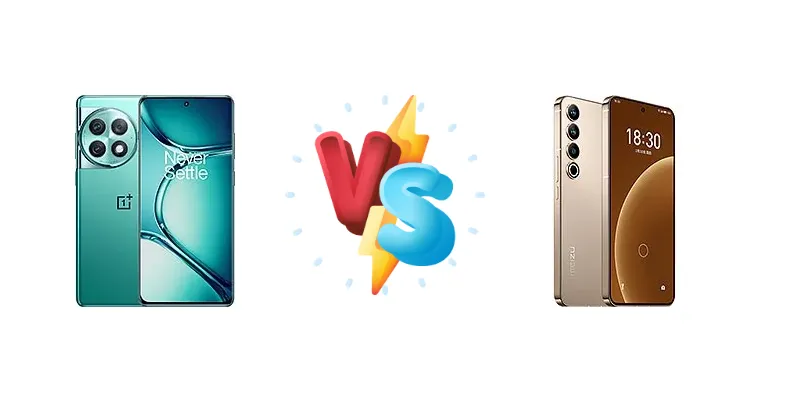
Both the OnePlus Ace 2 Pro and the Meizu 20 Pro represent compelling options in the flagship Android space, both powered by the Qualcomm Snapdragon 8 Gen 2. However, they diverge significantly in their approach to power delivery and overall user experience, making a direct comparison crucial for discerning buyers. This analysis will dissect their key differences, focusing on charging, performance, and potential use cases.
🏆 Quick Verdict
For the average user prioritizing raw charging speed and a more established software ecosystem, the OnePlus Ace 2 Pro emerges as the winner. Its 150W wired charging is significantly faster than the Meizu 20 Pro’s 80W, and the wider availability of OnePlus software updates provides greater long-term support.
| Network |
|---|
| 2G bands | GSM 850 / 900 / 1800 / 1900 | GSM 850 / 900 / 1800 / 1900 |
| 3G bands | HSDPA 850 / 900 / 1700(AWS) / 2100 | HSDPA 850 / 900 / 1900 / 2100 |
| 4G bands | 1, 3, 4, 5, 7, 8, 18, 19, 26, 28, 34, 38, 39, 40, 41 | 1, 2, 3, 4, 5, 7, 8, 12, 28, 34, 38, 39, 40, 41 |
| 5G bands | 1, 3, 5, 8, 28, 41, 77, 78 SA/NSA | 1, 3, 5, 8, 28, 38, 41, 77, 78, 79 SA/NSA |
| Speed | HSPA, LTE, 5G | HSPA, LTE, 5G |
| Technology | GSM / CDMA / HSPA / LTE / 5G | GSM / HSPA / LTE / 5G |
| Launch |
|---|
| Announced | 2023, August 16 | 2023, March 30 |
| Status | Available. Released 2023, August 23 | Available. Released 2023, June 20 |
| Body |
|---|
| Build | Glass front (Asahi Glass), plastic frame, glass back (Gorilla Glass 5) | - |
| Dimensions | 163.1 x 74.2 x 9 mm (6.42 x 2.92 x 0.35 in) | 164.2 x 76.4 x 7.8 mm (6.46 x 3.01 x 0.31 in) |
| SIM | Nano-SIM + Nano-SIM | Nano-SIM + Nano-SIM |
| Weight | 210 g (7.41 oz) | 209 g (7.37 oz) |
| | - | IP54 |
| Display |
|---|
| Protection | Asahi Glass | - |
| Resolution | 1240 x 2772 pixels, 20:9 ratio (~451 ppi density) | 1440 x 3200 pixels, 20:9 ratio (~515 ppi density) |
| Size | 6.74 inches, 109.2 cm2 (~90.3% screen-to-body ratio) | 6.81 inches, 112.0 cm2 (~89.3% screen-to-body ratio) |
| Type | AMOLED, 1B colors, 120Hz, HDR10+, 550 nits (typ), 1200 nits (HBM), 1600 nits (peak) | LTPO OLED, 120Hz, HDR10+, 500 nits (typ), 1800 nits (peak) |
| Platform |
|---|
| CPU | Octa-core (1x3.2 GHz Cortex-X3 & 2x2.8 GHz Cortex-A715 & 2x2.8 GHz Cortex-A710 & 3x2.0 GHz Cortex-A510) | Octa-core (1x3.2 GHz Cortex-X3 & 2x2.8 GHz Cortex-A715 & 2x2.8 GHz Cortex-A710 & 3x2.0 GHz Cortex-A510) |
| Chipset | Qualcomm SM8550-AB Snapdragon 8 Gen 2 (4 nm) | Qualcomm SM8550-AB Snapdragon 8 Gen 2 (4 nm) |
| GPU | Adreno 740 | Adreno 740 |
| OS | Android 13, ColorOS 13.1 | Android 13, Flyme 10 |
| Memory |
|---|
| Card slot | No | No |
| Internal | 256GB 12GB RAM, 512GB 16GB RAM, 1TB 24GB RAM | 128GB 12GB RAM, 256GB 12GB RAM, 512GB 12GB RAM |
| | - | UFS 4.0 - 512GB |
| Main Camera |
|---|
| Features | Color spectrum sensor, LED flash, HDR, panorama | Ring-LED flash, panorama, HDR |
| Triple | 50 MP, f/1.8, 24mm (wide), 1/1.56", 1.0µm, PDAF, OIS
8 MP, f/2.2, 16mm, 112˚ (ultrawide), 1/4.0", 1.12µm
2 MP (macro) | 50 MP, f/1.9, (wide), PDAF, OIS
50 MP f/1.9, (telephoto), PDAF, 2x optical zoom
50 MP, f/2.2, 129˚ (ultrawide) |
| Video | 4K@30/60fps, 1080p@30/60/120/240fps, gyro-EIS, OIS | 8K, 4K, 1080p; gyro-EIS |
| Selfie camera |
|---|
| Features | HDR | HDR |
| Single | 16 MP, f/2.4, 26mm (wide), 1/3.09", 1.0µm | 32 MP, f/2.5, (wide) |
| Video | 1080p@30fps | Yes |
| Sound |
|---|
| 3.5mm jack | - | No |
| 35mm jack | No | No |
| Loudspeaker | Yes, with stereo speakers | Yes, with stereo speakers |
| Comms |
|---|
| Bluetooth | 5.3, A2DP, LE, aptX HD | 5.3, A2DP, LE |
| Infrared port | Yes | Yes |
| NFC | Yes | Yes |
| Positioning | GPS (L1+L5), GLONASS (G1), BDS (B1I+B1c+B2a), GALILEO (E1+E5a), QZSS (L1+L5) | GPS (L1+L5), GLONASS, BDS (B1I+B1c+B2a), GALILEO, QZSS |
| Radio | No | No |
| USB | USB Type-C 2.0 | USB Type-C |
| WLAN | Wi-Fi 802.11 a/b/g/n/ac/6/7, dual-band | Wi-Fi 802.11 а/b/g/n/ac/6e/7, tri-band |
| Features |
|---|
| Sensors | Fingerprint (under display, optical), accelerometer, gyro, proximity, compass | Fingerprint (under display, ultrasonic), accelerometer, gyro, proximity, compass |
| Battery |
|---|
| Charging | 150W wired | 80W wired, PD3 PPS, QC4+
50W wireless |
| Type | Li-Po 5000 mAh | Li-Po 5000 mAh |
| Misc |
|---|
| Colors | Aurora Green, Titanium Gray | Gray, Gold, Silver |
| Models | PJA110 | - |
| Price | About 380 EUR | About 530 EUR |
OnePlus Ace 2 Pro
- Industry-leading 150W wired charging
- Potentially superior thermal management for sustained performance
- Well-established and frequently updated software ecosystem
- Lacks wireless charging capability
- Design may be less refined than the Meizu 20 Pro
Meizu 20 Pro
- 50W wireless charging for added convenience
- Sleek and minimalist design aesthetic
- Support for PD3 PPS and QC4+ charging standards
- Significantly slower 80W wired charging
- Software updates may be less frequent and slower to arrive
Display Comparison
While both devices likely feature high-quality AMOLED panels, specific details like peak brightness and refresh rate are missing. However, the core Snapdragon 8 Gen 2 chipset supports displays up to 144Hz, suggesting both phones can deliver smooth visuals. The absence of LTPO information means we can't assess dynamic refresh rate efficiency. Bezels are likely comparable given the flagship positioning, and color accuracy will depend on software calibration, a known strength for OnePlus.
Camera Comparison
Without detailed camera specifications, a direct comparison is limited. However, the market positioning suggests both phones will feature capable camera systems. The absence of sensor size information is critical; larger sensors generally capture more light and produce better images, especially in low-light conditions. The Meizu 20 Pro’s emphasis on design may prioritize a slimmer camera bump, potentially impacting sensor size. Image processing style will also be a key differentiator – OnePlus tends towards vibrant, social media-friendly images, while Meizu may favor a more natural look.
Performance
Both the OnePlus Ace 2 Pro and the Meizu 20 Pro utilize the Qualcomm SM8550-AB Snapdragon 8 Gen 2 (4 nm) chipset, featuring the same Octa-core CPU configuration (1x3.2 GHz Cortex-X3, 2x2.8 GHz Cortex-A715, 2x2.8 GHz Cortex-A710, 3x2.0 GHz Cortex-A510). This means CPU performance will be virtually identical. The key differentiator will be thermal management. OnePlus has a strong track record of effective cooling solutions, potentially allowing the Ace 2 Pro to sustain peak performance for longer durations during demanding tasks like gaming. RAM configuration (LPDDR5x) is also likely similar, further minimizing performance gaps.
Battery Life
The Meizu 20 Pro’s inclusion of 80W wired charging, PD3 PPS, and QC4+ alongside 50W wireless charging is a significant advantage in terms of versatility. The OnePlus Ace 2 Pro counters with a blistering 150W wired charging speed. While battery capacity isn’t specified, the faster wired charging of the Ace 2 Pro will likely result in significantly quicker 0-100% charge times. The 50W wireless charging on the Meizu 20 Pro offers a convenient alternative, but will be slower than the Ace 2 Pro’s wired charging. The efficiency of the 4nm Snapdragon 8 Gen 2 will play a role in overall battery life, but the charging speed difference is the defining factor here.
Buying Guide
Buy the OnePlus Ace 2 Pro if you need the absolute fastest wired charging available, prioritize gaming performance with minimal throttling, and value a well-established Android experience with frequent updates. Buy the Meizu 20 Pro if you prefer a more refined, minimalist design, appreciate the convenience of 50W wireless charging, and are comfortable with a less mainstream software experience that emphasizes customization.
Frequently Asked Questions
❓ How much faster is the 150W charging on the OnePlus Ace 2 Pro compared to the 80W on the Meizu 20 Pro?
Based on typical charging curves, the OnePlus Ace 2 Pro’s 150W charging can potentially charge a comparable battery from 0-100% in around 20-25 minutes, while the Meizu 20 Pro’s 80W charging would likely take 40-50 minutes. This is a substantial difference for users who frequently need to top up their battery quickly.
❓ Does the Meizu 20 Pro’s wireless charging support fast wireless charging standards?
Yes, the Meizu 20 Pro supports 50W wireless charging and is compatible with the Qi standard. This allows for convenient wireless charging with compatible chargers, though it will still be slower than the Ace 2 Pro’s wired charging.
❓ Will the Snapdragon 8 Gen 2 in both phones overheat during extended gaming sessions?
The Snapdragon 8 Gen 2 is a thermally efficient chip, but sustained high performance can still generate heat. OnePlus typically implements robust cooling solutions, potentially giving the Ace 2 Pro an edge in maintaining peak performance for longer gaming sessions compared to the Meizu 20 Pro, where thermal design priorities are unknown.