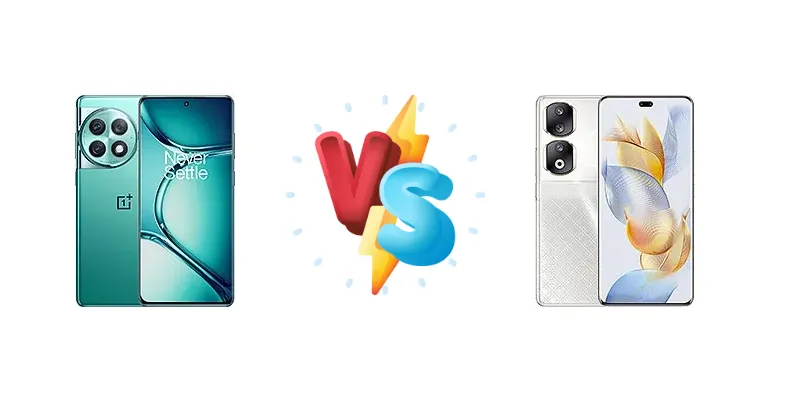
The OnePlus Ace 2 Pro and Honor 90 Pro represent compelling options in the increasingly competitive flagship smartphone market. While both aim for a premium experience, they diverge significantly in their core hardware, particularly in their chipset and charging capabilities. This comparison dissects these differences to determine which device delivers the best value and performance for various user needs.
🏆 Quick Verdict
For users prioritizing raw performance and future-proofing, the OnePlus Ace 2 Pro emerges as the winner. Its Snapdragon 8 Gen 2 chipset offers a substantial performance leap over the Honor 90 Pro’s Snapdragon 8+ Gen 1, coupled with significantly faster 150W charging. However, the Honor 90 Pro remains a strong contender for those seeking a balanced experience with a focus on efficient power management.
| Network |
|---|
| 2G bands | GSM 850 / 900 / 1800 / 1900 | GSM 850 / 900 / 1800 / 1900 |
| 3G bands | HSDPA 850 / 900 / 1700(AWS) / 2100 | HSDPA 800 / 850 / 900 / 1700(AWS) / 1900 / 2100 |
| 4G bands | 1, 3, 4, 5, 7, 8, 18, 19, 26, 28, 34, 38, 39, 40, 41 | 1, 2, 3, 4, 5, 8, 19, 28, 34, 38, 39, 40, 41 |
| 5G bands | 1, 3, 5, 8, 28, 41, 77, 78 SA/NSA | 1, 5, 8, 28, 41, 77, 78 SA/NSA |
| Speed | HSPA, LTE, 5G | HSPA, LTE, 5G |
| Technology | GSM / CDMA / HSPA / LTE / 5G | GSM / CDMA / HSPA / CDMA2000 / LTE / 5G |
| Launch |
|---|
| Announced | 2023, August 16 | 2023, May 29 |
| Status | Available. Released 2023, August 23 | Available. Released 2023, June 07 |
| Body |
|---|
| Build | Glass front (Asahi Glass), plastic frame, glass back (Gorilla Glass 5) | - |
| Dimensions | 163.1 x 74.2 x 9 mm (6.42 x 2.92 x 0.35 in) | 163.8 x 74.9 x 8.1 mm (6.45 x 2.95 x 0.32 in) |
| SIM | Nano-SIM + Nano-SIM | Nano-SIM + Nano-SIM |
| Weight | 210 g (7.41 oz) | 192 g (6.77 oz) |
| Display |
|---|
| Protection | Asahi Glass | - |
| Resolution | 1240 x 2772 pixels, 20:9 ratio (~451 ppi density) | 1224 x 2700 pixels (~437 ppi density) |
| Size | 6.74 inches, 109.2 cm2 (~90.3% screen-to-body ratio) | 6.78 inches, 111.5 cm2 (~90.9% screen-to-body ratio) |
| Type | AMOLED, 1B colors, 120Hz, HDR10+, 550 nits (typ), 1200 nits (HBM), 1600 nits (peak) | AMOLED, 1B colors, 120Hz, HDR, 1600 nits (peak) |
| Platform |
|---|
| CPU | Octa-core (1x3.2 GHz Cortex-X3 & 2x2.8 GHz Cortex-A715 & 2x2.8 GHz Cortex-A710 & 3x2.0 GHz Cortex-A510) | Octa-core (1x3.0 GHz Cortex-X2 & 3x2.5 GHz Cortex-A710 & 4x1.80 GHz Cortex-A510) |
| Chipset | Qualcomm SM8550-AB Snapdragon 8 Gen 2 (4 nm) | Qualcomm SM8475 Snapdragon 8+ Gen 1 (4 nm) |
| GPU | Adreno 740 | Adreno 730 |
| OS | Android 13, ColorOS 13.1 | Android 13, MagicOS 7.1 |
| Memory |
|---|
| Card slot | No | No |
| Internal | 256GB 12GB RAM, 512GB 16GB RAM, 1TB 24GB RAM | 256GB 12GB RAM, 256GB 16GB RAM, 512GB 16GB RAM |
| Main Camera |
|---|
| Features | Color spectrum sensor, LED flash, HDR, panorama | LED flash, HDR, panorama |
| Triple | 50 MP, f/1.8, 24mm (wide), 1/1.56", 1.0µm, PDAF, OIS
8 MP, f/2.2, 16mm, 112˚ (ultrawide), 1/4.0", 1.12µm
2 MP (macro) | 200 MP, f/1.9, (wide), 1/1.4", 0.56µm, PDAF
32 MP, f/2.4, (telephoto), PDAF, OIS, 2.5x optical zoom
12 MP, f/2.2, 112˚ (ultrawide), AF |
| Video | 4K@30/60fps, 1080p@30/60/120/240fps, gyro-EIS, OIS | 4K@30fps, 1080p@30/60fps, gyro-EIS |
| Selfie camera |
|---|
| Dual | - | 50 MP, f/2.4, 100˚, (ultrawide)
2 MP, f/2.4, (depth) |
| Features | HDR | HDR |
| Single | 16 MP, f/2.4, 26mm (wide), 1/3.09", 1.0µm | - |
| Video | 1080p@30fps | 4K@30fps, 1080p@30fps, gyro-EIS |
| Sound |
|---|
| 35mm jack | No | No |
| Loudspeaker | Yes, with stereo speakers | Yes, with stereo speakers |
| Comms |
|---|
| Bluetooth | 5.3, A2DP, LE, aptX HD | 5.2, A2DP, LE, aptX HD |
| Infrared port | Yes | - |
| NFC | Yes | Yes |
| Positioning | GPS (L1+L5), GLONASS (G1), BDS (B1I+B1c+B2a), GALILEO (E1+E5a), QZSS (L1+L5) | GPS, GALILEO, GLONASS, BDS, QZSS |
| Radio | No | No |
| USB | USB Type-C 2.0 | USB Type-C 2.0, OTG |
| WLAN | Wi-Fi 802.11 a/b/g/n/ac/6/7, dual-band | Wi-Fi 802.11 a/b/g/n/ac/6, dual-band, Wi-Fi Direct |
| Features |
|---|
| Sensors | Fingerprint (under display, optical), accelerometer, gyro, proximity, compass | Fingerprint (under display, optical), accelerometer, gyro, compass, ultrasound proximity |
| Battery |
|---|
| Charging | 150W wired | 90W wired, 3-56% in 15 min
5W reverse wired |
| Type | Li-Po 5000 mAh | Li-Po 5000 mAh |
| Misc |
|---|
| Colors | Aurora Green, Titanium Gray | Midnight Black, Emerald Green, Diamond Silver, Peacock Blue |
| Models | PJA110 | REP-AN00 |
| Price | About 380 EUR | About 440 EUR |
OnePlus Ace 2 Pro
- Significantly faster 150W charging
- More powerful Snapdragon 8 Gen 2 chipset
- Superior GPU performance for gaming
- More efficient CPU architecture
- Potentially higher price
- May run hotter under sustained load (though mitigated by improved thermal design)
Honor 90 Pro
- Competitive price point
- Efficient Snapdragon 8+ Gen 1 chipset
- Balanced performance for everyday tasks
- 5W reverse wired charging
- Slower charging speed (90W)
- Less powerful chipset compared to the Ace 2 Pro
Display Comparison
While both devices likely feature high-quality AMOLED panels (data not provided), the core difference lies in the underlying processing power driving them. The chipset impacts the responsiveness and smoothness of animations. We can assume both will have high refresh rates, but the Ace 2 Pro’s superior GPU will translate to higher, more stable frame rates in graphically intensive games. The Honor 90 Pro’s display will likely be optimized for color accuracy and viewing angles, but will be limited by the GPU.
Camera Comparison
Without specific camera sensor details, it’s difficult to make a definitive judgment. However, the chipset plays a crucial role in image processing. The Snapdragon 8 Gen 2’s ISP (Image Signal Processor) is more advanced, enabling faster processing, better noise reduction, and improved dynamic range. While the Honor 90 Pro’s ISP is capable, it won’t match the Ace 2 Pro’s capabilities. The Ace 2 Pro will likely excel in low-light photography and video recording due to its superior processing power. We can assume both phones will have capable main sensors, but the Ace 2 Pro’s processing will give it an edge.
Performance
The OnePlus Ace 2 Pro’s Snapdragon 8 Gen 2 (4nm) is a generational leap over the Honor 90 Pro’s Snapdragon 8+ Gen 1 (4nm). The 8 Gen 2 utilizes the newer Cortex-X3 prime core clocked at 3.2 GHz, compared to the 8+ Gen 1’s Cortex-X2 at 3.0 GHz. This, combined with architectural improvements, results in a significant performance advantage in CPU-bound tasks. The GPU difference is also substantial, offering better graphics performance and efficiency. The Ace 2 Pro’s LPDDR5x RAM further enhances performance, providing faster data access compared to the likely LPDDR5 in the Honor 90 Pro. This translates to snappier app loading and multitasking. The 4nm process node on both chips contributes to thermal efficiency, but the 8 Gen 2’s architectural improvements should result in less throttling under sustained load.
Battery Life
The Honor 90 Pro boasts 90W wired charging, capable of charging from 3-56% in 15 minutes. However, the OnePlus Ace 2 Pro’s 150W charging is significantly faster, promising a full charge in a fraction of the time. While battery capacity isn’t specified, the faster charging of the Ace 2 Pro mitigates any potential disadvantage from a slightly smaller battery. The Snapdragon 8 Gen 2’s improved efficiency also contributes to better battery life, potentially offsetting any capacity differences. The Honor 90 Pro’s 5W reverse wired charging is a niche feature, useful for topping up accessories, but doesn’t significantly impact the overall battery experience.
Buying Guide
Buy the OnePlus Ace 2 Pro if you demand the absolute best performance for demanding tasks like gaming and video editing, and if minimizing charging times is a priority. Its Snapdragon 8 Gen 2 provides a clear advantage in sustained performance. Buy the Honor 90 Pro if you value a refined user experience, efficient power consumption, and a potentially more competitive price point. It’s an excellent choice for everyday use and media consumption, offering a strong balance of features.
Frequently Asked Questions
❓ Will the Snapdragon 8+ Gen 1 in the Honor 90 Pro struggle with demanding games like Genshin Impact?
While the Snapdragon 8+ Gen 1 is a capable chip, it will likely require lower graphics settings and may experience more frame drops in demanding titles like Genshin Impact compared to the OnePlus Ace 2 Pro’s Snapdragon 8 Gen 2. The 8 Gen 2’s superior GPU and thermal management provide a smoother gaming experience.
❓ How much faster is the 150W charging on the OnePlus Ace 2 Pro compared to the 90W charging on the Honor 90 Pro in real-world use?
The 150W charging on the Ace 2 Pro can potentially charge a phone from 0-100% in around 25-30 minutes, while the Honor 90 Pro’s 90W charging takes closer to 45-60 minutes. This difference is particularly noticeable when you need a quick top-up before leaving the house.
❓ Does the Honor 90 Pro’s chipset overheat during prolonged gaming sessions?
The Snapdragon 8+ Gen 1 is generally well-managed in terms of thermals, but prolonged gaming at high settings can lead to some throttling. The Honor 90 Pro likely incorporates cooling solutions to mitigate this, but it won’t match the sustained performance of the Ace 2 Pro’s more efficient chipset.