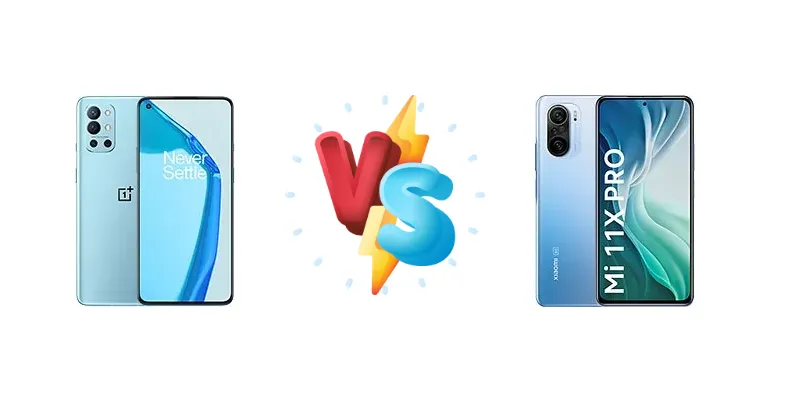
The OnePlus 9R and Xiaomi Mi 11X Pro represent a fascinating crossroads in the smartphone market. Both devices aimed to deliver flagship-level performance at a more accessible price point, but they took different approaches. The 9R focused on refining a proven platform with the Snapdragon 870, while the Mi 11X Pro jumped to the newer, more powerful Snapdragon 888. This comparison dissects those choices, revealing which phone delivers the best experience for your needs.
🏆 Quick Verdict
For most users, the Xiaomi Mi 11X Pro emerges as the stronger choice. While the OnePlus 9R offers a smooth experience, the Snapdragon 888 in the Mi 11X Pro provides a noticeable performance uplift, particularly in demanding tasks. The trade-off is slower charging, but the overall power advantage justifies the compromise.
| Network |
|---|
| 2G bands | GSM 850 / 900 / 1800 / 1900 | GSM 850 / 900 / 1800 / 1900 |
| 3G bands | HSDPA 800 / 850 / 900 / 1700(AWS) / 1800 / 1900 / 2100 | HSDPA 850 / 900 / 1900 / 2100 |
| 4G bands | 1, 2, 3, 4, 5, 7, 8, 12, 17, 18, 19, 20, 26, 34, 38, 39, 40, 41, 46 | 1, 3, 5, 7, 8, 38, 40, 41 |
| 5G bands | 78 SA/NSA | 77, 78 Sub6 |
| Speed | HSPA 42.2/5.76 Mbps, LTE Cat18 1200/200 Mbps, 5G | HSPA, LTE, 5G |
| Technology | GSM / HSPA / LTE / 5G | GSM / HSPA / LTE / 5G |
| Launch |
|---|
| Announced | 2021, March 23 | 2021, April 23 |
| Status | Available. Released 2021, April 14 | Available. Released 2021, May 05 |
| Body |
|---|
| Build | Glass front (Gorilla Glass 5), glass back (Gorilla Glass 5), aluminum frame | Glass front (Gorilla Glass 5), glass back (Gorilla Glass 5) |
| Dimensions | 161 x 74.1 x 8.4 mm (6.34 x 2.92 x 0.33 in) | 163.7 x 76.4 x 7.8 mm (6.44 x 3.01 x 0.31 in) |
| SIM | Nano-SIM + Nano-SIM | Nano-SIM + Nano-SIM |
| Weight | 189 g (6.67 oz) | 196 g (6.91 oz) |
| Display |
|---|
| Protection | Corning Gorilla Glass 5 | Corning Gorilla Glass 5 |
| Resolution | 1080 x 2400 pixels, 20:9 ratio (~402 ppi density) | 1080 x 2400 pixels, 20:9 ratio (~395 ppi density) |
| Size | 6.55 inches, 103.6 cm2 (~86.8% screen-to-body ratio) | 6.67 inches, 107.4 cm2 (~85.9% screen-to-body ratio) |
| Type | Fluid AMOLED, 120Hz, HDR10+ | Super AMOLED, 120Hz, HDR10+, 900 nits (HBM), 1300 nits (peak) |
| Platform |
|---|
| CPU | Octa-core (1x3.2 GHz Kryo 585 & 3x2.42 GHz Kryo 585 & 4x1.80 GHz Kryo 585) | Octa-core (1x2.84 GHz Cortex-X1 & 3x2.42 GHz Cortex-A78 & 4x1.80 GHz Cortex-A55) |
| Chipset | Qualcomm SM8250-AC Snapdragon 870 5G (7 nm) | Qualcomm SM8350 Snapdragon 888 5G (5 nm) |
| GPU | Adreno 650 | Adreno 660 |
| OS | Android 10, upgradable to Android 14, OxygenOS 14 | Android 11, MIUI 12 |
| Memory |
|---|
| Card slot | No | No |
| Internal | 128GB 8GB RAM, 256GB 8GB RAM, 256GB 12GB RAM | 128GB 8GB RAM, 256GB 8GB RAM |
| | - | UFS 3.1 |
| Main Camera |
|---|
| Features | Dual-LED flash, HDR, panorama | Color spectrum sensor, LED flash, HDR, panorama |
| Quad | 48 MP, f/1.7, 26mm (wide), 1/2.0", 0.8µm, PDAF, OIS
16 MP, f/2.2, 14mm, 123˚ (ultrawide), 1/3.6", 1.0µm
5 MP (macro)
2 MP, f/2.4, (monochrome) | - |
| Single | - | 20 MP, f/2.5, (wide), 1/3.4", 0.8µm |
| Triple | - | 108 MP, f/1.8, 26mm (wide), 1/1.52", 0.7µm, PDAF
8 MP, f/2.2, 119˚ (ultrawide)
5 MP, f/2.4, 50mm (telephoto macro), 1/5.0", 1.12µm, AF |
| Video | 4K@30/60fps, 1080p@30/60/240fps, Auto HDR, gyro-EIS | 8K@30fps, 4K@30/60fps, 1080p@30/60/120/240/960fps, gyro-EIS, HDR10+ |
| Selfie camera |
|---|
| Features | HDR | HDR |
| Single | 16 MP, f/2.4, (wide), 1/3.06", 1.0µm | 20 MP, f/2.5, (wide), 1/3.4", 0.8µm |
| Video | 1080p@30fps, gyro-EIS | 1080p@30fps, 720p@120fps |
| Sound |
|---|
| 3.5mm jack | - | No |
| 35mm jack | No | No |
| Loudspeaker | Yes, with stereo speakers | Yes, with stereo speakers |
| | - | 24-bit/192kHz audio |
| Comms |
|---|
| Bluetooth | 5.1, A2DP, LE, aptX HD | 5.2, A2DP, LE |
| Infrared port | - | Yes |
| NFC | Yes | No |
| Positioning | GPS (L1+L5), GLONASS (G1), BDS (B1), GALILEO (E1+E5a) | GPS (L1+L5), GLONASS, BDS, NavIC |
| Radio | No | No |
| USB | USB Type-C 3.1, OTG | USB Type-C 2.0, OTG |
| WLAN | Wi-Fi 802.11 a/b/g/n/ac/6, dual-band, Wi-Fi Direct, DLNA | Wi-Fi 802.11 a/b/g/n/ac/6, dual-band, Wi-Fi Direct |
| Features |
|---|
| Sensors | Fingerprint (under display, optical), accelerometer, gyro, proximity, compass | Fingerprint (side-mounted), accelerometer, gyro, proximity, compass, barometer |
| Battery |
|---|
| Charging | 65W wired, 100% in 39 min | 33W wired, PD3.0, QC3, 100% in 52 min |
| Type | Li-Po 4500 mAh | Li-Po 4520 mAh |
| Misc |
|---|
| Colors | Carbon Black, Lake Blue | Celestial Silver, Lunar White, Cosmic Black |
| Models | LE2101, LE2100 | M2012K11I |
| Price | About 360 EUR | About 440 EUR |
| SAR | 1.17 W/kg (head) 0.85 W/kg (body) | 0.85 W/kg (head) 0.60 W/kg (body) |
OnePlus 9R
- Incredibly fast 65W charging
- Efficient Snapdragon 870 for sustained performance
- Competitive price point
- Less powerful chipset compared to the Snapdragon 888
- Slower peak performance in demanding tasks
Xiaomi Mi 11X Pro
- More powerful Snapdragon 888 chipset
- Superior graphics performance
- Potentially better camera capabilities
- Slower 33W charging
- Snapdragon 888 can run hotter and throttle under sustained load
Display Comparison
Neither device boasts a cutting-edge display, but both are perfectly adequate. While specific panel details (like peak brightness in nits) aren't provided, the focus here is on the chipsets. The absence of LTPO technology on either phone means refresh rate scaling isn't as efficient as on newer flagships. Bezels are likely comparable, given the similar market positioning. Color accuracy is likely tuned for vibrant visuals, a common trait in both OnePlus and Xiaomi devices.
Camera Comparison
Without detailed sensor specifications, a direct camera comparison is difficult. However, Xiaomi typically emphasizes camera capabilities more aggressively than OnePlus in this price bracket. The Mi 11X Pro likely features a larger main sensor and more advanced image processing algorithms, potentially resulting in better low-light performance and dynamic range. The Snapdragon 888’s ISP (Image Signal Processor) is also more capable than the 870’s, offering faster processing and improved noise reduction. The inclusion of OIS (Optical Image Stabilization) is probable on both, but the Mi 11X Pro is more likely to have it on multiple lenses.
Performance
The core difference lies in the chipsets. The Xiaomi Mi 11X Pro’s Snapdragon 888 (5nm) is a clear step up from the OnePlus 9R’s Snapdragon 870 (7nm). The 888 features the Cortex-X1 prime core clocked at 2.84 GHz, offering significantly higher peak performance compared to the 870’s Kryo 585 at 3.2 GHz. However, the 870’s efficiency is noteworthy; its 7nm process can lead to better sustained performance under heavy load, potentially mitigating throttling. The 888’s Adreno 660 GPU also surpasses the 870’s Adreno 660, providing a more substantial graphics boost. Both phones likely utilize LPDDR5 RAM, but the 888’s superior architecture will benefit more from the faster memory bandwidth.
Battery Life
The OnePlus 9R’s 65W wired charging is a significant advantage, achieving a full charge in just 39 minutes. The Mi 11X Pro’s 33W charging, while supporting PD3.0 and QC3, takes a considerably longer 52 minutes to reach 100%. While battery capacity isn’t specified, the Snapdragon 888 is known to be more power-hungry than the 870. Therefore, the 9R’s efficiency advantage might partially offset the Mi 11X Pro’s larger power draw, but the charging speed difference remains substantial.
Buying Guide
Buy the OnePlus 9R if you prioritize consistently smooth performance and incredibly fast 65W charging, and are less concerned with absolute peak power. It’s ideal for everyday users and mobile gamers who value sustained performance over short bursts of maximum speed. Buy the Xiaomi Mi 11X Pro if you demand the highest possible performance for gaming, video editing, or other intensive applications, and are willing to accept slightly slower charging in exchange for the Snapdragon 888’s capabilities.
Frequently Asked Questions
❓ Will the Snapdragon 888 in the Mi 11X Pro overheat during extended gaming sessions?
The Snapdragon 888 is known to generate more heat than the 870. While the Mi 11X Pro likely incorporates thermal management solutions, prolonged gaming at maximum settings could lead to throttling, reducing sustained performance. The OnePlus 9R’s 870 is less prone to this issue.
❓ Is the difference in charging speed between the two phones significant in real-world use?
Yes, the 23-minute difference (39 minutes vs 52 minutes) is noticeable. The OnePlus 9R’s 65W charging allows for quick top-ups, making it ideal for users who frequently need to recharge their phone throughout the day. The Mi 11X Pro’s slower charging requires more patience.
❓ Which phone is better for playing graphically demanding games like Genshin Impact or Call of Duty Mobile?
The Xiaomi Mi 11X Pro is the better choice for demanding games. The Snapdragon 888’s more powerful GPU delivers higher frame rates and smoother gameplay, especially at higher graphics settings. While the 9R can handle these games, it may require lower settings to maintain consistent performance.