
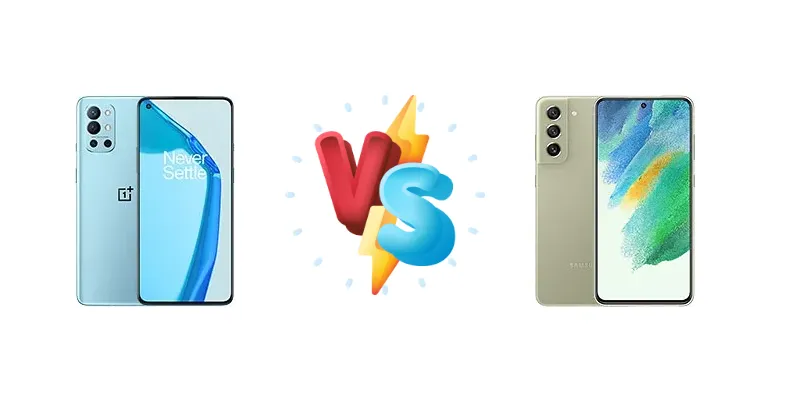
OnePlus 9R vs Samsung Galaxy S21 FE 5G: Which Flagship Killer Delivers More?
| Phones Images | |||||
|---|---|---|---|---|---|
|
🏆 Quick Verdict
For most users, the Samsung Galaxy S21 FE 5G emerges as the better overall choice. While the OnePlus 9R boasts incredibly fast 65W charging, the S21 FE’s superior display brightness, more versatile camera system, and wider availability of software updates outweigh this advantage. However, the 9R remains a strong contender for users prioritizing sustained performance and rapid charging above all else.
| PHONES | ||
|---|---|---|
| Phone Names | OnePlus 9R | Samsung Galaxy S21 FE 5G |
| Network | ||
|---|---|---|
| 2G bands | GSM 850 / 900 / 1800 / 1900 | GSM 850 / 900 / 1800 / 1900 |
| 3G bands | HSDPA 800 / 850 / 900 / 1700(AWS) / 1800 / 1900 / 2100 | HSDPA 850 / 900 / 1700(AWS) / 1900 / 2100 |
| 4G bands | 1, 2, 3, 4, 5, 7, 8, 12, 17, 18, 19, 20, 26, 34, 38, 39, 40, 41, 46 | 1, 2, 3, 4, 5, 7, 8, 12, 17, 20, 26, 28, 32, 38, 40, 41, 66 - International |
| 5G bands | 78 SA/NSA | 1, 3, 5, 8, 20, 28, 38, 40, 41, 66, 78 SA/NSA/Sub6 - International |
| Speed | HSPA 42.2/5.76 Mbps, LTE Cat18 1200/200 Mbps, 5G | HSPA 42.2/5.76 Mbps, LTE (5CA) Cat19 1600/200 Mbps, 5G |
| Technology | GSM / HSPA / LTE / 5G | GSM / CDMA / HSPA / EVDO / LTE / 5G |
| - | 41, 66, 71, 260, 261 SA/NSA/Sub6/mmWave - USA | |
| Launch | ||
|---|---|---|
| Announced | 2021, March 23 | 2022, January 04 |
| Status | Available. Released 2021, April 14 | Available. Released 2022, January 07 |
| Body | ||
|---|---|---|
| Build | Glass front (Gorilla Glass 5), glass back (Gorilla Glass 5), aluminum frame | Glass front (Gorilla Glass Victus), plastic back, aluminum frame |
| Dimensions | 161 x 74.1 x 8.4 mm (6.34 x 2.92 x 0.33 in) | 155.7 x 74.5 x 7.9 mm (6.13 x 2.93 x 0.31 in) |
| SIM | Nano-SIM + Nano-SIM | · Nano-SIM· Nano-SIM + Nano-SIM |
| Weight | 189 g (6.67 oz) | 177 g (6.24 oz) |
| - | IP68 dust/water resistant (up to 1.5m for 30 min) | |
| Display | ||
|---|---|---|
| Protection | Corning Gorilla Glass 5 | Corning Gorilla Glass Victus |
| Resolution | 1080 x 2400 pixels, 20:9 ratio (~402 ppi density) | 1080 x 2340 pixels, 19.5:9 ratio (~403 ppi density) |
| Size | 6.55 inches, 103.6 cm2 (~86.8% screen-to-body ratio) | 6.4 inches, 100.5 cm2 (~86.7% screen-to-body ratio) |
| Type | Fluid AMOLED, 120Hz, HDR10+ | Dynamic AMOLED 2X, 120Hz, HDR10+ |
| - | Always-on display | |
| Platform | ||
|---|---|---|
| CPU | Octa-core (1x3.2 GHz Kryo 585 & 3x2.42 GHz Kryo 585 & 4x1.80 GHz Kryo 585) | Octa-core (1x2.84 GHz Cortex-X1 & 3x2.42 GHz Cortex-A78 & 4x1.80 GHz Cortex-A55) - Version 1Octa-core (1x2.9 GHz Cortex-X1 & 3x2.80 GHz Cortex-A78 & 4x2.2 GHz Cortex-A55) - Version 2 |
| Chipset | Qualcomm SM8250-AC Snapdragon 870 5G (7 nm) | Qualcomm SM8350 Snapdragon 888 5G (5 nm) - Version 1Exynos 2100 (5 nm) - Version 2 |
| GPU | Adreno 650 | Adreno 660 - Version 1Mali-G78 MP14 - Version 2 |
| OS | Android 10, upgradable to Android 14, OxygenOS 14 | Android 12, up to 4 major Android upgrades, One UI 8 |
| Memory | ||
|---|---|---|
| Card slot | No | No |
| Internal | 128GB 8GB RAM, 256GB 8GB RAM, 256GB 12GB RAM | 128GB 6GB RAM, 128GB 8GB RAM, 256GB 6GB RAM, 256GB 8GB RAM |
| Main Camera | ||
|---|---|---|
| Features | Dual-LED flash, HDR, panorama | LED flash, auto-HDR, panorama |
| Quad | 48 MP, f/1.7, 26mm (wide), 1/2.0", 0.8µm, PDAF, OIS 16 MP, f/2.2, 14mm, 123˚ (ultrawide), 1/3.6", 1.0µm 5 MP (macro) 2 MP, f/2.4, (monochrome) | - |
| Single | - | 32 MP, f/2.2, 26mm (wide), 1/2.74", 0.8µm |
| Triple | - | 12 MP, f/1.8, 26mm (wide), 1/1.76", 1.8µm, dual pixel PDAF, OIS 8 MP, f/2.4, 76mm (telephoto), 1/4.5", 1.0µm, PDAF, OIS, 3x optical zoom 12 MP, f/2.2, 13mm, 123˚ (ultrawide), 1/3.0", 1.12µm |
| Video | 4K@30/60fps, 1080p@30/60/240fps, Auto HDR, gyro-EIS | 4K@30/60fps, 1080p@30/60/120/240fps, HDR10+, gyro-EIS |
| Selfie camera | ||
|---|---|---|
| Features | HDR | HDR |
| Single | 16 MP, f/2.4, (wide), 1/3.06", 1.0µm | 32 MP, f/2.2, 26mm (wide), 1/2.74", 0.8µm |
| Video | 1080p@30fps, gyro-EIS | 4K@30/60fps, 1080p@30/60fps, gyro-EIS |
| Sound | ||
|---|---|---|
| 3.5mm jack | - | No |
| 35mm jack | No | No |
| Loudspeaker | Yes, with stereo speakers | Yes, with stereo speakers |
| - | 32-bit/384kHz audio | |
| Comms | ||
|---|---|---|
| Bluetooth | 5.1, A2DP, LE, aptX HD | 5.0, A2DP, LE |
| NFC | Yes | Yes |
| Positioning | GPS (L1+L5), GLONASS (G1), BDS (B1), GALILEO (E1+E5a) | GPS, GLONASS, BDS, GALILEO |
| Radio | No | Unspecified |
| USB | USB Type-C 3.1, OTG | USB Type-C, OTG |
| WLAN | Wi-Fi 802.11 a/b/g/n/ac/6, dual-band, Wi-Fi Direct, DLNA | Wi-Fi 802.11 a/b/g/n/ac/6, dual-band, Wi-Fi Direct |
| Features | ||
|---|---|---|
| Sensors | Fingerprint (under display, optical), accelerometer, gyro, proximity, compass | Fingerprint (under display, optical), accelerometer, gyro, proximity, compass |
| - | Bixby natural language commands and dictation Samsung Pay (Visa, MasterCard certified) Samsung DeX (desktop experience support) | |
| Battery | ||
|---|---|---|
| Charging | 65W wired, 100% in 39 min | 25W wired, PD3.0, 50% in 30 min 15W wireless Reverse wireless |
| Type | Li-Po 4500 mAh | Li-Ion 4500 mAh |
| Misc | ||
|---|---|---|
| Colors | Carbon Black, Lake Blue | White, Graphite, Lavender, Olive |
| Models | LE2101, LE2100 | SM-G990B, SM-G990B/DS, SM-G990U, SM-G990U1, SM-G990W, SM-G990E, SM-G9900, SM-G990B2, SM-G990U2, SM-G990W2, SM-G990U3 |
| Price | About 360 EUR | € 199.00 / $ 143.95 / £ 154.99 / ₹ 29,990 |
| SAR | 1.17 W/kg (head) 0.85 W/kg (body) | 0.77 W/kg (head) 0.90 W/kg (body) |
| SAR EU | - | 0.95 W/kg (head) 1.48 W/kg (body) |
| Tests | ||
|---|---|---|
| Battery life | - | Endurance rating 92h |
| Camera | - | Photo / Video |
| Display | - | Contrast ratio: Infinite (nominal) |
| Loudspeaker | - | -26.9 LUFS (Good) |
| Performance | - | AnTuTu: 566529 (v8), 719696 (v9) GeekBench: 3049 (v5.1) GFXBench: 56fps (ES 3.1 onscreen) |
OnePlus 9R
- Incredibly fast 65W charging
- Excellent sustained performance due to Snapdragon 870’s thermal efficiency
- Potentially more affordable price point
- Less refined camera system
- Potentially less frequent software updates
- Display likely inferior to S21 FE
Samsung Galaxy S21 FE 5G
- Brighter and more vibrant display
- More versatile camera system with advanced features
- Samsung’s reliable software support
- Slower charging speeds (25W)
- Potential for thermal throttling (especially Exynos variant)
- Higher price point
Display Comparison
The Samsung Galaxy S21 FE 5G significantly outshines the OnePlus 9R in display quality. With a measured peak brightness of 792 nits, the S21 FE offers superior visibility in direct sunlight. While both displays feature an 'infinite' contrast ratio (typical for OLED panels), the S21 FE’s higher peak brightness and potentially better color calibration (data not provided) contribute to a more immersive viewing experience. The 9R’s display specs are not provided, making a direct comparison difficult, but it’s reasonable to assume it falls short of the S21 FE’s capabilities in this area.
Camera Comparison
Samsung’s Galaxy S21 FE 5G offers a more comprehensive camera system. While both phones are listed as having 'Photo / Video' capabilities, the S21 FE benefits from Samsung’s established image processing algorithms and likely a more sophisticated sensor array. The S21 FE’s camera system likely includes features like advanced night mode, portrait mode, and video stabilization, which are not explicitly mentioned for the 9R. The 9R’s camera specs are not detailed enough to assess its capabilities, but it’s unlikely to match the S21 FE’s versatility. The presence of a 2MP macro camera on the S21 FE is largely inconsequential, but the overall system is more robust.
Performance
The performance battle is nuanced. The Samsung Galaxy S21 FE 5G, equipped with either the Snapdragon 888 (5nm) or Exynos 2100 (5nm), theoretically holds an advantage due to its newer, smaller node process. The Snapdragon 888’s Cortex-X1 prime core (2.84/2.9 GHz depending on version) offers higher peak performance than the OnePlus 9R’s Kryo 585 (3.2 GHz). However, the Snapdragon 870 in the 9R is known for its excellent thermal efficiency. The 870’s architecture allows it to maintain higher sustained clock speeds for longer periods, potentially leading to more consistent performance in demanding tasks like prolonged gaming. The S21 FE, particularly the Exynos variant, has been reported to experience thermal throttling under heavy load. The 9R’s LPDDR4X RAM is a potential bottleneck compared to the S21 FE’s likely LPDDR5 RAM, impacting multitasking speeds.
Battery Life
Both devices achieve an endurance rating of 92 hours, suggesting comparable battery life in typical usage scenarios. However, the charging experience differs dramatically. The OnePlus 9R’s 65W wired charging is significantly faster, achieving a 100% charge in just 39 minutes. The S21 FE’s 25W wired charging takes approximately 30 minutes to reach 50%, implying a full charge will take considerably longer. The S21 FE also offers 15W wireless charging and reverse wireless charging, features absent on the 9R. While the S21 FE’s battery capacity isn’t specified, the faster charging of the 9R is a significant advantage for users who frequently need to top up their battery quickly.
Buying Guide
Buy the OnePlus 9R if you prioritize sustained gaming performance and incredibly fast charging speeds, and are comfortable with potentially less frequent software updates. It’s ideal for power users who demand responsiveness and don’t mind a slightly less polished camera experience. Buy the Samsung Galaxy S21 FE 5G if you value a brighter, more vibrant display, a more versatile camera system with better image processing, and the peace of mind of Samsung’s software support. It’s the better choice for everyday users, content creators, and those who appreciate a more refined user experience.