
OnePlus 9R vs OnePlus 8T: A Detailed Comparison of Performance and Value
| Phones Images | |||||
|---|---|---|---|---|---|
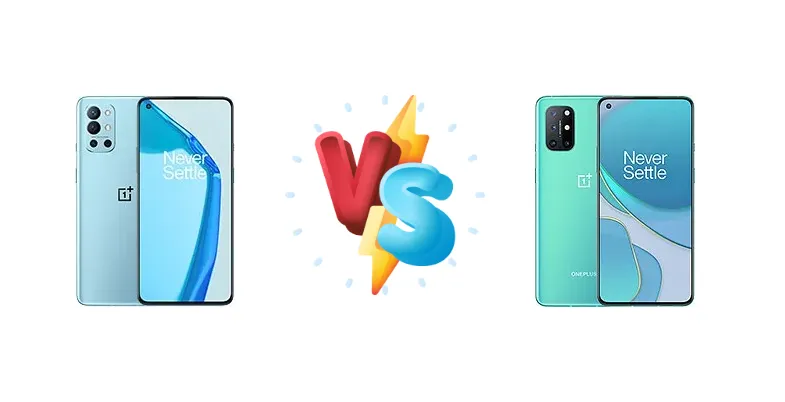
|
🏆 Quick Verdict
For most users prioritizing raw performance and future-proofing, the OnePlus 9R is the better buy. Its Snapdragon 870 chipset delivers a noticeable uplift in CPU and GPU performance compared to the 8T’s Snapdragon 865, all while maintaining the same 65W charging speed. However, the 8T remains a solid choice if found at a significantly lower price.
| PHONES | ||
|---|---|---|
| Phone Names | OnePlus 9R | OnePlus 8T |
| Network | ||
|---|---|---|
| 2G bands | GSM 850 / 900 / 1800 / 1900 | GSM 850 / 900 / 1800 / 1900 |
| 3G bands | HSDPA 800 / 850 / 900 / 1700(AWS) / 1800 / 1900 / 2100 | HSDPA 800 / 850 / 900 / 1700(AWS) / 1800 / 1900 / 2100 |
| 4G bands | 1, 2, 3, 4, 5, 7, 8, 12, 17, 18, 19, 20, 26, 34, 38, 39, 40, 41, 46 | 1, 2, 3, 4, 5, 7, 8, 12, 13, 17, 18, 19, 20, 25, 26, 28, 32, 34, 38, 39, 40, 41, 42, 66 - EU |
| 5G bands | 78 SA/NSA | 1, 3, 7, 28, 41, 78 SA/NSA - EU |
| Speed | HSPA 42.2/5.76 Mbps, LTE Cat18 1200/200 Mbps, 5G | HSPA 42.2/5.76 Mbps, LTE (5CA) Cat18 1200/200 Mbps, 5G 7.5 Gbps DL |
| Technology | GSM / HSPA / LTE / 5G | GSM / CDMA / HSPA / LTE / 5G |
| - | 41, 78, 79 SA/NSA - CN | |
| Launch | ||
|---|---|---|
| Announced | 2021, March 23 | 2020, October 14 |
| Status | Available. Released 2021, April 14 | Available. Released 2020, October 16 |
| Body | ||
|---|---|---|
| Build | Glass front (Gorilla Glass 5), glass back (Gorilla Glass 5), aluminum frame | Glass front (Gorilla Glass 5), glass back (Gorilla Glass 5), aluminum frame |
| Dimensions | 161 x 74.1 x 8.4 mm (6.34 x 2.92 x 0.33 in) | 160.7 x 74.1 x 8.4 mm (6.33 x 2.92 x 0.33 in) |
| SIM | Nano-SIM + Nano-SIM | Nano-SIM + Nano-SIM |
| Weight | 189 g (6.67 oz) | 188 g (6.63 oz) |
| Display | ||
|---|---|---|
| Protection | Corning Gorilla Glass 5 | Corning Gorilla Glass 5 |
| Resolution | 1080 x 2400 pixels, 20:9 ratio (~402 ppi density) | 1080 x 2400 pixels, 20:9 ratio (~402 ppi density) |
| Size | 6.55 inches, 103.6 cm2 (~86.8% screen-to-body ratio) | 6.55 inches, 103.6 cm2 (~87.0% screen-to-body ratio) |
| Type | Fluid AMOLED, 120Hz, HDR10+ | Fluid AMOLED, 120Hz, HDR10+ |
| - | Always-on display | |
| Platform | ||
|---|---|---|
| CPU | Octa-core (1x3.2 GHz Kryo 585 & 3x2.42 GHz Kryo 585 & 4x1.80 GHz Kryo 585) | Octa-core (1x2.84 GHz Cortex-A77 & 3x2.42 GHz Cortex-A77 & 4x1.80 GHz Cortex-A55) |
| Chipset | Qualcomm SM8250-AC Snapdragon 870 5G (7 nm) | Qualcomm SM8250 Snapdragon 865 5G (7 nm+) |
| GPU | Adreno 650 | Adreno 650 |
| OS | Android 10, upgradable to Android 14, OxygenOS 14 | Android 11, upgradable to Android 14, OxygenOS 14 |
| Memory | ||
|---|---|---|
| Card slot | No | No |
| Internal | 128GB 8GB RAM, 256GB 8GB RAM, 256GB 12GB RAM | 128GB 8GB RAM, 256GB 12GB RAM |
| - | UFS 3.1 | |
| Main Camera | ||
|---|---|---|
| Features | Dual-LED flash, HDR, panorama | Dual-LED flash, HDR, panorama |
| Quad | 48 MP, f/1.7, 26mm (wide), 1/2.0", 0.8µm, PDAF, OIS 16 MP, f/2.2, 14mm, 123˚ (ultrawide), 1/3.6", 1.0µm 5 MP (macro) 2 MP, f/2.4, (monochrome) | 48 MP, f/1.7, 26mm (wide), 1/2.0", 0.8µm, PDAF, OIS 16 MP, f/2.2, 14mm, 123˚ (ultrawide), 1/3.6", 1.0µm 5 MP (macro) 2 MP, f/2.4, (monochrome) |
| Video | 4K@30/60fps, 1080p@30/60/240fps, Auto HDR, gyro-EIS | 4K@30/60fps, 1080p@30/60/240fps, Auto HDR, gyro-EIS |
| Selfie camera | ||
|---|---|---|
| Features | HDR | HDR |
| Single | 16 MP, f/2.4, (wide), 1/3.06", 1.0µm | 16 MP, f/2.4, (wide), 1/3.06", 1.0µm |
| Video | 1080p@30fps, gyro-EIS | 1080p@30fps, gyro-EIS |
| Sound | ||
|---|---|---|
| 3.5mm jack | - | No |
| 35mm jack | No | No |
| Loudspeaker | Yes, with stereo speakers | Yes, with stereo speakers |
| Comms | ||
|---|---|---|
| Bluetooth | 5.1, A2DP, LE, aptX HD | 5.1, A2DP, LE, aptX HD |
| NFC | Yes | Yes |
| Positioning | GPS (L1+L5), GLONASS (G1), BDS (B1), GALILEO (E1+E5a) | GPS (L1+L5), GLONASS (G1), BDS (B1), GALILEO (E1+E5a) |
| Radio | No | No |
| USB | USB Type-C 3.1, OTG | USB Type-C 3.1, OTG |
| WLAN | Wi-Fi 802.11 a/b/g/n/ac/6, dual-band, Wi-Fi Direct, DLNA | Wi-Fi 802.11 a/b/g/n/ac/6, dual-band, Wi-Fi Direct, DLNA |
| Features | ||
|---|---|---|
| Sensors | Fingerprint (under display, optical), accelerometer, gyro, proximity, compass | Fingerprint (under display, optical), accelerometer, gyro, proximity, compass, barometer (market dependant) |
| Battery | ||
|---|---|---|
| Charging | 65W wired, 100% in 39 min | 65W wired, 100% in 39 min |
| Type | Li-Po 4500 mAh | Li-Po 4500 mAh |
| Misc | ||
|---|---|---|
| Colors | Carbon Black, Lake Blue | Aquamarine Green, Lunar Silver, Cyberpunk 2077 Edition |
| Models | LE2101, LE2100 | KB2001, KB2000, KB2003, KB2005 |
| Price | About 360 EUR | € 130.75 |
| SAR | 1.17 W/kg (head) 0.85 W/kg (body) | - |
| Tests | ||
|---|---|---|
| Battery life | - | Endurance rating 104h |
| Camera | - | Photo / Video |
| Display | - | Contrast ratio: Infinite (nominal) |
| Loudspeaker | - | -24.0 LUFS (Very good) |
| Performance | - | AnTuTu: 586000 (v8) GeekBench: 3126 (v5.1) GFXBench: 46fps (ES 3.1 onscreen) |
OnePlus 9R
- Faster Snapdragon 870 processor
- Potentially longer software support due to newer chipset
- 65W fast charging
- Battery capacity not specified
- Camera specs are unknown
OnePlus 8T
- Solid 104-hour endurance rating
- 802 nits peak brightness
- 65W fast charging
- Older Snapdragon 865 processor
- May receive fewer software updates
Display Comparison
Both the OnePlus 9R and 8T feature excellent displays, though detailed specifications are limited for the 9R. The 8T boasts a measured peak brightness of 802 nits, ensuring good visibility even outdoors. While the 9R’s display specs aren’t explicitly stated, OnePlus typically uses high-quality AMOLED panels. The 8T’s ‘Infinite’ contrast ratio (nominal) is standard for AMOLED technology, delivering deep blacks and vibrant colors. Without specific refresh rate or resolution data for the 9R, it’s difficult to definitively declare a display winner, but the 8T’s measured brightness provides a concrete advantage.
Camera Comparison
Both phones are listed as having 'Photo / Video' capabilities, lacking specific details. Without sensor size, aperture, or image processing details, a direct comparison is impossible. However, given the 9R’s positioning as a performance-focused device, it’s reasonable to assume OnePlus invested in a capable camera system. The 8T likely benefits from OnePlus’s established camera software algorithms. The absence of detailed camera specs makes it difficult to determine a clear winner; the real-world image quality would need to be assessed through independent testing.
Performance
The core difference lies in the chipsets. The OnePlus 9R utilizes the Qualcomm SM8250-AC Snapdragon 870 5G, built on a 7nm process. Its octa-core CPU configuration (1x3.2 GHz Kryo 585, 3x2.42 GHz Kryo 585, 4x1.80 GHz Kryo 585) provides a significant performance boost over the OnePlus 8T’s Snapdragon 865 (SM8250) with its (1x2.84 GHz Cortex-A77, 3x2.42 GHz Cortex-A77, 4x1.80 GHz Cortex-A55). The 870’s Kryo 585 cores represent an architectural improvement over the 865’s Cortex-A77, resulting in faster processing speeds and improved efficiency. This translates to smoother multitasking, quicker app loading times, and a more responsive gaming experience on the 9R. While both support 5G, the 870’s improved modem offers potentially faster and more reliable connectivity.
Battery Life
The OnePlus 8T has an endurance rating of 104 hours, indicating solid battery life. The 9R’s battery capacity is not specified, but both devices share the same 65W wired charging, achieving a full charge in 39 minutes. This fast charging mitigates any potential disadvantage the 9R might have with a smaller battery capacity. The 8T’s 104-hour endurance rating suggests a well-optimized power management system, but the 9R’s more efficient Snapdragon 870 could potentially close the gap in real-world usage, especially during demanding tasks.
Buying Guide
Buy the OnePlus 9R if you need a phone capable of handling demanding games and applications with ease, and appreciate a more modern chipset for longer software support. Buy the OnePlus 8T if you prioritize a potentially lower price and are content with excellent, but not leading-edge, performance for everyday tasks. The 8T is ideal for users who don't heavily game or run resource-intensive apps.