
OnePlus 9 vs Xiaomi Mi 11i: Which Snapdragon 888 Flagship Reigns Supreme?
| Phones Images | |||||
|---|---|---|---|---|---|
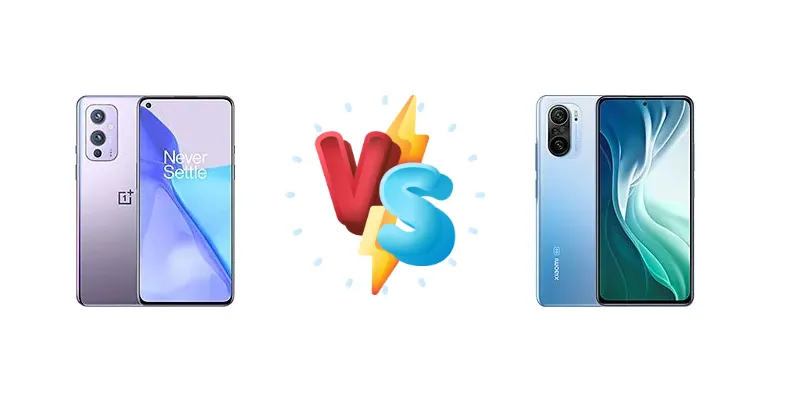
|
🏆 Quick Verdict
For most users, the Xiaomi Mi 11i emerges as the stronger choice. Its significantly longer battery life – boasting a 96-hour endurance rating versus the OnePlus 9’s 87 – and brighter display outweigh the OnePlus 9’s potentially more refined software experience. The Mi 11i offers a more practical daily experience.
| PHONES | ||
|---|---|---|
| Phone Names | OnePlus 9 | Xiaomi Mi 11i |
| Network | ||
|---|---|---|
| 2G bands | GSM 850 / 900 / 1800 / 1900 | GSM 850 / 900 / 1800 / 1900 |
| 3G bands | HSDPA 800 / 850 / 900 / 1700(AWS) / 1800 / 1900 / 2100 | HSDPA 850 / 900 / 1700(AWS) / 1900 / 2100 |
| 4G bands | 1, 2, 3, 4, 5, 7, 8, 12, 13, 17, 18, 19, 20, 25, 26, 28, 32, 38, 39, 40, 41, 66 - EU | 1, 2, 3, 4, 5, 7, 8, 12, 17, 20, 28, 38, 40, 41, 66 |
| 5G bands | 1, 3, 5, 7, 8, 20, 28, 38, 40, 41, 66, 78 SA/NSA - EU | 1, 3, 5, 7, 8, 20, 28, 38, 41, 77, 78 SA/NSA |
| Speed | HSPA 42.2/5.76 Mbps, LTE Cat20 2000/200 Mbps, 5G | HSPA, LTE, 5G |
| Technology | GSM / CDMA / HSPA / LTE / 5G | GSM / HSPA / LTE / 5G |
| 1, 3, 28, 41, 78, 79 SA/NSA - CN | - | |
| Launch | ||
|---|---|---|
| Announced | 2021, March 23 | 2021, March 29 |
| Status | Available. Released 2021, March 26 | Available. Released 2021, May 31 |
| Body | ||
|---|---|---|
| Build | Glass front (Gorilla Glass 5), glass back (Gorilla Glass 5), plastic frame | - |
| Dimensions | 160 x 74.2 x 8.7 mm (EU/NA)160 x 73.9 x 8.1 mm (IN/CN) | 163.7 x 76.4 x 7.8 mm (6.44 x 3.01 x 0.31 in) |
| SIM | · Nano-SIM· Nano-SIM + Nano-SIM | Nano-SIM + Nano-SIM |
| Weight | 192 g (EU/NA)183 g (IN/CN) (6.46 oz) | 196 g (6.91 oz) |
| IP68 (T-Mobile version only) | IP53, dust and splash resistant | |
| Display | ||
|---|---|---|
| Protection | Corning Gorilla Glass 5 | Corning Gorilla Glass 5 |
| Resolution | 1080 x 2400 pixels, 20:9 ratio (~402 ppi density) | 1080 x 2400 pixels, 20:9 ratio (~395 ppi density) |
| Size | 6.55 inches, 103.6 cm2 (~87.6% screen-to-body ratio) | 6.67 inches, 107.4 cm2 (~85.9% screen-to-body ratio) |
| Type | Fluid AMOLED, 120Hz, HDR10+, 1100 nits (peak) | Super AMOLED, 120Hz, HDR10+, 900 nits (HBM), 1300 nits (peak) |
| Always-on display | - | |
| Platform | ||
|---|---|---|
| CPU | Octa-core (1x2.84 GHz Cortex-X1 & 3x2.42 GHz Cortex-A78 & 4x1.80 GHz Cortex-A55) | Octa-core (1x2.84 GHz Cortex-X1 & 3x2.42 GHz Cortex-A78 & 4x1.80 GHz Cortex-A55) |
| Chipset | Qualcomm SM8350 Snapdragon 888 5G (5 nm) | Qualcomm SM8350 Snapdragon 888 5G (5 nm) |
| GPU | Adreno 660 | Adreno 660 |
| OS | Android 11, upgradable to Android 13, OxygenOS 13 | Android 11, MIUI 12 |
| Memory | ||
|---|---|---|
| Card slot | No | No |
| Internal | 128GB 8GB RAM, 256GB 12GB RAM | 128GB 8GB RAM, 256GB 8GB RAM |
| UFS 3.1 | UFS 3.1 | |
| Main Camera | ||
|---|---|---|
| Features | Hasselblad Color Calibration, color spectrum sensor, dual-LED flash, HDR, panorama | Color spectrum sensor, LED flash, HDR, panorama |
| Single | 16 MP, f/2.4, (wide), 1/3.06", 1.0µm | 20 MP, f/2.5, (wide), 1/3.4", 0.8µm |
| Triple | 48 MP, f/1.8, 23mm (wide), 1/1.43", 1.12µm, multi-directional PDAF 50 MP, f/2.2, 14mm (ultrawide), 1/1.56", 1.0µm, AF 2 MP, f/2.4, (monochrome) | 108 MP, f/1.8, 26mm (wide), 1/1.52", 0.7µm, PDAF 8 MP, f/2.2, 119˚ (ultrawide) 5 MP, f/2.4, 50mm (telephoto macro), 1/5.0", 1.12µm, AF |
| Video | 8K@30fps, 4K@30/60fps, 1080p@30/60/240fps, Auto HDR, gyro-EIS | 8K@30fps, 4K@30/60fps, 1080p@30/60/120/240/960fps, gyro-EIS, HDR10+ |
| Selfie camera | ||
|---|---|---|
| Features | HDR | HDR |
| Single | 16 MP, f/2.4, (wide), 1/3.06", 1.0µm | 20 MP, f/2.5, (wide), 1/3.4", 0.8µm |
| Video | 1080p@30fps, gyro-EIS | 1080p@30fps, 720p@120fps |
| Sound | ||
|---|---|---|
| 3.5mm jack | No | No |
| 35mm jack | No | No |
| Loudspeaker | Yes, with stereo speakers | Yes, with stereo speakers |
| 24-bit/192kHz audio | 24-bit/192kHz audio | |
| Comms | ||
|---|---|---|
| Bluetooth | 5.2, A2DP, LE, aptX HD | 5.2, A2DP, LE |
| Infrared port | - | Yes |
| NFC | Yes | Yes (market/region dependent) |
| Positioning | GPS (L1+L5), GLONASS (G1), BDS (B1), GALILEO (E1+E5a) | GPS (L1+L5), GLONASS (L1), BDS (B1I+B1c+B2a), GALILEO (E1+E5a), QZSS (L1+L5), NavIC (L5) |
| Radio | No | No |
| USB | USB Type-C 3.1, OTG | USB Type-C 2.0, OTG |
| WLAN | Wi-Fi 802.11 a/b/g/n/ac/6, dual-band, Wi-Fi Direct, DLNA | Wi-Fi 802.11 a/b/g/n/ac/6, dual-band, Wi-Fi Direct |
| Features | ||
|---|---|---|
| Sensors | Fingerprint (under display, optical), accelerometer, gyro, proximity, compass | Fingerprint (side-mounted), accelerometer, gyro, proximity, compass, barometer |
| Battery | ||
|---|---|---|
| Charging | 65W wired, PD, 100% in 29 min 15W wireless (EU/NA) | 33W wired, PD3.0, QC3, 100% in 52 min |
| Type | Li-Po 4500 mAh | Li-Po 4520 mAh |
| Misc | ||
|---|---|---|
| Colors | Winter Mist, Arctic Sky, Astral Black | Celestial Silver, Frosty White, Cosmic Black |
| Models | LE2113, LE2111, LE2110, LE2117, LE2115 | M2012K11G |
| Price | $ 145.00 / £ 200.00 / € 249.99 | About 230 EUR |
| SAR | - | 0.95 W/kg (head) 0.74 W/kg (body) |
| SAR EU | - | 0.57 W/kg (head) 0.77 W/kg (body) |
| Tests | ||
|---|---|---|
| Battery life | Endurance rating 87h | Endurance rating 96h |
| Camera | Photo / Video | Photo / Video |
| Display | - | Contrast ratio: Infinite (nominal) |
| Loudspeaker | -24.5 LUFS (Very good) | -26.0 LUFS (Very good) |
| Performance | - | AnTuTu: 690021 (v8) GeekBench: 3641 (v5.1) |
OnePlus 9
- Faster 65W wired charging
- Potentially smoother software experience (OnePlus OxygenOS)
- 15W wireless charging (EU/NA)
- Significantly shorter battery life (87h endurance)
- Lower peak display brightness (821 nits)
- May require more frequent charging
Xiaomi Mi 11i
- Longer battery life (96h endurance)
- Brighter display (939 nits)
- More efficient power management
- Slower 33W wired charging
- Software experience may not be as refined as OxygenOS
- No wireless charging
Display Comparison
The Xiaomi Mi 11i boasts a notably brighter display, reaching a measured 939 nits compared to the OnePlus 9’s 821 nits. This translates to superior visibility under direct sunlight. While both utilize AMOLED panels, the Mi 11i’s higher peak brightness and infinite contrast ratio provide a more vibrant and immersive viewing experience. Neither manufacturer specifies PWM dimming rates, but the difference in peak brightness is a tangible advantage for the Mi 11i, particularly for outdoor use.
Camera Comparison
Both phones feature capable camera systems, but detailed sensor information is lacking in the provided data. Given the market positioning, it’s likely both rely on similar Sony IMX sensors. The image processing style will be the key differentiator, with OnePlus typically favoring more saturated colors and Xiaomi leaning towards a more natural look. Without specific sensor details, it’s difficult to declare a clear winner, but the Mi 11i’s potentially better thermal management could lead to more consistent video recording quality during extended sessions.
Performance
Both the OnePlus 9 and Xiaomi Mi 11i are powered by the Qualcomm SM8350 Snapdragon 888 5G (5 nm) chipset, featuring the same Octa-core CPU configuration. This means raw processing power will be virtually identical for most tasks. However, the Mi 11i’s superior battery life suggests more efficient power management, potentially allowing for sustained peak performance for longer durations. Thermal throttling, a common issue with the Snapdragon 888, may be less pronounced on the Mi 11i due to its more efficient power delivery.
Battery Life
The Xiaomi Mi 11i’s 96-hour endurance rating significantly surpasses the OnePlus 9’s 87-hour rating. This difference is substantial and directly impacts daily usability. While the OnePlus 9 offers incredibly fast 65W wired charging (100% in 29 minutes), the Mi 11i’s 33W charging (100% in 52 minutes) is still respectable. The Mi 11i’s longer battery life reduces the reliance on fast charging, offering a more convenient user experience. The OnePlus 9’s 15W wireless charging (EU/NA) is a bonus, but the Mi 11i’s superior battery endurance is the more impactful feature.
Buying Guide
Buy the OnePlus 9 if you prioritize a potentially smoother software experience and are willing to compromise on battery life. Its 65W charging mitigates some battery concerns, but frequent top-ups will be necessary. Buy the Xiaomi Mi 11i if you value all-day battery life, a brighter display for outdoor visibility, and a more efficient charging profile, making it ideal for power users and those who dislike constant charging.