
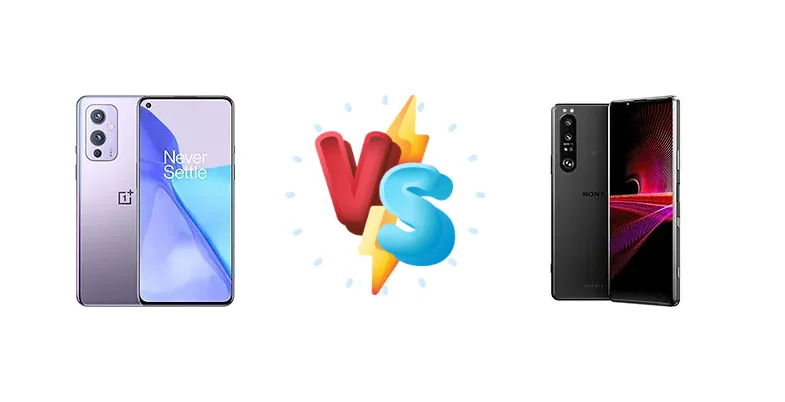
OnePlus 9 vs Sony Xperia 1 III: Which Snapdragon 888 Flagship Reigns Supreme?
| Phones Images | |||||
|---|---|---|---|---|---|
|
🏆 Quick Verdict
For the average user prioritizing value and rapid charging, the OnePlus 9 emerges as the winner. Its significantly brighter display and 65W charging are compelling advantages. However, content creators and those valuing a more refined, cinematic experience will find the Xperia 1 III’s feature set more appealing.
| PHONES | ||
|---|---|---|
| Phone Names | OnePlus 9 | Sony Xperia 1 III |
| Network | ||
|---|---|---|
| 2G bands | GSM 850 / 900 / 1800 / 1900 | GSM 850 / 900 / 1800 / 1900 |
| 3G bands | HSDPA 800 / 850 / 900 / 1700(AWS) / 1800 / 1900 / 2100 | HSDPA 800 / 850 / 900 / 1700(AWS) / 1900 / 2100 |
| 4G bands | 1, 2, 3, 4, 5, 7, 8, 12, 13, 17, 18, 19, 20, 25, 26, 28, 32, 38, 39, 40, 41, 66 - EU | 1, 2, 3, 4, 5, 7, 8, 12, 13, 17, 19, 20, 25, 26, 28, 29, 32, 34, 38, 39, 40, 41, 46, 66 - Europe |
| 5G bands | 1, 3, 5, 7, 8, 20, 28, 38, 40, 41, 66, 78 SA/NSA - EU | 1, 3, 5, 7, 8, 20, 28, 38, 40, 41, 77, 78 SA/NSA/Sub6 - Europe |
| Speed | HSPA 42.2/5.76 Mbps, LTE Cat20 2000/200 Mbps, 5G | HSPA, LTE, 5G |
| Technology | GSM / CDMA / HSPA / LTE / 5G | GSM / HSPA / LTE / 5G |
| 1, 3, 28, 41, 78, 79 SA/NSA - CN | SA/NSA/Sub6/mmWave - USA (specific) | |
| Launch | ||
|---|---|---|
| Announced | 2021, March 23 | 2021, April 14 |
| Status | Available. Released 2021, March 26 | Available. Released 2021, August 25 |
| Body | ||
|---|---|---|
| Build | Glass front (Gorilla Glass 5), glass back (Gorilla Glass 5), plastic frame | Glass front (Gorilla Glass Victus), glass back (Gorilla Glass 6), aluminum frame |
| Dimensions | 160 x 74.2 x 8.7 mm (EU/NA)160 x 73.9 x 8.1 mm (IN/CN) | 165 x 71 x 8.2 mm (6.50 x 2.80 x 0.32 in) |
| SIM | · Nano-SIM· Nano-SIM + Nano-SIM | Nano-SIM + Nano-SIM |
| Weight | 192 g (EU/NA)183 g (IN/CN) (6.46 oz) | 186 g / 187.1 g (mmWave) (6.56 oz) |
| IP68 (T-Mobile version only) | IP65/IP68 dust/water resistant (up to 1.5m for 30 min) | |
| Display | ||
|---|---|---|
| Protection | Corning Gorilla Glass 5 | Corning Gorilla Glass Victus |
| Resolution | 1080 x 2400 pixels, 20:9 ratio (~402 ppi density) | 1644 x 3840 pixels, 21:9 ratio (~643 ppi density) |
| Size | 6.55 inches, 103.6 cm2 (~87.6% screen-to-body ratio) | 6.5 inches, 98.6 cm2 (~84.2% screen-to-body ratio) |
| Type | Fluid AMOLED, 120Hz, HDR10+, 1100 nits (peak) | OLED, 1B colors, 120Hz, HDR BT.2020 |
| Always-on display | Runs at 1096 x 2560 pixels except for select use cases | |
| Platform | ||
|---|---|---|
| CPU | Octa-core (1x2.84 GHz Cortex-X1 & 3x2.42 GHz Cortex-A78 & 4x1.80 GHz Cortex-A55) | Octa-core (1x2.84 GHz Cortex-X1 & 3x2.42 GHz Cortex-A78 & 4x1.80 GHz Cortex-A55) |
| Chipset | Qualcomm SM8350 Snapdragon 888 5G (5 nm) | Qualcomm SM8350 Snapdragon 888 5G (5 nm) |
| GPU | Adreno 660 | Adreno 660 |
| OS | Android 11, upgradable to Android 13, OxygenOS 13 | Android 11, upgradable to Android 13 |
| Memory | ||
|---|---|---|
| Card slot | No | microSDXC (uses shared SIM slot) |
| Internal | 128GB 8GB RAM, 256GB 12GB RAM | 256GB 12GB RAM, 512GB 12GB RAM |
| UFS 3.1 | UFS 3.X | |
| Main Camera | ||
|---|---|---|
| Features | Hasselblad Color Calibration, color spectrum sensor, dual-LED flash, HDR, panorama | Zeiss optics, Zeiss T* lens coating, color spectrum sensor, LED flash, panorama, HDR, eye tracking |
| Single | 16 MP, f/2.4, (wide), 1/3.06", 1.0µm | 8 MP, f/2.0, 24mm (wide), 1/4", 1.12µm |
| Triple | 48 MP, f/1.8, 23mm (wide), 1/1.43", 1.12µm, multi-directional PDAF 50 MP, f/2.2, 14mm (ultrawide), 1/1.56", 1.0µm, AF 2 MP, f/2.4, (monochrome) | 12 MP, f/1.7, 24mm (wide), 1/1.7", 1.8µm, dual pixel PDAF, OIS 12 MP, f/2.3, 70mm (telephoto), f/2.8, 105mm (telephoto), 1/2.9", dual pixel PDAF, 3x/4.4x optical zoom, OIS 12 MP, f/2.2, 124˚, 16mm (ultrawide), 1/2.6", dual pixel PDAF 0.3 MP, TOF 3D, (depth) |
| Video | 8K@30fps, 4K@30/60fps, 1080p@30/60/240fps, Auto HDR, gyro-EIS | 4K@24/25/30/60/120fps HDR, 1080p@30/60/120fps; 5-axis gyro-EIS, OIS |
| Selfie camera | ||
|---|---|---|
| Features | HDR | HDR |
| Single | 16 MP, f/2.4, (wide), 1/3.06", 1.0µm | 8 MP, f/2.0, 24mm (wide), 1/4.0", 1.12µm |
| Video | 1080p@30fps, gyro-EIS | 1080p@30fps, 5-axis gyro-EIS |
| Sound | ||
|---|---|---|
| 3.5mm jack | No | Yes |
| 35mm jack | No | Yes |
| Loudspeaker | Yes, with stereo speakers | Yes, with stereo speakers |
| 24-bit/192kHz audio | 24-bit/192kHz audio Dynamic vibration system | |
| Comms | ||
|---|---|---|
| Bluetooth | 5.2, A2DP, LE, aptX HD | 5.2, A2DP, LE, aptX HD, aptX Adaptive |
| NFC | Yes | Yes |
| Positioning | GPS (L1+L5), GLONASS (G1), BDS (B1), GALILEO (E1+E5a) | GPS, GLONASS, BDS, GALILEO, QZSS |
| Radio | No | No |
| USB | USB Type-C 3.1, OTG | USB Type-C 3.1, OTG, video output |
| WLAN | Wi-Fi 802.11 a/b/g/n/ac/6, dual-band, Wi-Fi Direct, DLNA | Wi-Fi 802.11 a/b/g/n/ac/6, dual-band, Wi-Fi Direct, DLNA |
| Features | ||
|---|---|---|
| Sensors | Fingerprint (under display, optical), accelerometer, gyro, proximity, compass | Fingerprint (side-mounted), accelerometer, gyro, proximity, barometer, compass |
| - | Native Sony Alpha camera support | |
| Battery | ||
|---|---|---|
| Charging | 65W wired, PD, 100% in 29 min 15W wireless (EU/NA) | 30W wired, PD, 50% in 30 min Wireless Reverse wireless |
| Type | Li-Po 4500 mAh | Li-Po 4500 mAh |
| Misc | ||
|---|---|---|
| Colors | Winter Mist, Arctic Sky, Astral Black | Frosted Black, Frosted Gray, Frosted Purple |
| Models | LE2113, LE2111, LE2110, LE2117, LE2115 | XQBC62/V, XQBC52V.UKCX, SO-51B, SOG03, A101SO, XQ-BC62, XQ-BC72, XQ-BC52, XQ-BC01, XQ-BC11, XQ-BC21, XQ-BC72 |
| Price | $ 145.00 / £ 200.00 / € 249.99 | € 505.26 / $ 903.43 |
| Tests | ||
|---|---|---|
| Battery life | Endurance rating 87h | Endurance rating 82h |
| Camera | Photo / Video | Photo / Video |
| Display | - | Contrast ratio: Infinite (nominal) |
| Loudspeaker | -24.5 LUFS (Very good) | -26.5 LUFS (Good) |
| Performance | - | AnTuTu: 607423 (v8) GeekBench: 3515 (v5.1) GFXBench: 54fps (ES 3.1 onscreen) |
OnePlus 9
- Significantly faster 65W charging
- Brighter display for outdoor visibility
- More affordable price point
- Lacks wireless charging
- Potentially less refined camera experience
Sony Xperia 1 III
- Wireless and reverse wireless charging
- Professional-grade camera features
- Potentially better sustained performance due to thermal design
- Slower 30W charging
- Dimmer display compared to OnePlus 9
- Higher price
Display Comparison
The display is a key differentiator. The OnePlus 9 boasts a measured peak brightness of 821 nits, significantly outshining the Xperia 1 III’s 620 nits. This translates to superior visibility in direct sunlight. While the Xperia 1 III touts an infinite contrast ratio, this is typical of OLED panels and doesn’t necessarily equate to a better viewing experience than the OnePlus 9. The lack of specific refresh rate data for the Xperia 1 III means we can't assess motion clarity, but the OnePlus 9's display is likely to be more vibrant and easily viewable outdoors.
Camera Comparison
Both phones offer capable camera systems, but their approaches differ. While both are listed as 'Photo / Video', the Xperia 1 III’s emphasis on manual controls and professional features caters to videographers. The lack of detailed sensor information for either phone makes a direct comparison difficult. However, Sony’s history suggests a focus on image quality and color science, potentially offering a more natural look. The OnePlus 9 likely prioritizes computational photography for quick, shareable results. The absence of details regarding OIS and lens apertures prevents a deeper analysis.
Performance
Both devices are powered by the Qualcomm SM8350 Snapdragon 888 5G (5 nm) chipset, featuring the same Octa-core CPU configuration. Therefore, raw processing power will be nearly identical. However, thermal management could vary. While neither device’s specs reveal specific cooling solutions, Sony’s focus on sustained performance for video recording suggests a potentially more robust thermal design. Both utilize LPDDR5 RAM, but the speed isn't specified, making it difficult to determine a performance edge. Real-world performance will likely be similar for most tasks, but prolonged intensive workloads might reveal differences in sustained performance.
Battery Life
The OnePlus 9 has an endurance rating of 87 hours, slightly exceeding the Xperia 1 III’s 82 hours. However, charging speeds are where the OnePlus 9 truly shines. Its 65W wired charging can reach 100% in just 29 minutes, a massive advantage over the Xperia 1 III’s 30W charging, which only achieves 50% in 30 minutes. The Xperia 1 III offers wireless and reverse wireless charging, features absent on the OnePlus 9, providing added convenience for compatible devices. The faster charging of the OnePlus 9 mitigates the slightly smaller battery capacity.
Buying Guide
Buy the OnePlus 9 if you need a fast-charging, bright-screened phone for everyday use, gaming, and general productivity. It’s the ideal choice for users who want flagship performance without a flagship price tag. Buy the Sony Xperia 1 III if you prioritize a professional-grade camera experience, a more immersive multimedia consumption experience, and don't mind slower charging in exchange for a feature-rich ecosystem geared towards content creation.