
OnePlus 9 vs. Samsung Galaxy S21 FE 5G: A Deep Dive into Flagship Value
| Phones Images | |||||
|---|---|---|---|---|---|
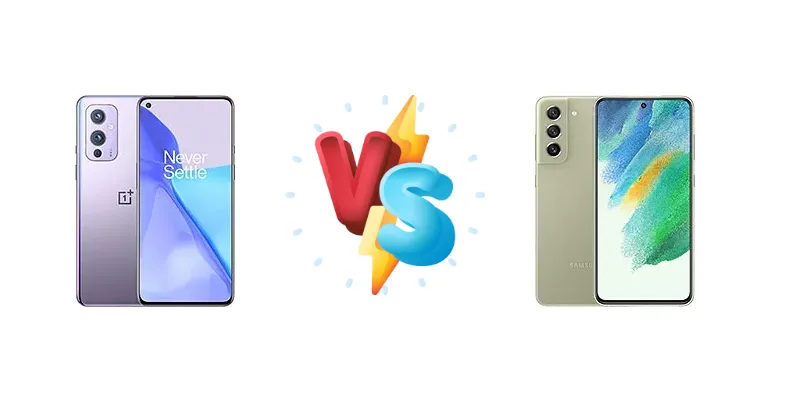
|
🏆 Quick Verdict
For most users, the Samsung Galaxy S21 FE 5G emerges as the slightly better choice. Its marginally superior battery endurance (92h vs 87h) and wider availability of software features, coupled with the potential for a more refined software experience, outweigh the OnePlus 9’s faster charging. However, OnePlus’s clean OxygenOS remains a strong draw for purists.
| PHONES | ||
|---|---|---|
| Phone Names | OnePlus 9 | Samsung Galaxy S21 FE 5G |
| Network | ||
|---|---|---|
| 2G bands | GSM 850 / 900 / 1800 / 1900 | GSM 850 / 900 / 1800 / 1900 |
| 3G bands | HSDPA 800 / 850 / 900 / 1700(AWS) / 1800 / 1900 / 2100 | HSDPA 850 / 900 / 1700(AWS) / 1900 / 2100 |
| 4G bands | 1, 2, 3, 4, 5, 7, 8, 12, 13, 17, 18, 19, 20, 25, 26, 28, 32, 38, 39, 40, 41, 66 - EU | 1, 2, 3, 4, 5, 7, 8, 12, 17, 20, 26, 28, 32, 38, 40, 41, 66 - International |
| 5G bands | 1, 3, 5, 7, 8, 20, 28, 38, 40, 41, 66, 78 SA/NSA - EU | 1, 3, 5, 8, 20, 28, 38, 40, 41, 66, 78 SA/NSA/Sub6 - International |
| Speed | HSPA 42.2/5.76 Mbps, LTE Cat20 2000/200 Mbps, 5G | HSPA 42.2/5.76 Mbps, LTE (5CA) Cat19 1600/200 Mbps, 5G |
| Technology | GSM / CDMA / HSPA / LTE / 5G | GSM / CDMA / HSPA / EVDO / LTE / 5G |
| 1, 3, 28, 41, 78, 79 SA/NSA - CN | 41, 66, 71, 260, 261 SA/NSA/Sub6/mmWave - USA | |
| Launch | ||
|---|---|---|
| Announced | 2021, March 23 | 2022, January 04 |
| Status | Available. Released 2021, March 26 | Available. Released 2022, January 07 |
| Body | ||
|---|---|---|
| Build | Glass front (Gorilla Glass 5), glass back (Gorilla Glass 5), plastic frame | Glass front (Gorilla Glass Victus), plastic back, aluminum frame |
| Dimensions | 160 x 74.2 x 8.7 mm (EU/NA)160 x 73.9 x 8.1 mm (IN/CN) | 155.7 x 74.5 x 7.9 mm (6.13 x 2.93 x 0.31 in) |
| SIM | · Nano-SIM· Nano-SIM + Nano-SIM | · Nano-SIM· Nano-SIM + Nano-SIM |
| Weight | 192 g (EU/NA)183 g (IN/CN) (6.46 oz) | 177 g (6.24 oz) |
| IP68 (T-Mobile version only) | IP68 dust/water resistant (up to 1.5m for 30 min) | |
| Display | ||
|---|---|---|
| Protection | Corning Gorilla Glass 5 | Corning Gorilla Glass Victus |
| Resolution | 1080 x 2400 pixels, 20:9 ratio (~402 ppi density) | 1080 x 2340 pixels, 19.5:9 ratio (~403 ppi density) |
| Size | 6.55 inches, 103.6 cm2 (~87.6% screen-to-body ratio) | 6.4 inches, 100.5 cm2 (~86.7% screen-to-body ratio) |
| Type | Fluid AMOLED, 120Hz, HDR10+, 1100 nits (peak) | Dynamic AMOLED 2X, 120Hz, HDR10+ |
| Always-on display | Always-on display | |
| Platform | ||
|---|---|---|
| CPU | Octa-core (1x2.84 GHz Cortex-X1 & 3x2.42 GHz Cortex-A78 & 4x1.80 GHz Cortex-A55) | Octa-core (1x2.84 GHz Cortex-X1 & 3x2.42 GHz Cortex-A78 & 4x1.80 GHz Cortex-A55) - Version 1Octa-core (1x2.9 GHz Cortex-X1 & 3x2.80 GHz Cortex-A78 & 4x2.2 GHz Cortex-A55) - Version 2 |
| Chipset | Qualcomm SM8350 Snapdragon 888 5G (5 nm) | Qualcomm SM8350 Snapdragon 888 5G (5 nm) - Version 1Exynos 2100 (5 nm) - Version 2 |
| GPU | Adreno 660 | Adreno 660 - Version 1Mali-G78 MP14 - Version 2 |
| OS | Android 11, upgradable to Android 13, OxygenOS 13 | Android 12, up to 4 major Android upgrades, One UI 8 |
| Memory | ||
|---|---|---|
| Card slot | No | No |
| Internal | 128GB 8GB RAM, 256GB 12GB RAM | 128GB 6GB RAM, 128GB 8GB RAM, 256GB 6GB RAM, 256GB 8GB RAM |
| UFS 3.1 | - | |
| Main Camera | ||
|---|---|---|
| Features | Hasselblad Color Calibration, color spectrum sensor, dual-LED flash, HDR, panorama | LED flash, auto-HDR, panorama |
| Single | 16 MP, f/2.4, (wide), 1/3.06", 1.0µm | 32 MP, f/2.2, 26mm (wide), 1/2.74", 0.8µm |
| Triple | 48 MP, f/1.8, 23mm (wide), 1/1.43", 1.12µm, multi-directional PDAF 50 MP, f/2.2, 14mm (ultrawide), 1/1.56", 1.0µm, AF 2 MP, f/2.4, (monochrome) | 12 MP, f/1.8, 26mm (wide), 1/1.76", 1.8µm, dual pixel PDAF, OIS 8 MP, f/2.4, 76mm (telephoto), 1/4.5", 1.0µm, PDAF, OIS, 3x optical zoom 12 MP, f/2.2, 13mm, 123˚ (ultrawide), 1/3.0", 1.12µm |
| Video | 8K@30fps, 4K@30/60fps, 1080p@30/60/240fps, Auto HDR, gyro-EIS | 4K@30/60fps, 1080p@30/60/120/240fps, HDR10+, gyro-EIS |
| Selfie camera | ||
|---|---|---|
| Features | HDR | HDR |
| Single | 16 MP, f/2.4, (wide), 1/3.06", 1.0µm | 32 MP, f/2.2, 26mm (wide), 1/2.74", 0.8µm |
| Video | 1080p@30fps, gyro-EIS | 4K@30/60fps, 1080p@30/60fps, gyro-EIS |
| Sound | ||
|---|---|---|
| 3.5mm jack | No | No |
| 35mm jack | No | No |
| Loudspeaker | Yes, with stereo speakers | Yes, with stereo speakers |
| 24-bit/192kHz audio | 32-bit/384kHz audio | |
| Comms | ||
|---|---|---|
| Bluetooth | 5.2, A2DP, LE, aptX HD | 5.0, A2DP, LE |
| NFC | Yes | Yes |
| Positioning | GPS (L1+L5), GLONASS (G1), BDS (B1), GALILEO (E1+E5a) | GPS, GLONASS, BDS, GALILEO |
| Radio | No | Unspecified |
| USB | USB Type-C 3.1, OTG | USB Type-C, OTG |
| WLAN | Wi-Fi 802.11 a/b/g/n/ac/6, dual-band, Wi-Fi Direct, DLNA | Wi-Fi 802.11 a/b/g/n/ac/6, dual-band, Wi-Fi Direct |
| Features | ||
|---|---|---|
| Sensors | Fingerprint (under display, optical), accelerometer, gyro, proximity, compass | Fingerprint (under display, optical), accelerometer, gyro, proximity, compass |
| - | Bixby natural language commands and dictation Samsung Pay (Visa, MasterCard certified) Samsung DeX (desktop experience support) | |
| Battery | ||
|---|---|---|
| Charging | 65W wired, PD, 100% in 29 min 15W wireless (EU/NA) | 25W wired, PD3.0, 50% in 30 min 15W wireless Reverse wireless |
| Type | Li-Po 4500 mAh | Li-Ion 4500 mAh |
| Misc | ||
|---|---|---|
| Colors | Winter Mist, Arctic Sky, Astral Black | White, Graphite, Lavender, Olive |
| Models | LE2113, LE2111, LE2110, LE2117, LE2115 | SM-G990B, SM-G990B/DS, SM-G990U, SM-G990U1, SM-G990W, SM-G990E, SM-G9900, SM-G990B2, SM-G990U2, SM-G990W2, SM-G990U3 |
| Price | $ 145.00 / £ 200.00 / € 249.99 | € 199.00 / $ 143.95 / £ 154.99 / ₹ 29,990 |
| SAR | - | 0.77 W/kg (head) 0.90 W/kg (body) |
| SAR EU | - | 0.95 W/kg (head) 1.48 W/kg (body) |
| Tests | ||
|---|---|---|
| Battery life | Endurance rating 87h | Endurance rating 92h |
| Camera | Photo / Video | Photo / Video |
| Display | - | Contrast ratio: Infinite (nominal) |
| Loudspeaker | -24.5 LUFS (Very good) | -26.9 LUFS (Good) |
| Performance | - | AnTuTu: 566529 (v8), 719696 (v9) GeekBench: 3049 (v5.1) GFXBench: 56fps (ES 3.1 onscreen) |
OnePlus 9
- Significantly faster 65W wired charging
- Clean OxygenOS software experience
- Slightly brighter display (821 nits)
- Shorter battery life (87h endurance)
- Less feature-rich software compared to Samsung
- Potentially less consistent camera processing
Samsung Galaxy S21 FE 5G
- Longer battery life (92h endurance)
- Reverse wireless charging
- More versatile software features (Samsung)
- Gorilla Glass Victus protection
- Slower 25W wired charging
- Exynos variant may exhibit more thermal throttling
- Software can feel bloated to some users
Display Comparison
Both phones feature excellent displays, but subtle differences exist. The OnePlus 9 achieves a peak brightness of 821 nits, slightly exceeding the S21 FE’s 792 nits, potentially offering better visibility in direct sunlight. While both utilize AMOLED technology, the S21 FE boasts an 'Infinite' contrast ratio (nominal), suggesting deeper blacks. The S21 FE’s display is also protected by Gorilla Glass Victus, offering enhanced scratch resistance compared to the OnePlus 9’s unspecified glass. The lack of LTPO on either device means refresh rate scaling isn’t as efficient as on newer flagships, impacting battery life during dynamic content viewing.
Camera Comparison
Both phones offer versatile camera systems, but differ in their approach. Both are capable of excellent photo and video capture. The S21 FE’s camera system benefits from Samsung’s extensive image processing algorithms, often resulting in vibrant, shareable images. While both phones have a similar primary sensor, the S21 FE’s image processing tends to prioritize saturation and contrast. The OnePlus 9’s camera, developed in partnership with Hasselblad, aims for more natural color reproduction. The inclusion of OIS on both primary lenses helps stabilize photos and videos. The 2MP macro cameras on both devices are largely a marketing gimmick and offer limited practical benefit.
Performance
The core processing power is largely similar, with both phones often equipped with the Qualcomm Snapdragon 888 5G (5nm). However, the S21 FE introduces a variant with Samsung’s Exynos 2100 (5nm) chipset. While the Snapdragon 888 generally exhibits slightly better sustained performance and thermal management, the Exynos 2100 is competitive. Both CPUs share the same core configuration (1x2.84 GHz Cortex-X1, 3x2.42 GHz Cortex-A78, 4x1.80 GHz Cortex-A55), but the S21 FE’s Exynos version bumps the Cortex-X1 to 2.9 GHz and the A78 cores to 2.80 GHz, and the A55 cores to 2.2 GHz, potentially offering a marginal performance boost in CPU-intensive tasks. Both phones utilize LPDDR5 RAM, ensuring snappy multitasking.
Battery Life
The Samsung Galaxy S21 FE 5G holds a slight edge in battery endurance, achieving a measured 92 hours compared to the OnePlus 9’s 87 hours. This difference, while not massive, is noticeable in real-world usage. The OnePlus 9 compensates with significantly faster charging: 65W wired charging delivers a full charge in just 29 minutes, while the S21 FE’s 25W charging takes approximately 30 minutes to reach 50%. Both support 15W wireless charging, and the S21 FE adds the convenience of reverse wireless charging, allowing it to charge other Qi-compatible devices.
Buying Guide
Buy the OnePlus 9 if you prioritize blazing-fast 65W wired charging and a near-stock Android experience with OxygenOS. This phone is ideal for users who frequently top up their battery and dislike software bloat. Buy the Samsung Galaxy S21 FE 5G if you value longer battery life, a more feature-rich software suite (including reverse wireless charging), and the potential for a more consistent camera experience, even if it means slightly slower charging speeds.