
OnePlus 11 vs. OnePlus 9 Pro: Which Flagship Reigns Supreme?
| Phones Images | |||||
|---|---|---|---|---|---|
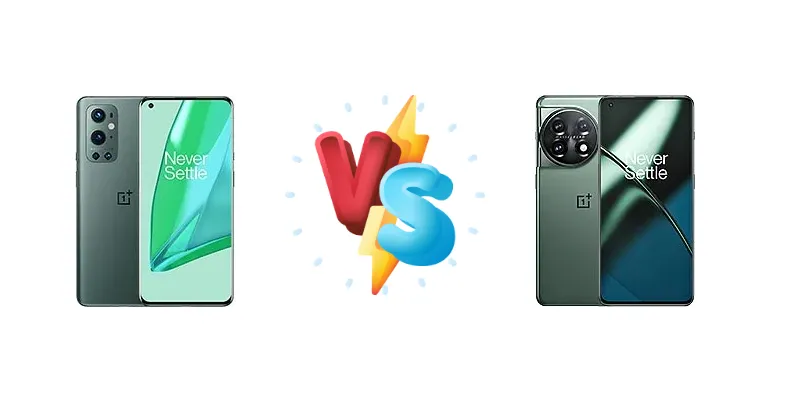
|
🏆 Quick Verdict
For most users, the OnePlus 11 is the clear winner. Its Snapdragon 8 Gen 2 delivers superior performance and efficiency, translating to a substantial battery life improvement (108h endurance vs 86h). While the 9 Pro's display is slightly brighter, the 11's faster charging and overall package make it the more compelling choice.
| PHONES | ||
|---|---|---|
| Phone Names | OnePlus 9 Pro | OnePlus 11 |
| Network | ||
|---|---|---|
| 2G bands | GSM 850 / 900 / 1800 / 1900 | GSM 850 / 900 / 1800 / 1900 |
| 3G bands | HSDPA 800 / 850 / 900 / 1700(AWS) / 1800 / 1900 / 2100 | HSDPA 800 / 850 / 900 / 1700(AWS) / 1900 / 2100 |
| 4G bands | 1, 2, 3, 4, 5, 7, 8, 12, 13, 17, 18, 19, 20, 25, 26, 28, 32, 38, 39, 40, 41, 66 - EU | 1, 2, 3, 4, 5, 7, 8, 12, 13, 17, 18, 19, 20, 25, 26, 28, 30, 32, 38, 39, 41, 40, 46, 48, 66, 71 - International |
| 5G bands | 1, 3, 5, 7, 8, 20, 28, 38, 40, 41, 66, 78 SA/NSA - EU | 1, 2, 3, 5, 7, 8, 20, 25, 28, 30, 38, 40, 41, 66, 71, 75, 77, 78 SA/NSA - International |
| Speed | HSPA 42.2/5.76 Mbps, LTE Cat20 2000/200 Mbps, 5G | HSPA, LTE, 5G |
| Technology | GSM / CDMA / HSPA / LTE / 5G | GSM / CDMA / HSPA / EVDO / LTE / 5G |
| 1, 3, 28, 41, 78, 79 SA/NSA - CN | 1, 3, 5, 7, 8, 20, 28, 38, 40, 41, 66, 77, 78 SA/NSA - China | |
| Launch | ||
|---|---|---|
| Announced | 2021, March 23 | 2023, January 04 |
| Status | Available. Released 2021, March 30 | Available. Released 2023, January 09 |
| Body | ||
|---|---|---|
| Build | Glass front (Gorilla Glass 5), glass back (Gorilla Glass 5), aluminum frame | Glass front (Gorilla Glass Victus), glass back (Gorilla Glass 5), aluminum frame |
| Dimensions | 163.2 x 73.6 x 8.7 mm (6.43 x 2.90 x 0.34 in) | 163.1 x 74.1 x 8.5 mm (6.42 x 2.92 x 0.33 in) |
| SIM | · Nano-SIM· Nano-SIM + Nano-SIM | · Nano-SIM· Nano-SIM + Nano-SIM + eSIM (max 2 at a time) |
| Weight | 197 g (6.95 oz) | 205 g (7.23 oz) |
| IP68 dust/water resistant (up to 1.5m for 30 min) | IP64 | |
| Display | ||
|---|---|---|
| Protection | Corning Gorilla Glass 5 | Corning Gorilla Glass Victus |
| Resolution | 1440 x 3216 pixels, 20:9 ratio (~525 ppi density) | 1440 x 3216 pixels, 20:9 ratio (~525 ppi density) |
| Size | 6.7 inches, 108.4 cm2 (~90.3% screen-to-body ratio) | 6.7 inches, 108.4 cm2 (~89.7% screen-to-body ratio) |
| Type | LTPO Fluid2 AMOLED, 1B colors, 120Hz, HDR10+, 1300 nits (peak) | LTPO3 Fluid AMOLED, 1B colors, 120Hz, Dolby Vision, HDR10+, 500 nits (typ), 800 nits (HBM), 1300 nits (peak) |
| Always-on display | Always-on display | |
| Platform | ||
|---|---|---|
| CPU | Octa-core (1x2.84 GHz Cortex-X1 & 3x2.42 GHz Cortex-A78 & 4x1.80 GHz Cortex-A55 | Octa-core (1x3.2 GHz Cortex-X3 & 2x2.8 GHz Cortex-A715 & 2x2.8 GHz Cortex-A710 & 3x2.0 GHz Cortex-A510) |
| Chipset | Qualcomm SM8350 Snapdragon 888 5G (5 nm) | Qualcomm SM8550-AB Snapdragon 8 Gen 2 (4 nm) |
| GPU | Adreno 660 | Adreno 740 |
| OS | Android 11, upgradable to Android 14, OxygenOS 14 | Android 13, upgradable to Android 15, OxygenOS 15 (International), ColorOS 14 (China) |
| Memory | ||
|---|---|---|
| Card slot | No | No |
| Internal | 128GB 8GB RAM, 256GB 8GB RAM, 256GB 12GB RAM | 128GB 8GB RAM, 256GB 12GB RAM, 256GB 16GB RAM, 512GB 16GB RAM |
| UFS 3.1 | UFS 3.1 - 128GB only UFS 4.0 | |
| Main Camera | ||
|---|---|---|
| Features | Laser AF, color spectrum sensor, Hasselblad Color Calibration, dual-LED flash, HDR, panorama | Hasselblad Color Calibration, color spectrum sensor, Dual-LED flash, HDR, panorama |
| Quad | 48 MP, f/1.8, 23mm (wide), 1/1.43", 1.12µm, multi-directional PDAF, OIS 8 MP, f/2.4, 77mm (telephoto), 1.0µm, PDAF, OIS, 3.3x optical zoom 50 MP, f/2.2, 14mm (ultrawide), 1/1.56", 1.0µm, AF 2 MP, f/2.4, (monochrome) | - |
| Single | 16 MP, f/2.4, (wide), 1/3.06", 1.0µm | 16 MP, f/2.5, 25mm (wide), 1.0µm |
| Triple | - | 50 MP, f/1.8, 24mm (wide), 1/1.56", 1.0µm, multi-directional PDAF, OIS 32 MP, f/2.0, 48mm (telephoto), 1/2.74", PDAF, 2x optical zoom 48 MP, f/2.2, 115˚, (ultrawide), 1/2.0", AF |
| Video | 8K@30fps, 4K@30/60/120fps, 1080p@30/60/240fps, Auto HDR, gyro-EIS | 8K@24fps, 4K@30/60fps, 1080p@30/60/240fps, Auto HDR, gyro-EIS |
| Selfie camera | ||
|---|---|---|
| Features | HDR | HDR, panorama |
| Single | 16 MP, f/2.4, (wide), 1/3.06", 1.0µm | 16 MP, f/2.5, 25mm (wide), 1.0µm |
| Video | 1080p@30fps, gyro-EIS | 1080p@30fps, gyro-EIS |
| Sound | ||
|---|---|---|
| 3.5mm jack | No | No |
| 35mm jack | No | No |
| Loudspeaker | Yes, with stereo speakers | Yes, with stereo speakers |
| 24-bit/192kHz audio | 24-bit/192kHz audio | |
| Comms | ||
|---|---|---|
| Bluetooth | 5.2, A2DP, LE, aptX HD | 5.3, A2DP, LE, aptX HD |
| NFC | Yes | Yes |
| Positioning | GPS (L1+L5), GLONASS (G1), BDS (B1), GALILEO (E1+E5a) | GPS (L1+L5), GLONASS (G1), BDS (B1I+B1c+B2a), GALILEO (E1+E5a), QZSS (L1+L5) |
| Radio | No | No |
| USB | USB Type-C 3.1, OTG | USB Type-C 2.0, OTG |
| WLAN | Wi-Fi 802.11 a/b/g/n/ac/6, dual-band, Wi-Fi Direct, DLNA | Wi-Fi 802.11 a/b/g/n/ac/6/7, dual-band, Wi-Fi Direct |
| Features | ||
|---|---|---|
| Sensors | Fingerprint (under display, optical), accelerometer, gyro, proximity, compass | Fingerprint (under display, optical), accelerometer, gyro, proximity, compass |
| Battery | ||
|---|---|---|
| Charging | 65W wired, PD, 100% in 29 min 50W wireless, 100% in 43 min 5W reverse wireless | 100W wired, PD, 50% in 10 min, 100% in 25 min - International 80W wired, PD - USA |
| Type | Li-Po 4500 mAh | Li-Po 5000 mAh |
| Misc | ||
|---|---|---|
| Colors | Morning Mist, Forest Green, Stellar Black | Titan Black, Eternal Green, Jupiter Rock |
| Models | LE2121, LE2125, LE2123, LE2120, LE2127 | PHB110, CPH2449, CPH2447, CPH2451 |
| Price | € 246.17 / $ 264.95 / £ 287.00 | $ 379.99 / ₹ 33,990 |
| SAR | - | 1.19 W/kg (head) 0.99 W/kg (body) |
| Tests | ||
|---|---|---|
| Battery life | Endurance rating 86h | Endurance rating 108h |
| Camera | Photo / Video | Photo / Video |
| Display | - | Contrast ratio: Infinite (nominal) |
| Loudspeaker | -24.1 LUFS (Very good) | -25.2 LUFS (Very good) |
| Performance | - | AnTuTu: 1140661 (v9) GeekBench: 4899 (v5.1) GFXBench: 57fps (ES 3.1 onscreen) |
OnePlus 9 Pro
- Slightly brighter display (859 nits)
- Hasselblad-tuned camera (potentially preferred color science)
- Mature software experience
- Less efficient Snapdragon 888 chipset
- Shorter battery life (86h endurance)
- Slower charging speeds (65W wired)
OnePlus 11
- Significantly improved battery life (108h endurance)
- Faster Snapdragon 8 Gen 2 chipset
- Faster charging speeds (100W/80W wired)
- Likely more efficient display technology (LTPO)
- Slightly dimmer display (767 nits)
- Potentially less refined software at launch
- May be more expensive
Display Comparison
The OnePlus 9 Pro boasts a peak brightness of 859 nits, offering excellent visibility outdoors. However, the OnePlus 11's display, while measuring 767 nits, benefits from an infinite contrast ratio, providing deeper blacks and a more immersive viewing experience. Both displays are excellent, but the 9 Pro's higher peak brightness may be preferable in direct sunlight. Neither specification details refresh rate, but both are expected to have 120Hz panels. The 11's panel technology is likely LTPO, offering variable refresh rate for improved efficiency, a feature not confirmed for the 9 Pro.
Camera Comparison
Both phones feature capable camera systems, but detailed sensor information is lacking. The context data only indicates 'Photo / Video' capabilities for both. However, given OnePlus's trajectory, the 11 likely incorporates newer image processing algorithms and potentially larger sensors. The 9 Pro's Hasselblad partnership was a key selling point, and the 11 builds upon that foundation. Without specific sensor size or aperture details, it's difficult to definitively declare a winner, but the 11's newer processing pipeline likely delivers improved image quality, particularly in low-light conditions.
Performance
The core difference lies in the chipsets. The OnePlus 9 Pro's Snapdragon 888 (5nm) is a capable performer, but the OnePlus 11's Snapdragon 8 Gen 2 (4nm) represents a significant leap forward. The 4nm process node provides better thermal efficiency, reducing throttling during sustained workloads. The 11's CPU – an Octa-core configuration with a Cortex-X3 prime core clocked at 3.2 GHz – outperforms the 9 Pro’s Cortex-X1 (2.84 GHz). This translates to faster app loading times, smoother multitasking, and improved gaming performance. The 11 also likely benefits from faster LPDDR5x RAM, further enhancing responsiveness.
Battery Life
The OnePlus 11 delivers a substantial battery life advantage. Its endurance rating of 108 hours significantly surpasses the 9 Pro's 86 hours. This is due to a combination of the more efficient Snapdragon 8 Gen 2 chipset and potentially a larger battery capacity (not specified in the data). The 11 also boasts significantly faster charging: 100W wired (50% in 10 minutes, 100% in 25 minutes) internationally, and 80W in the USA, compared to the 9 Pro's 65W (100% in 29 minutes). The 11 also offers 50W wireless charging, a step up from the 9 Pro's 50W, and both support 5W reverse wireless charging.
Buying Guide
Buy the OnePlus 9 Pro if you prioritize a slightly brighter display and can find it at a significantly discounted price. It remains a capable phone for everyday tasks and photography. Buy the OnePlus 11 if you demand the best possible performance, extended battery life, and the fastest charging speeds available, especially if you're a power user or gamer.