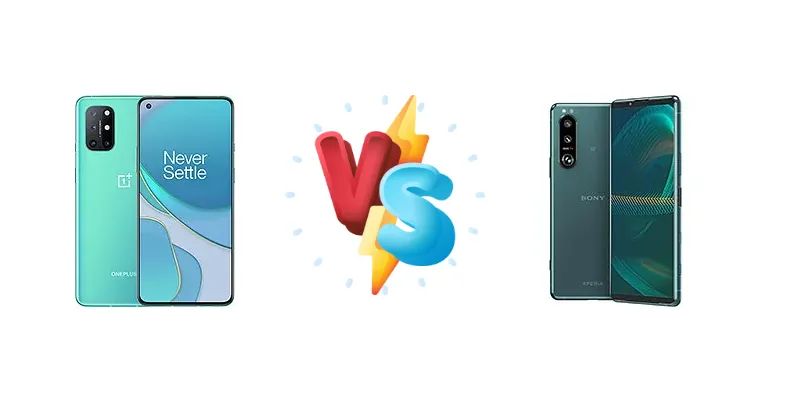
The Sony Xperia 5 III and OnePlus 8T+ 5G represent distinct philosophies in the Android space. The Xperia 5 III aims for a compact, professional-grade experience focused on content creation, while the 8T+ 5G historically targeted a balance of features and value. This comparison dissects their strengths and weaknesses, particularly given the 8T+'s age and potential price drops.
🏆 Quick Verdict
For the average user prioritizing all-day battery life and a smooth experience, the OnePlus 8T+ 5G likely offers better value, assuming a competitive price point. However, the Sony Xperia 5 III caters to power users and content creators who demand a more refined camera and compact form factor.
| Network |
|---|
| 2G bands | GSM 850 / 900 / 1800 / 1900 - SIM 1 & SIM 2 | GSM 850 / 900 / 1800 / 1900 |
| 3G bands | - | HSDPA 800 / 850 / 900 / 1700(AWS) / 1900 / 2100 |
| 4G bands | - | 1, 2, 3, 4, 5, 7, 8, 12, 13, 17, 19, 20, 25, 26, 28, 29, 32, 34, 38, 39, 40, 41, 46, 48, 66, 71 - USA |
| 5G bands | - | 1, 2, 3, 5, 7, 8, 20, 28, 38, 40, 41, 66, 71, 77, 78 SA/NSA/Sub6 - USA |
| EDGE | No | - |
| GPRS | Yes | - |
| Speed | - | HSPA, LTE, 5G |
| Technology | GSM | GSM / HSPA / LTE / 5G |
| | - | 1, 3, 5, 7, 8, 28, 38, 40, 41, 77, 78, 79 SA/NSA/Sub6 - Asia |
| Launch |
|---|
| Announced | 2011, September. Released 2011, September | 2021, April 14 |
| Status | Discontinued | Available. Released 2021, October 08 |
| Body |
|---|
| Build | - | Glass front (Gorilla Glass 6), glass back (Gorilla Glass 6), aluminum frame |
| Dimensions | 111.4 x 57.1 x 16.1 mm (4.39 x 2.25 x 0.63 in) | 157 x 68 x 8.2 mm (6.18 x 2.68 x 0.32 in) |
| Keyboard | QWERTY | - |
| SIM | Dual SIM (Mini-SIM, dual stand-by) | · Nano-SIM· Nano-SIM + Nano-SIM |
| Weight | 63.8 g (2.22 oz) | 168 g (5.93 oz) |
| | Flashlight | IP65/IP68 dust/water resistant (up to 1.5m for 30 min) |
| Display |
|---|
| Protection | - | Corning Gorilla Glass 6 |
| Resolution | 240 x 320 pixels, 4:3 ratio (~200 ppi density) | 1080 x 2520 pixels, 21:9 ratio (~449 ppi density) |
| Size | 2.0 inches, 12.4 cm2 (~19.5% screen-to-body ratio) | 6.1 inches, 86.9 cm2 (~81.4% screen-to-body ratio) |
| Type | TFT | OLED, 1B colors, 120Hz, HDR BT.2020 |
| Platform |
|---|
| CPU | - | Octa-core (1x2.84 GHz Cortex-X1 & 3x2.42 GHz Cortex-A78 & 4x1.80 GHz Cortex-A55) |
| Chipset | - | Qualcomm SM8350 Snapdragon 888 5G (5 nm) |
| GPU | - | Adreno 660 |
| OS | - | Android 11, upgradable to Android 13 |
| Memory |
|---|
| Call records | Yes | - |
| Card slot | microSDHC (dedicated slot) | microSDXC (uses shared SIM slot) |
| Internal | 64MB ROM, 32MB RAM | 128GB 8GB RAM, 256GB 8GB RAM |
| Phonebook | 300 entries | - |
| | - | UFS 3.X |
| Main Camera |
|---|
| Features | LED flash | Zeiss optics, Zeiss T* lens coating, color spectrum sensor, LED flash, panorama, HDR, eye tracking |
| Single | 1.3 MP | 8 MP, f/2.0, 24mm (wide), 1/4", 1.12µm |
| Triple | - | 12 MP, f/1.7, 24mm (wide), 1/1.7", 1.8µm, dual pixel PDAF, OIS
12 MP, f/2.3, 70mm (telephoto), f/2.8, 105mm (telephoto), 1/2.9", dual pixel PDAF, 3x/4.4x optical zoom, OIS
12 MP, f/2.2, 124˚, 16mm (ultrawide), 1/2.6", dual pixel PDAF |
| Video | Yes | 4K@24/25/30/60/120fps HDR, 1080p@30/60/120fps; 5-axis gyro-EIS, OIS |
| Selfie camera |
|---|
| Features | - | HDR |
| Single | - | 8 MP, f/2.0, 24mm (wide), 1/4.0", 1.12µm |
| Video | - | 1080p@30fps, 5-axis gyro-EIS |
| | No | - |
| Sound |
|---|
| 3.5mm jack | No | Yes |
| 35mm jack | - | Yes |
| Loudspeaker | Yes | Yes, with stereo speakers |
| | - | 24-bit/192kHz audio
Dynamic vibration system |
| Comms |
|---|
| Bluetooth | Yes | 5.2, A2DP, LE, aptX HD, aptX Adaptive |
| NFC | - | Yes |
| Positioning | No | GPS, GLONASS, BDS, GALILEO, QZSS |
| Radio | FM radio | No |
| USB | microUSB | USB Type-C 3.1, OTG, video output |
| WLAN | No | Wi-Fi 802.11 a/b/g/n/ac/6, dual-band, Wi-Fi Direct, DLNA |
| Features |
|---|
| Games | Yes | - |
| Java | No | - |
| Messaging | SMS, MMS, Email, IM | - |
| Sensors | - | Fingerprint (side-mounted), accelerometer, gyro, proximity, barometer, compass |
| | Analog TV
MSN, Facebook, Yahoo, Twitter applications
MP3/WAV player
MP4/H.263 player | Native Sony Alpha camera support |
| Battery |
|---|
| Charging | - | Wired, PD, 50% in 30 min |
| Stand-by | Up to 400 h | - |
| Talk time | Up to 4 h | - |
| Type | Removable Li-Ion 1000 mAh battery (BL-4L) | Li-Po 4500 mAh |
| Misc |
|---|
| Colors | Black, Red, Blue, White | Black, Green, Pink |
| Models | - | XQBQ62/G, XQBQ52G.UKCX, XQBQ52B.UKCX, XQ-BQ52, XQ-BQ72, XQ-BQ42, XQ-BQ62, SO-53B |
| Price | - | € 431.90 / £ 199.99 |
| Tests |
|---|
| Battery life | - |
Endurance rating 100h
|
| Camera | - |
Photo / Video |
| Display | - |
Contrast ratio: Infinite (nominal) |
| Loudspeaker | - |
-26.7 LUFS (Good)
|
| Performance | - |
AnTuTu: 708394 (v9)
GeekBench: 3549 (v5.1)
GFXBench: 53fps (ES 3.1 onscreen) |
OnePlus 8T+ 5G
- Fast 50% charge in 30 minutes
- Potentially more affordable price point (due to age)
- Likely smooth and responsive user experience
- Battery life potentially lower than Xperia 5 III
- Camera capabilities less defined than Xperia 5 III
- Display specs largely unknown
Sony Xperia 5 III
- Exceptional 100-hour battery endurance
- Compact and ergonomic design
- Professional-grade camera features for photo and video
- May require more careful battery management
- Snapdragon 888 can generate heat under load
- Potentially higher price point
Display Comparison
The Sony Xperia 5 III boasts a 590 nits max brightness, providing good visibility outdoors. While the OnePlus 8T+ 5G's display specs are unavailable, OnePlus historically prioritizes vibrant colors. The Xperia 5 III’s contrast ratio is listed as infinite (nominal), typical of OLED panels, suggesting deep blacks. The Xperia 5 III’s compact 6.1-inch form factor is a key differentiator, appealing to users who find larger phones unwieldy. Without specific data on the 8T+, it’s difficult to compare panel technology (LTPO, refresh rate), but the Xperia 5 III’s size is a significant advantage for one-handed use.
Camera Comparison
The Sony Xperia 5 III is explicitly marketed for its photo and video capabilities. While specific sensor details are missing for both, Sony’s expertise in camera technology suggests a focus on image quality and professional features. The Xperia 5 III likely offers advanced video recording options and manual controls. The OnePlus 8T+ 5G’s camera performance is less defined, but it likely prioritizes versatility. Without detailed specs, it’s difficult to assess the quality of the OnePlus 8T+ 5G’s image processing compared to Sony’s renowned algorithms. We can assume the Xperia 5 III will offer more granular control for experienced photographers.
Performance
Both devices are powered by the Qualcomm SM8350 Snapdragon 888 5G (5 nm) chipset, meaning raw processing power will be comparable. The Snapdragon 888 features an octa-core CPU configuration: 1x2.84 GHz Cortex-X1, 3x2.42 GHz Cortex-A78, and 4x1.80 GHz Cortex-A55. The Xperia 5 III’s thermal management will be crucial, as the Snapdragon 888 is known to generate heat under sustained load. The OnePlus 8T+ 5G’s RAM configuration is unknown, but the Xperia 5 III’s performance will depend on efficient RAM management to maintain responsiveness during multitasking. The 5nm fabrication process of the Snapdragon 888 aims for efficiency, but sustained gaming will likely impact battery life on both devices.
Battery Life
The Sony Xperia 5 III achieves an impressive 100-hour endurance rating, indicating excellent battery life. This suggests optimized software and efficient power management. The OnePlus 8T+ 5G’s battery capacity is unknown, but its charging capabilities are listed as wired, PD, and 50% charge in 30 minutes. This fast charging is a significant advantage for users who need quick top-ups. The Xperia 5 III’s endurance rating suggests it can comfortably last a full day of moderate to heavy use, while the 8T+ 5G will rely on its fast charging to compensate for potentially lower capacity.
Buying Guide
Buy the OnePlus 8T+ 5G if you need a reliable daily driver with excellent battery endurance and fast charging, and are less concerned with having the absolute latest camera technology. Buy the Sony Xperia 5 III if you prioritize a compact design, professional-grade camera features for both photo and video, and are willing to manage battery life more carefully for peak performance.
Frequently Asked Questions
❓ Does the Snapdragon 888 in the Xperia 5 III suffer from overheating during extended gaming sessions?
The Snapdragon 888 is known to generate heat under sustained load. Sony likely implemented thermal management solutions, such as vapor chamber cooling, to mitigate throttling. However, expect some performance reduction during prolonged gaming, and battery life will be impacted.
❓ How does the Sony Xperia 5 III's camera perform in low-light conditions compared to the OnePlus 8T+ 5G?
Given Sony's expertise in image sensor technology and image processing, the Xperia 5 III is expected to excel in low-light photography. It likely utilizes larger sensors and advanced algorithms to capture more detail and reduce noise in challenging lighting conditions. Without specific details on the 8T+ 5G, it's difficult to make a direct comparison, but Sony generally holds an advantage in this area.
❓ Is the fast charging on the OnePlus 8T+ 5G compatible with all USB-PD chargers?
The OnePlus 8T+ 5G supports USB Power Delivery (PD) charging. While it should work with most USB-PD chargers, using a charger specifically designed for OnePlus devices or one that supports the correct voltage and amperage will ensure optimal charging speeds. Using a lower-wattage charger will still charge the phone, but at a slower rate.