
OnePlus 8 vs Xiaomi Mi 10S: A Deep Dive into Two Snapdragon Flagships
| Phones Images | |||||
|---|---|---|---|---|---|
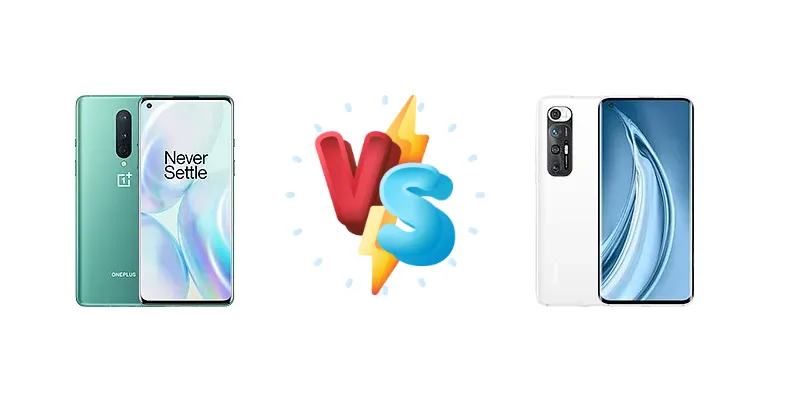
|
🏆 Quick Verdict
For most users, the Xiaomi Mi 10S emerges as the stronger choice. Its Snapdragon 870 chipset delivers a noticeable performance uplift over the OnePlus 8’s Snapdragon 865, and the inclusion of 33W wired and 30W wireless charging provides greater convenience. While the OnePlus 8 boasts a slightly brighter display, the Mi 10S’s overall package is more compelling.
| PHONES | ||
|---|---|---|
| Phone Names | OnePlus 8 | Xiaomi Mi 10S |
| Network | ||
|---|---|---|
| 2G bands | GSM 850 / 900 / 1800 / 1900 | GSM 850 / 900 / 1800 / 1900 |
| 3G bands | HSDPA 800 / 850 / 900 / 1700(AWS) / 1800 / 1900 / 2100 | HSDPA 850 / 900 / 1700(AWS) / 1900 / 2100 |
| 4G bands | 1, 2, 3, 4, 5, 7, 8, 12, 13, 17, 18, 19, 20, 25, 26, 28, 32, 34, 38, 39, 40, 41, 42, 46, 66 - EU | 1, 2, 3, 4, 5, 7, 8, 12, 17, 34, 38, 39, 40, 41 |
| 5G bands | 1, 3, 7, 28, 78 SA/NSA - EU | 1, 3, 41, 78, 79 SA/NSA |
| Speed | HSPA 42.2/5.76 Mbps, LTE (5CA) Cat18 1200/150 Mbps, 5G 7.5 Gbps DL | HSPA, LTE, 5G |
| Technology | GSM / CDMA / HSPA / LTE / 5G | GSM / HSPA / LTE / 5G |
| 41, 78, 79 SA/NSA - CN | - | |
| Launch | ||
|---|---|---|
| Announced | 2020, April 14 | 2021, March 10 |
| Status | Available. Released 2020, April 21 | Available. Released 2021, March 12 |
| Body | ||
|---|---|---|
| Build | Glass front (Gorilla Glass 5), glass back (Gorilla Glass 5), aluminum frame | - |
| Dimensions | 160.2 x 72.9 x 8 mm (6.31 x 2.87 x 0.31 in) | 162.6 x 74.8 x 9 mm (6.40 x 2.94 x 0.35 in) |
| SIM | Nano-SIM + Nano-SIM | Nano-SIM + Nano-SIM |
| Weight | 180 g (6.35 oz) | 208 g (7.34 oz) |
| Display | ||
|---|---|---|
| Protection | Corning Gorilla Glass 5 | Corning Gorilla Glass 5 |
| Resolution | 1080 x 2400 pixels, 20:9 ratio (~402 ppi density) | 1080 x 2340 pixels, 19.5:9 ratio (~386 ppi density) |
| Size | 6.55 inches, 103.6 cm2 (~88.7% screen-to-body ratio) | 6.67 inches, 109.2 cm2 (~89.8% screen-to-body ratio) |
| Type | Fluid AMOLED, 90Hz, HDR10+ | AMOLED, 90Hz, HDR10+, 500 nits (typ), 1120 nits (peak) |
| Platform | ||
|---|---|---|
| CPU | Octa-core (1x2.84 GHz Cortex-A77 & 3x2.42 GHz Cortex-A77 & 4x1.80 GHz Cortex-A55) | Octa-core (1x3.2 GHz Kryo 585 & 3x2.42 GHz Kryo 585 & 4x1.80 GHz Kryo 585) |
| Chipset | Qualcomm SM8250 Snapdragon 865 5G (7 nm+) | Qualcomm SM8250-AC Snapdragon 870 5G (7 nm) |
| GPU | Adreno 650 | Adreno 650 |
| OS | Android 10, upgradable to Android 13, OxygenOS 13 | Android 11, MIUI 12 |
| Memory | ||
|---|---|---|
| Card slot | No | No |
| Internal | 128GB 6GB RAM, 128GB 8GB RAM, 256GB 12GB RAM | 128GB 8GB RAM, 256GB 8GB RAM, 256GB 12GB RAM |
| UFS 3.0, 2-LANE | UFS 3.0 | |
| Main Camera | ||
|---|---|---|
| Features | Dual-LED flash, HDR, panorama | Dual-LED dual-tone flash, HDR, panorama |
| Quad | - | 108 MP, f/1.7, 26mm (wide), 1/1.33", 0.8µm, PDAF, OIS 13 MP, f/2.4, 123˚ (ultrawide) 2 MP (macro) Auxiliary lens |
| Single | - | 20 MP, (wide), 1/3.4", 0.8µm |
| Triple | 48 MP, f/1.8, 26mm (wide), 1/2.0", 0.8µm, PDAF, OIS 16 MP, f/2.2, 14mm, 116˚ (ultrawide), 1/3.6", 1.0µm 2 MP (macro) | - |
| Video | 4K@30/60fps, 1080p@30/60/240fps, Auto HDR, gyro-EIS | 8K@30fps, 4K@30/60fps, 1080p@30/60/120fps; gyro-EIS |
| Selfie camera | ||
|---|---|---|
| Features | HDR | HDR, panorama |
| Single | 16 MP, f/2.4, (wide), 1/3.06", 1.0µm | 20 MP, (wide), 1/3.4", 0.8µm |
| Video | 1080p@30fps, gyro-EIS | 1080p@30fps, 720p@120fps |
| Sound | ||
|---|---|---|
| 3.5mm jack | No | No |
| 35mm jack | No | No |
| Loudspeaker | Yes, with stereo speakers | Yes, with stereo speakers |
| - | 24-bit/192kHz audio Tuned by Harman Kardon | |
| Comms | ||
|---|---|---|
| Bluetooth | 5.1, A2DP, LE, aptX HD | 5.1, A2DP, LE, aptX HD, aptX Adaptive |
| Infrared port | - | Yes |
| NFC | Yes | Yes |
| Positioning | GPS (L1+L5), GLONASS (G1), BDS (B1), GALILEO (E1+E5a) | GPS (L1+L5), GLONASS (G1), BDS (B1I+B2a), GALILEO (E1+E5a), QZSS (L1+L5) |
| Radio | No | No |
| USB | USB Type-C 3.1, OTG | USB Type-C 2.0, OTG |
| WLAN | Wi-Fi 802.11 a/b/g/n/ac/6, dual-band, Wi-Fi Direct, DLNA | Wi-Fi 802.11 a/b/g/n/ac/6, dual-band, Wi-Fi Direct |
| Features | ||
|---|---|---|
| Sensors | Fingerprint (under display, optical), accelerometer, gyro, proximity, compass | Fingerprint (under display, optical), accelerometer, gyro, proximity, compass, barometer |
| Battery | ||
|---|---|---|
| Charging | 30W wired, 50% in 22 min | 33W wired, PD3.0, QC4, 100% in 56 min 30W wireless, 100% in 69 min 10W reverse wireless |
| Type | Li-Po 4300 mAh | Li-Po 4780 mAh |
| Misc | ||
|---|---|---|
| Colors | Onyx Black, Glacial Green, Interstellar Glow, Polar Silver | Titanium Black, Ice Blue, Pearl White |
| Models | IN2013, IN2017, IN2010, IN2019, IN2011 | M2102J2SC |
| Price | About 840 EUR | About 430 EUR |
| Tests | ||
|---|---|---|
| Battery life | Endurance rating 108h | - |
| Camera | Photo / Video | - |
| Display | Contrast ratio: Infinite (nominal) | - |
| Loudspeaker | -22.5 LUFS (Excellent) | - |
| Performance | AnTuTu: 564708 (v8) GeekBench: 13291 (v4.4), 3399 (v5.1) GFXBench: 46fps (ES 3.1 onscreen) | - |
OnePlus 8
- Slightly brighter display (803 nits)
- Established software experience (OxygenOS)
- Compact form factor
- Slower Snapdragon 865 chipset
- Limited charging options (30W wired only)
- No wireless charging
Xiaomi Mi 10S
- Faster Snapdragon 870 chipset
- 33W wired and 30W wireless charging
- Reverse wireless charging
- Potentially less refined software experience (MIUI)
- Larger size and weight
- Display brightness not specified
Display Comparison
The OnePlus 8 features a display capable of reaching 803 nits of peak brightness, providing excellent visibility in direct sunlight. While impressive, the Mi 10S’s display specifications aren’t available, it’s reasonable to assume it’s in the same ballpark. Both displays have an 'Infinite' (nominal) contrast ratio, typical of OLED panels. The OnePlus 8’s display is likely to be more color accurate out of the box, given OnePlus’s historical focus on display calibration, but without specific data on the Mi 10S, this remains an assumption. The lack of high refresh rate on either device is a notable omission compared to later models.
Camera Comparison
Both phones are listed as having 'Photo / Video' capabilities, lacking specific details. Given the market positioning, it’s likely both feature multi-camera systems. Without sensor size or aperture information, a direct comparison is difficult. However, Xiaomi generally prioritizes camera hardware, and the Mi 10S likely benefits from more advanced image processing algorithms. The absence of detailed camera specs makes it hard to definitively declare a winner, but Xiaomi’s track record suggests a slight edge.
Performance
The core difference lies in the chipsets. The OnePlus 8 utilizes the Snapdragon 865 (7nm+), while the Xiaomi Mi 10S steps up to the Snapdragon 870 (7nm). The 870 boasts a faster prime core – 3.2 GHz Kryo 585 versus the 865’s 2.84 GHz Cortex-A77. This translates to a tangible performance advantage in CPU-intensive tasks and gaming. While both chips share the same Adreno 650 GPU, the 870’s higher clock speeds and improved thermal management allow it to sustain peak performance for longer periods. The Mi 10S is the clear winner for users who demand the best possible performance.
Battery Life
The OnePlus 8 has an endurance rating of 108 hours, indicating respectable battery life. The Mi 10S offers a more versatile charging solution: 33W wired (100% in 56 minutes), 30W wireless (100% in 69 minutes), and 10W reverse wireless charging. The OnePlus 8 is limited to 30W wired charging (50% in 22 minutes) and lacks wireless charging. The Mi 10S’s faster wired charging and the addition of wireless charging options provide a significant convenience advantage, offsetting any potential difference in battery capacity.
Buying Guide
Buy the OnePlus 8 if you prioritize a slightly brighter display and a more established software ecosystem, and are comfortable with a slower charging speed. Buy the Xiaomi Mi 10S if you value raw performance, faster charging (both wired and wireless), and a more feature-rich charging experience including reverse wireless charging. The Mi 10S is the better option for power users and gamers.