
OnePlus 8 vs Sony Xperia 1 III: A Deep Dive into Flagship Performance and Battery Life
| Phones Images | |||||
|---|---|---|---|---|---|
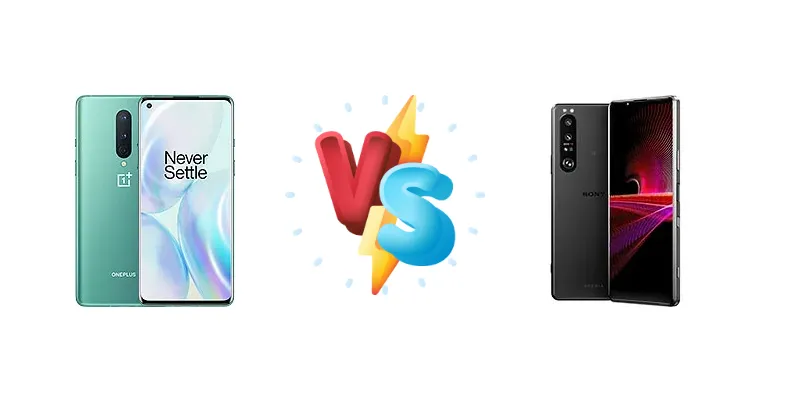
|
🏆 Quick Verdict
For the average user prioritizing value and consistent performance, the OnePlus 8 emerges as the better choice. While the Sony Xperia 1 III boasts a newer Snapdragon 888, its significantly lower battery endurance rating of 82 hours compared to the OnePlus 8’s 108 hours, coupled with a slower 50% charge time, makes it less practical for daily use.
| PHONES | ||
|---|---|---|
| Phone Names | OnePlus 8 | Sony Xperia 1 III |
| Network | ||
|---|---|---|
| 2G bands | GSM 850 / 900 / 1800 / 1900 | GSM 850 / 900 / 1800 / 1900 |
| 3G bands | HSDPA 800 / 850 / 900 / 1700(AWS) / 1800 / 1900 / 2100 | HSDPA 800 / 850 / 900 / 1700(AWS) / 1900 / 2100 |
| 4G bands | 1, 2, 3, 4, 5, 7, 8, 12, 13, 17, 18, 19, 20, 25, 26, 28, 32, 34, 38, 39, 40, 41, 42, 46, 66 - EU | 1, 2, 3, 4, 5, 7, 8, 12, 13, 17, 19, 20, 25, 26, 28, 29, 32, 34, 38, 39, 40, 41, 46, 66 - Europe |
| 5G bands | 1, 3, 7, 28, 78 SA/NSA - EU | 1, 3, 5, 7, 8, 20, 28, 38, 40, 41, 77, 78 SA/NSA/Sub6 - Europe |
| Speed | HSPA 42.2/5.76 Mbps, LTE (5CA) Cat18 1200/150 Mbps, 5G 7.5 Gbps DL | HSPA, LTE, 5G |
| Technology | GSM / CDMA / HSPA / LTE / 5G | GSM / HSPA / LTE / 5G |
| 41, 78, 79 SA/NSA - CN | SA/NSA/Sub6/mmWave - USA (specific) | |
| Launch | ||
|---|---|---|
| Announced | 2020, April 14 | 2021, April 14 |
| Status | Available. Released 2020, April 21 | Available. Released 2021, August 25 |
| Body | ||
|---|---|---|
| Build | Glass front (Gorilla Glass 5), glass back (Gorilla Glass 5), aluminum frame | Glass front (Gorilla Glass Victus), glass back (Gorilla Glass 6), aluminum frame |
| Dimensions | 160.2 x 72.9 x 8 mm (6.31 x 2.87 x 0.31 in) | 165 x 71 x 8.2 mm (6.50 x 2.80 x 0.32 in) |
| SIM | Nano-SIM + Nano-SIM | Nano-SIM + Nano-SIM |
| Weight | 180 g (6.35 oz) | 186 g / 187.1 g (mmWave) (6.56 oz) |
| - | IP65/IP68 dust/water resistant (up to 1.5m for 30 min) | |
| Display | ||
|---|---|---|
| Protection | Corning Gorilla Glass 5 | Corning Gorilla Glass Victus |
| Resolution | 1080 x 2400 pixels, 20:9 ratio (~402 ppi density) | 1644 x 3840 pixels, 21:9 ratio (~643 ppi density) |
| Size | 6.55 inches, 103.6 cm2 (~88.7% screen-to-body ratio) | 6.5 inches, 98.6 cm2 (~84.2% screen-to-body ratio) |
| Type | Fluid AMOLED, 90Hz, HDR10+ | OLED, 1B colors, 120Hz, HDR BT.2020 |
| - | Runs at 1096 x 2560 pixels except for select use cases | |
| Platform | ||
|---|---|---|
| CPU | Octa-core (1x2.84 GHz Cortex-A77 & 3x2.42 GHz Cortex-A77 & 4x1.80 GHz Cortex-A55) | Octa-core (1x2.84 GHz Cortex-X1 & 3x2.42 GHz Cortex-A78 & 4x1.80 GHz Cortex-A55) |
| Chipset | Qualcomm SM8250 Snapdragon 865 5G (7 nm+) | Qualcomm SM8350 Snapdragon 888 5G (5 nm) |
| GPU | Adreno 650 | Adreno 660 |
| OS | Android 10, upgradable to Android 13, OxygenOS 13 | Android 11, upgradable to Android 13 |
| Memory | ||
|---|---|---|
| Card slot | No | microSDXC (uses shared SIM slot) |
| Internal | 128GB 6GB RAM, 128GB 8GB RAM, 256GB 12GB RAM | 256GB 12GB RAM, 512GB 12GB RAM |
| UFS 3.0, 2-LANE | UFS 3.X | |
| Main Camera | ||
|---|---|---|
| Features | Dual-LED flash, HDR, panorama | Zeiss optics, Zeiss T* lens coating, color spectrum sensor, LED flash, panorama, HDR, eye tracking |
| Single | - | 8 MP, f/2.0, 24mm (wide), 1/4", 1.12µm |
| Triple | 48 MP, f/1.8, 26mm (wide), 1/2.0", 0.8µm, PDAF, OIS 16 MP, f/2.2, 14mm, 116˚ (ultrawide), 1/3.6", 1.0µm 2 MP (macro) | 12 MP, f/1.7, 24mm (wide), 1/1.7", 1.8µm, dual pixel PDAF, OIS 12 MP, f/2.3, 70mm (telephoto), f/2.8, 105mm (telephoto), 1/2.9", dual pixel PDAF, 3x/4.4x optical zoom, OIS 12 MP, f/2.2, 124˚, 16mm (ultrawide), 1/2.6", dual pixel PDAF 0.3 MP, TOF 3D, (depth) |
| Video | 4K@30/60fps, 1080p@30/60/240fps, Auto HDR, gyro-EIS | 4K@24/25/30/60/120fps HDR, 1080p@30/60/120fps; 5-axis gyro-EIS, OIS |
| Selfie camera | ||
|---|---|---|
| Features | HDR | HDR |
| Single | 16 MP, f/2.4, (wide), 1/3.06", 1.0µm | 8 MP, f/2.0, 24mm (wide), 1/4.0", 1.12µm |
| Video | 1080p@30fps, gyro-EIS | 1080p@30fps, 5-axis gyro-EIS |
| Sound | ||
|---|---|---|
| 3.5mm jack | No | Yes |
| 35mm jack | No | Yes |
| Loudspeaker | Yes, with stereo speakers | Yes, with stereo speakers |
| - | 24-bit/192kHz audio Dynamic vibration system | |
| Comms | ||
|---|---|---|
| Bluetooth | 5.1, A2DP, LE, aptX HD | 5.2, A2DP, LE, aptX HD, aptX Adaptive |
| NFC | Yes | Yes |
| Positioning | GPS (L1+L5), GLONASS (G1), BDS (B1), GALILEO (E1+E5a) | GPS, GLONASS, BDS, GALILEO, QZSS |
| Radio | No | No |
| USB | USB Type-C 3.1, OTG | USB Type-C 3.1, OTG, video output |
| WLAN | Wi-Fi 802.11 a/b/g/n/ac/6, dual-band, Wi-Fi Direct, DLNA | Wi-Fi 802.11 a/b/g/n/ac/6, dual-band, Wi-Fi Direct, DLNA |
| Features | ||
|---|---|---|
| Sensors | Fingerprint (under display, optical), accelerometer, gyro, proximity, compass | Fingerprint (side-mounted), accelerometer, gyro, proximity, barometer, compass |
| - | Native Sony Alpha camera support | |
| Battery | ||
|---|---|---|
| Charging | 30W wired, 50% in 22 min | 30W wired, PD, 50% in 30 min Wireless Reverse wireless |
| Type | Li-Po 4300 mAh | Li-Po 4500 mAh |
| Misc | ||
|---|---|---|
| Colors | Onyx Black, Glacial Green, Interstellar Glow, Polar Silver | Frosted Black, Frosted Gray, Frosted Purple |
| Models | IN2013, IN2017, IN2010, IN2019, IN2011 | XQBC62/V, XQBC52V.UKCX, SO-51B, SOG03, A101SO, XQ-BC62, XQ-BC72, XQ-BC52, XQ-BC01, XQ-BC11, XQ-BC21, XQ-BC72 |
| Price | About 840 EUR | € 505.26 / $ 903.43 |
| Tests | ||
|---|---|---|
| Battery life | Endurance rating 108h | Endurance rating 82h |
| Camera | Photo / Video | Photo / Video |
| Display | Contrast ratio: Infinite (nominal) | Contrast ratio: Infinite (nominal) |
| Loudspeaker | -22.5 LUFS (Excellent) | -26.5 LUFS (Good) |
| Performance | AnTuTu: 564708 (v8) GeekBench: 13291 (v4.4), 3399 (v5.1) GFXBench: 46fps (ES 3.1 onscreen) | AnTuTu: 607423 (v8) GeekBench: 3515 (v5.1) GFXBench: 54fps (ES 3.1 onscreen) |
OnePlus 8
- Superior battery endurance (108h)
- Faster charging speed (22 min to 50%)
- Better value for money
- Older Snapdragon 865 chipset
- Potentially lower peak camera performance
Sony Xperia 1 III
- Newer Snapdragon 888 chipset
- Wireless and reverse wireless charging
- Potentially better image processing
- Significantly lower battery endurance (82h)
- Slower charging speed (30 min to 50%)
- Lower peak display brightness
Display Comparison
The OnePlus 8 features a display capable of reaching 803 nits of peak brightness, providing good visibility outdoors. However, the Sony Xperia 1 III lags behind at 620 nits, potentially struggling in direct sunlight. Both displays share an 'Infinite' (nominal) contrast ratio, suggesting deep blacks, but the Xperia 1 III’s lower brightness impacts overall image vibrancy. While neither specification details refresh rate, the Xperia 1 III’s target audience would likely benefit from a higher refresh rate for smoother video playback, a feature the OnePlus 8 may or may not have.
Camera Comparison
Both phones offer photo and video capabilities, but the context data lacks specifics to make a definitive judgment. The Xperia 1 III’s Snapdragon 888 includes an upgraded Image Signal Processor (ISP), potentially leading to better image processing and low-light performance. However, without sensor size or aperture information, it’s difficult to assess the raw image quality. The Xperia 1 III’s focus on professional video recording suggests a more robust suite of video features, but the OnePlus 8’s camera system is likely capable of producing excellent results for casual users. The absence of detail regarding OIS on either device makes it impossible to compare stabilization performance.
Performance
The Sony Xperia 1 III’s Snapdragon 888 (5nm) represents a generational leap over the OnePlus 8’s Snapdragon 865 (7nm+). The 5nm process inherently offers improved power efficiency and thermal characteristics. The Xperia 1 III’s CPU configuration, featuring a Cortex-X1 prime core, promises faster single-core performance compared to the OnePlus 8’s Cortex-A77. However, the real-world performance difference may be less pronounced for typical tasks, and the OnePlus 8’s optimized software could mitigate the chipset gap. Both devices utilize Octa-core CPUs, but the architectural improvements in the Cortex-A78 cores of the Xperia 1 III contribute to a more modern and efficient processing experience.
Battery Life
The OnePlus 8’s endurance rating of 108 hours significantly surpasses the Sony Xperia 1 III’s 82 hours. This suggests the OnePlus 8 can comfortably last a full day of moderate to heavy use, while the Xperia 1 III may require more frequent charging. Despite both supporting 30W wired charging, the OnePlus 8 achieves 50% charge in 22 minutes, while the Xperia 1 III takes 30 minutes. The Xperia 1 III adds wireless and reverse wireless charging, offering convenience, but these features come at the cost of overall battery efficiency and slower charging speeds.
Buying Guide
Buy the OnePlus 8 if you need a reliable daily driver with excellent battery life and a smooth, responsive experience. It’s ideal for users who prioritize value and don’t require the absolute latest features. Buy the Sony Xperia 1 III if you are a content creator or enthusiast who values a more specialized feature set, and are willing to trade battery life for the potential benefits of the Snapdragon 888’s image signal processor and multimedia capabilities.