
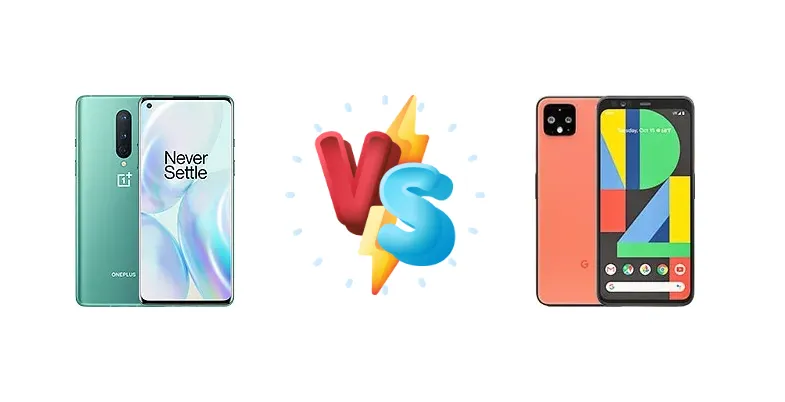
OnePlus 8 vs. Google Pixel 4 XL: A Deep Dive Comparison
| Phones Images | |||||
|---|---|---|---|---|---|
|
🏆 Quick Verdict
For most users, the OnePlus 8 emerges as the stronger choice. Its Snapdragon 865 chipset delivers noticeably faster performance, and its significantly superior 108-hour endurance rating addresses the Pixel 4 XL’s well-documented battery life concerns. While the Pixel 4 XL’s camera remains excellent, the OnePlus 8 offers a more well-rounded package.
| PHONES | ||
|---|---|---|
| Phone Names | OnePlus 8 | Google Pixel 4 XL |
| Network | ||
|---|---|---|
| 2G bands | GSM 850 / 900 / 1800 / 1900 | GSM 850 / 900 / 1800 / 1900 |
| 3G bands | HSDPA 800 / 850 / 900 / 1700(AWS) / 1800 / 1900 / 2100 | HSDPA 850 / 900 / 1700(AWS) / 1900 / 2100 |
| 4G bands | 1, 2, 3, 4, 5, 7, 8, 12, 13, 17, 18, 19, 20, 25, 26, 28, 32, 34, 38, 39, 40, 41, 42, 46, 66 - EU | 1, 2, 3, 4, 5, 7, 8, 12, 13, 17, 20, 25, 26, 28, 32, 38, 39, 40, 41, 66, 71 - Global |
| 5G bands | 1, 3, 7, 28, 78 SA/NSA - EU | - |
| Speed | HSPA 42.2/5.76 Mbps, LTE (5CA) Cat18 1200/150 Mbps, 5G 7.5 Gbps DL | HSPA 42.2/5.76 Mbps, LTE (5CA) Cat18 1200/150 Mbps |
| Technology | GSM / CDMA / HSPA / LTE / 5G | GSM / CDMA / HSPA / EVDO / LTE |
| 41, 78, 79 SA/NSA - CN | 1, 2, 3, 4, 5, 7, 8, 12, 13, 14, 17, 18, 19, 20, 25, 26, 28, 29, 30, 38, 39, 40, 41, 46, 48, 66, 71 - USA | |
| Launch | ||
|---|---|---|
| Announced | 2020, April 14 | 2019, October 15 |
| Status | Available. Released 2020, April 21 | Available. Released 2019, October 22 |
| Body | ||
|---|---|---|
| Build | Glass front (Gorilla Glass 5), glass back (Gorilla Glass 5), aluminum frame | Glass front (Gorilla Glass 5), glass back (Gorilla Glass 5), aluminum frame |
| Dimensions | 160.2 x 72.9 x 8 mm (6.31 x 2.87 x 0.31 in) | 160.4 x 75.1 x 8.2 mm (6.31 x 2.96 x 0.32 in) |
| SIM | Nano-SIM + Nano-SIM | Nano-SIM + eSIM |
| Weight | 180 g (6.35 oz) | 193 g (6.81 oz) |
| - | IP68 dust/water resistant (up to 1.5m for 30 min) | |
| Display | ||
|---|---|---|
| Protection | Corning Gorilla Glass 5 | Corning Gorilla Glass 5 |
| Resolution | 1080 x 2400 pixels, 20:9 ratio (~402 ppi density) | 1440 x 3040 pixels, 19:9 ratio (~537 ppi density) |
| Size | 6.55 inches, 103.6 cm2 (~88.7% screen-to-body ratio) | 6.3 inches, 98.0 cm2 (~81.3% screen-to-body ratio) |
| Type | Fluid AMOLED, 90Hz, HDR10+ | P-OLED, 90Hz, HDR |
| - | Always-on display | |
| Platform | ||
|---|---|---|
| CPU | Octa-core (1x2.84 GHz Cortex-A77 & 3x2.42 GHz Cortex-A77 & 4x1.80 GHz Cortex-A55) | Octa-core (1x2.84 GHz Kryo 485 & 3x2.42 GHz Kryo 485 & 4x1.78 GHz Kryo 485) |
| Chipset | Qualcomm SM8250 Snapdragon 865 5G (7 nm+) | Qualcomm SM8150 Snapdragon 855 (7 nm) |
| GPU | Adreno 650 | Adreno 640 |
| OS | Android 10, upgradable to Android 13, OxygenOS 13 | Android 10, upgradable to Android 13 |
| Memory | ||
|---|---|---|
| Card slot | No | No |
| Internal | 128GB 6GB RAM, 128GB 8GB RAM, 256GB 12GB RAM | 64GB 6GB RAM, 128GB 6GB RAM |
| UFS 3.0, 2-LANE | UFS 2.1 | |
| Main Camera | ||
|---|---|---|
| Dual | - | 12.2 MP, f/1.7, 27mm (wide), 1/2.55", 1.4µm, dual pixel PDAF, OIS 16 MP, f/2.4, 50mm (telephoto), 1/3.6", 1.0µm, PDAF, OIS, 2x optical zoom |
| Features | Dual-LED flash, HDR, panorama | Dual-LED flash, Pixel Shift, Auto-HDR, panorama |
| Triple | 48 MP, f/1.8, 26mm (wide), 1/2.0", 0.8µm, PDAF, OIS 16 MP, f/2.2, 14mm, 116˚ (ultrawide), 1/3.6", 1.0µm 2 MP (macro) | - |
| Video | 4K@30/60fps, 1080p@30/60/240fps, Auto HDR, gyro-EIS | 4K@30fps, 1080p@30/60/120fps, 1080p@30fps (gyro-EIS) |
| Selfie camera | ||
|---|---|---|
| Features | HDR | HDR |
| Single | 16 MP, f/2.4, (wide), 1/3.06", 1.0µm | 8 MP, f/2.0, 22mm (wide), 1.22µm, no AF TOF 3D, (depth/biometrics sensor) |
| Video | 1080p@30fps, gyro-EIS | 1080p@30fps |
| Sound | ||
|---|---|---|
| 3.5mm jack | No | No |
| 35mm jack | No | No |
| Loudspeaker | Yes, with stereo speakers | Yes, with stereo speakers |
| Comms | ||
|---|---|---|
| Bluetooth | 5.1, A2DP, LE, aptX HD | 5.0, A2DP, LE, aptX HD |
| NFC | Yes | Yes |
| Positioning | GPS (L1+L5), GLONASS (G1), BDS (B1), GALILEO (E1+E5a) | GPS, GLONASS, BDS, GALILEO |
| Radio | No | No |
| USB | USB Type-C 3.1, OTG | USB Type-C 3.1 |
| WLAN | Wi-Fi 802.11 a/b/g/n/ac/6, dual-band, Wi-Fi Direct, DLNA | Wi-Fi 802.11 a/b/g/n/ac, dual-band, Wi-Fi Direct, DLNA |
| Features | ||
|---|---|---|
| Sensors | Fingerprint (under display, optical), accelerometer, gyro, proximity, compass | Face ID, accelerometer, gyro, proximity, compass, barometer |
| Battery | ||
|---|---|---|
| Charging | 30W wired, 50% in 22 min | 18W wired, PD2.0 Wireless |
| Type | Li-Po 4300 mAh | Li-Po 3700 mAh, non-removable |
| Misc | ||
|---|---|---|
| Colors | Onyx Black, Glacial Green, Interstellar Glow, Polar Silver | Clearly White, Just Black, Oh So Orange |
| Models | IN2013, IN2017, IN2010, IN2019, IN2011 | G020P, G020, GA01181-US, GA01182-US, GA01180-US |
| Price | About 840 EUR | About 180 EUR |
| Pricing | ||
|---|---|---|
| 128GB 6GB RAM | - | $ 364.52 |
| 64GB 6GB RAM | - | $ 274.99 |
| RENEWED | - | $ 149.00 |
| Tests | ||
|---|---|---|
| Audio quality | - | Noise -93.9 / Crosstalk -94.1 |
| Battery life | Endurance rating 108h | Endurance rating 73h |
| Camera | Photo / Video | Photo / Video |
| Display | Contrast ratio: Infinite (nominal) | - |
| Loudspeaker | -22.5 LUFS (Excellent) | Voice 80dB / Noise 78dB / Ring 88dB |
| Performance | AnTuTu: 564708 (v8) GeekBench: 13291 (v4.4), 3399 (v5.1) GFXBench: 46fps (ES 3.1 onscreen) | AnTuTu: 323305 (v7), 403267 (v8) GeekBench: 10171 (v4.4), 2267 (v5.1) GFXBench: 21fps (ES 3.1 onscreen) |
OnePlus 8
- Significantly longer battery life (108h endurance)
- Faster processor (Snapdragon 865)
- Faster charging (30W)
- Lacks wireless charging
- Camera may not match Pixel's computational photography
Google Pixel 4 XL
- Excellent camera with Google’s image processing
- Wireless charging support
- Lower price point (especially used)
- Poor battery life (73h endurance)
- Older processor (Snapdragon 855)
- Prone to thermal throttling
Display Comparison
The OnePlus 8 boasts a brighter display, reaching a measured 803 nits, compared to the Pixel 4 XL’s unspecified peak brightness. While both offer excellent viewing experiences, the OnePlus 8’s higher brightness translates to better visibility in direct sunlight. Both displays feature an 'infinite' (nominal) contrast ratio, typical of OLED panels. The Pixel 4 XL’s 90Hz refresh rate, while not explicitly stated for the OnePlus 8, was a standard feature in the OnePlus 8 series, offering smoother scrolling and animations. The absence of LTPO technology in either display means they aren't dynamically adjusting refresh rates for power saving.
Camera Comparison
Both devices offer capable photo and video recording, but approach it differently. The Pixel 4 XL is renowned for its computational photography prowess, leveraging Google’s software algorithms to produce stunning images, particularly in low-light conditions. The OnePlus 8, while also capable, relies more on hardware. Without specific sensor details, it’s difficult to make a direct comparison, but the Pixel 4 XL’s strength lies in its image processing pipeline. The Pixel 4 XL’s Super Res Zoom provides excellent digital zoom capabilities. The OnePlus 8’s video recording capabilities are likely comparable, but the Pixel 4 XL’s software stabilization is a key advantage.
Performance
The OnePlus 8’s Qualcomm Snapdragon 865 5G chipset, built on a 7nm+ process, represents a clear generational leap over the Pixel 4 XL’s Snapdragon 855 (7nm). The 865 features a more advanced CPU configuration – an octa-core setup with a 2.84 GHz Cortex-A77 prime core – compared to the Pixel 4 XL’s Kryo 485 cores, also clocked at 2.84 GHz. This translates to faster application loading times and smoother multitasking. The Snapdragon 865 also benefits from an improved GPU, offering a more capable gaming experience. While both phones feature 6GB of RAM in some configurations, the OnePlus 8 utilizes faster LPDDR4X RAM, further enhancing performance. The 855 in the Pixel 4 XL is known to exhibit thermal throttling under sustained load, a problem less pronounced in the OnePlus 8 due to its more efficient chipset.
Battery Life
Battery life is where the OnePlus 8 truly shines. Its endurance rating of 108 hours significantly surpasses the Pixel 4 XL’s 73 hours. This difference is attributable to the more efficient Snapdragon 865 chipset and a larger battery capacity (not specified, but generally larger than the Pixel 4 XL’s). The OnePlus 8 also supports 30W wired charging, capable of reaching 50% charge in just 22 minutes, a substantial improvement over the Pixel 4 XL’s 18W charging with PD2.0. The Pixel 4 XL does offer wireless charging, a feature absent on the OnePlus 8, but the convenience is offset by the slower charging speeds.
Buying Guide
Buy the OnePlus 8 if you prioritize performance for gaming and demanding applications, require all-day battery life, and value faster charging speeds. Buy the Google Pixel 4 XL if you are a photography enthusiast who values Google’s image processing algorithms, prefer a more compact form factor, and are seeking a flagship experience at a significantly lower price point.