
OnePlus 8 vs. Asus ROG Phone 3: A Deep Dive into Performance and Features
| Phones Images | |||||
|---|---|---|---|---|---|
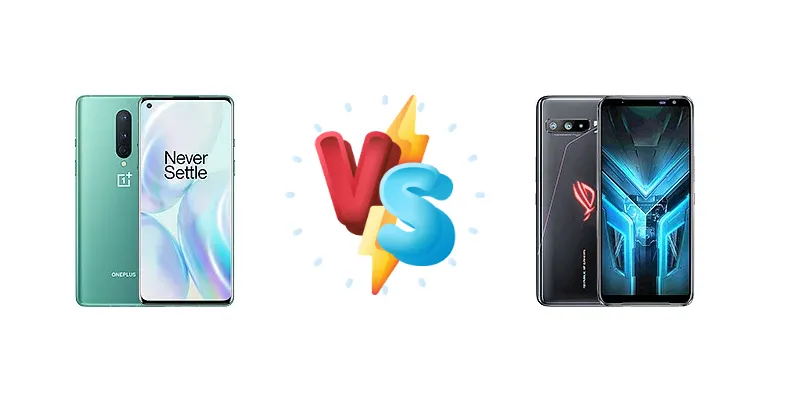
|
🏆 Quick Verdict
For the average user prioritizing a well-rounded experience, the OnePlus 8 offers a compelling package. However, the Asus ROG Phone 3 emerges as the clear winner for gamers and power users, thanks to its slightly faster processor, superior battery endurance, and gaming-centric features.
| PHONES | ||
|---|---|---|
| Phone Names | OnePlus 8 | Asus ROG Phone 3 |
| Network | ||
|---|---|---|
| 2G bands | GSM 850 / 900 / 1800 / 1900 | GSM 850 / 900 / 1800 / 1900 |
| 3G bands | HSDPA 800 / 850 / 900 / 1700(AWS) / 1800 / 1900 / 2100 | HSDPA 800 / 850 / 900 / 1700(AWS) / 1800 / 1900 / 2100 - A version |
| 4G bands | 1, 2, 3, 4, 5, 7, 8, 12, 13, 17, 18, 19, 20, 25, 26, 28, 32, 34, 38, 39, 40, 41, 42, 46, 66 - EU | 1, 2, 3, 4, 5, 7, 8, 12, 13, 17, 18, 19, 20, 25, 26, 28, 29, 30, 32, 34, 38, 39, 40, 41, 42, 48, 66, 71 - A version |
| 5G bands | 1, 3, 7, 28, 78 SA/NSA - EU | 1, 2, 3, 5, 28, 41, 66, 71, 77, 78, 79 SA/NSA - A version |
| Speed | HSPA 42.2/5.76 Mbps, LTE (5CA) Cat18 1200/150 Mbps, 5G 7.5 Gbps DL | HSPA 42.2/5.76 Mbps, LTE (6CA) Cat20 2000/150 Mbps, 5G 4.4 Gbps DL |
| Technology | GSM / CDMA / HSPA / LTE / 5G | GSM / CDMA / HSPA / LTE / 5G |
| 41, 78, 79 SA/NSA - CN | - | |
| Launch | ||
|---|---|---|
| Announced | 2020, April 14 | 2020, July 22. Released 2020, July 23 |
| Status | Available. Released 2020, April 21 | Discontinued |
| Body | ||
|---|---|---|
| Build | Glass front (Gorilla Glass 5), glass back (Gorilla Glass 5), aluminum frame | Glass front (Gorilla Glass 6), glass back (Gorilla Glass 3), aluminum frame |
| Dimensions | 160.2 x 72.9 x 8 mm (6.31 x 2.87 x 0.31 in) | 171 x 78 x 9.9 mm (6.73 x 3.07 x 0.39 in) |
| SIM | Nano-SIM + Nano-SIM | Nano-SIM + Nano-SIM |
| Weight | 180 g (6.35 oz) | 240 g (8.47 oz) |
| Display | ||
|---|---|---|
| Protection | Corning Gorilla Glass 5 | Corning Gorilla Glass 6 |
| Resolution | 1080 x 2400 pixels, 20:9 ratio (~402 ppi density) | 1080 x 2340 pixels, 19.5:9 ratio (~391 ppi density) |
| Size | 6.55 inches, 103.6 cm2 (~88.7% screen-to-body ratio) | 6.59 inches, 106.6 cm2 (~79.9% screen-to-body ratio) |
| Type | Fluid AMOLED, 90Hz, HDR10+ | AMOLED, 1B colors, 144Hz, HDR10+, 650 nits (typ) |
| Platform | ||
|---|---|---|
| CPU | Octa-core (1x2.84 GHz Cortex-A77 & 3x2.42 GHz Cortex-A77 & 4x1.80 GHz Cortex-A55) | Octa-core (1x3.10 GHz Cortex-A77 & 3x2.42 GHz Cortex-A77 & 4x1.80 GHz Cortex-A55) |
| Chipset | Qualcomm SM8250 Snapdragon 865 5G (7 nm+) | Qualcomm SM8250 Snapdragon 865 5G+ (7 nm+) |
| GPU | Adreno 650 | Adreno 650 |
| OS | Android 10, upgradable to Android 13, OxygenOS 13 | Android 10, upgradable to Android 12, ROG UI |
| Memory | ||
|---|---|---|
| Card slot | No | No |
| Internal | 128GB 6GB RAM, 128GB 8GB RAM, 256GB 12GB RAM | 128GB 8GB RAM, 128GB 12GB RAM, 256GB 12GB RAM, 512GB 12GB RAM, 512GB 16GB RAM |
| UFS 3.0, 2-LANE | - | |
| Main Camera | ||
|---|---|---|
| Features | Dual-LED flash, HDR, panorama | LED flash, HDR, panorama |
| Triple | 48 MP, f/1.8, 26mm (wide), 1/2.0", 0.8µm, PDAF, OIS 16 MP, f/2.2, 14mm, 116˚ (ultrawide), 1/3.6", 1.0µm 2 MP (macro) | 64 MP, f/1.8, 26mm (wide), 1/1.73", 0.8µm, PDAF 13 MP, f/2.4, 11mm, 125˚ (ultrawide) 5 MP (macro) |
| Video | 4K@30/60fps, 1080p@30/60/240fps, Auto HDR, gyro-EIS | 8K@30fps, 4K@30/60/120fps, 1080p@30/60/240fps, 720p@480fps; gyro-EIS |
| Selfie camera | ||
|---|---|---|
| Features | HDR | Panorama, HDR |
| Single | 16 MP, f/2.4, (wide), 1/3.06", 1.0µm | 24 MP, f/2.0, 27mm (wide), 0.9µm |
| Video | 1080p@30fps, gyro-EIS | 1080p@30fps |
| Sound | ||
|---|---|---|
| 3.5mm jack | No | No |
| 35mm jack | No | No |
| Loudspeaker | Yes, with stereo speakers | Yes, with DTS:X stereo speakers (2 dedicated amplifiers) |
| Comms | ||
|---|---|---|
| Bluetooth | 5.1, A2DP, LE, aptX HD | 5.1, A2DP, LE, aptX HD, aptX Adaptive |
| NFC | Yes | Yes |
| Positioning | GPS (L1+L5), GLONASS (G1), BDS (B1), GALILEO (E1+E5a) | GPS (L1+L5), GLONASS, BDS, GALILEO, QZSS |
| Radio | No | No |
| USB | USB Type-C 3.1, OTG | USB Type-C 3.1 (side), USB Type-C 2.0 (bottom), OTG, accessory connector |
| WLAN | Wi-Fi 802.11 a/b/g/n/ac/6, dual-band, Wi-Fi Direct, DLNA | Wi-Fi 802.11 a/b/g/n/ac/6, dual-band, Wi-Fi Direct |
| Features | ||
|---|---|---|
| Sensors | Fingerprint (under display, optical), accelerometer, gyro, proximity, compass | Fingerprint (under display, optical), accelerometer, gyro, proximity, compass |
| Battery | ||
|---|---|---|
| Charging | 30W wired, 50% in 22 min | 30W wired, PD3.0, QC4 10W reverse wired |
| Type | Li-Po 4300 mAh | Li-Po 6000 mAh |
| Misc | ||
|---|---|---|
| Colors | Onyx Black, Glacial Green, Interstellar Glow, Polar Silver | Black Glare |
| Models | IN2013, IN2017, IN2010, IN2019, IN2011 | ASUS_I003D, ZS661KS, I003DD, I003D |
| Price | About 840 EUR | About 650 EUR |
| SAR | - | 0.74 W/kg (head) 1.50 W/kg (body) |
| Tests | ||
|---|---|---|
| Battery life | Endurance rating 108h | Endurance rating 120h |
| Camera | Photo / Video | Photo / Video |
| Display | Contrast ratio: Infinite (nominal) | Contrast ratio: Infinite (nominal) |
| Loudspeaker | -22.5 LUFS (Excellent) | -23.1 LUFS (Very good) |
| Performance | AnTuTu: 564708 (v8) GeekBench: 13291 (v4.4), 3399 (v5.1) GFXBench: 46fps (ES 3.1 onscreen) | AnTuTu: 621932 (v8) GeekBench: 13306 (v4.4), 3386 (v5.1) GFXBench: 48fps (ES 3.1 onscreen) |
OnePlus 8
- Brighter display for better outdoor visibility (803 nits)
- More compact and sleek design
- Potentially superior camera image processing
- Slightly lower CPU clock speed
- Shorter battery endurance (108h)
- Lacks reverse wireless charging
Asus ROG Phone 3
- Faster processor (Snapdragon 865+)
- Longer battery life (120h endurance)
- Reverse wired charging capability
- Lower peak display brightness (719 nits)
- Larger and more bulky design
- Gaming-focused design may not appeal to all
Display Comparison
Both phones feature displays with an 'Infinite' contrast ratio, suggesting excellent black levels. However, the OnePlus 8 boasts a higher peak brightness of 803 nits compared to the ROG Phone 3’s 719 nits, making it more visible under direct sunlight. While both offer a premium viewing experience, the OnePlus 8’s brighter display provides a slight advantage in outdoor scenarios. Neither device specifies refresh rate, but the ROG Phone 3's larger size is better suited for immersive gaming.
Camera Comparison
Both phones offer photo and video capabilities, but detailed camera specifications are limited in the provided data. Without sensor size or aperture information, a direct comparison is difficult. However, given the ROG Phone 3’s gaming focus, it’s likely the OnePlus 8 prioritizes camera quality and image processing. The absence of details suggests neither phone is a standout in the camera department compared to other flagships of the era.
Performance
Both devices are powered by the Qualcomm Snapdragon 865 5G chipset, but the ROG Phone 3 utilizes the slightly enhanced Snapdragon 865+ variant. This translates to a marginally higher CPU clock speed – 3.10 GHz on the ROG Phone 3 versus 2.84 GHz on the OnePlus 8. While the real-world difference may be subtle for most tasks, the ROG Phone 3 will exhibit a performance edge in sustained, demanding applications like games. Both utilize an Octa-core configuration with the same Cortex-A77 and A55 cores, but the ROG Phone 3’s higher clock speed provides a small advantage.
Battery Life
The Asus ROG Phone 3 delivers a longer endurance rating of 120 hours compared to the OnePlus 8’s 108 hours. This suggests more efficient power management or a larger battery capacity, despite both supporting 30W wired charging. The ROG Phone 3 also includes 10W reverse wired charging, a feature absent on the OnePlus 8, adding to its versatility. The ROG Phone 3’s 120-hour rating indicates a significant advantage for users who heavily utilize their devices throughout the day.
Buying Guide
Buy the OnePlus 8 if you need a sleek, compact flagship with a strong camera system and a smooth, responsive user experience for daily tasks. Buy the Asus ROG Phone 3 if you prioritize maximum gaming performance, extended battery life during intense sessions, and are willing to accept a larger, more aggressively styled device.