
OnePlus 8 vs. iPhone 11 Pro Max: A Deep Dive into Flagship Performance and Value
| Phones Images | |||||
|---|---|---|---|---|---|
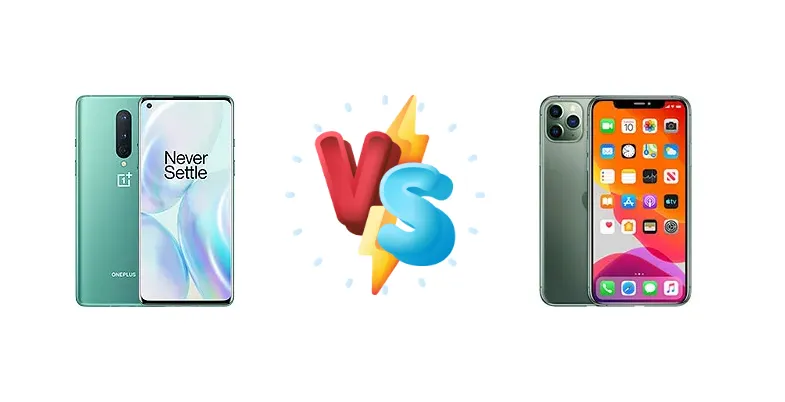
|
🏆 Quick Verdict
For the average user prioritizing long-term software support, efficient performance, and a polished ecosystem, the iPhone 11 Pro Max is the stronger choice. However, the OnePlus 8 offers compelling value with its faster charging and comparable performance for a significantly lower price, making it ideal for Android enthusiasts.
| PHONES | ||
|---|---|---|
| Phone Names | OnePlus 8 | Apple iPhone 11 Pro Max |
| Network | ||
|---|---|---|
| 2G bands | GSM 850 / 900 / 1800 / 1900 | GSM 850 / 900 / 1800 / 1900 |
| 3G bands | HSDPA 800 / 850 / 900 / 1700(AWS) / 1800 / 1900 / 2100 | HSDPA 850 / 900 / 1700(AWS) / 1900 / 2100 |
| 4G bands | 1, 2, 3, 4, 5, 7, 8, 12, 13, 17, 18, 19, 20, 25, 26, 28, 32, 34, 38, 39, 40, 41, 42, 46, 66 - EU | 1, 2, 3, 4, 5, 7, 8, 11, 12, 13, 17, 18, 19, 20, 21, 25, 26, 28, 29, 30, 32, 34, 38, 39, 40, 41, 42, 46, 48, 66 - A2218 |
| 5G bands | 1, 3, 7, 28, 78 SA/NSA - EU | - |
| Speed | HSPA 42.2/5.76 Mbps, LTE (5CA) Cat18 1200/150 Mbps, 5G 7.5 Gbps DL | HSPA, LTE 1.6 Gbps DL, EV-DO Rev.A 3.1 Mbps |
| Technology | GSM / CDMA / HSPA / LTE / 5G | GSM / CDMA / HSPA / EVDO / LTE |
| 41, 78, 79 SA/NSA - CN | 1, 2, 3, 4, 5, 7, 8, 12, 13, 14, 17, 18, 19, 20, 25, 26, 29, 30, 34, 38, 39, 40, 41, 42, 46, 48, 66, 71 - A2161, A2220 | |
| Launch | ||
|---|---|---|
| Announced | 2020, April 14 | 2019, September 10 |
| Status | Available. Released 2020, April 21 | Available. Released 2019, September 20 |
| Body | ||
|---|---|---|
| Build | Glass front (Gorilla Glass 5), glass back (Gorilla Glass 5), aluminum frame | Glass front (Corning-made glass), glass back (Corning-made glass), stainless steel frame |
| Dimensions | 160.2 x 72.9 x 8 mm (6.31 x 2.87 x 0.31 in) | 158 x 77.8 x 8.1 mm (6.22 x 3.06 x 0.32 in) |
| SIM | Nano-SIM + Nano-SIM | · Nano-SIM + eSIM· Nano-SIM + Nano-SIM (China) |
| Weight | 180 g (6.35 oz) | 226 g (7.97 oz) |
| - | IP68 dust/water resistant (up to 4m for 30 min) Apple Pay (Visa, MasterCard, AMEX certified) | |
| Display | ||
|---|---|---|
| Protection | Corning Gorilla Glass 5 | Scratch-resistant glass |
| Resolution | 1080 x 2400 pixels, 20:9 ratio (~402 ppi density) | 1242 x 2688 pixels, 19.5:9 ratio (~458 ppi density) |
| Size | 6.55 inches, 103.6 cm2 (~88.7% screen-to-body ratio) | 6.5 inches, 102.9 cm2 (~83.7% screen-to-body ratio) |
| Type | Fluid AMOLED, 90Hz, HDR10+ | Super Retina XDR OLED, HDR10, Dolby Vision, 800 nits (HBM), 1200 nits (peak) |
| Platform | ||
|---|---|---|
| CPU | Octa-core (1x2.84 GHz Cortex-A77 & 3x2.42 GHz Cortex-A77 & 4x1.80 GHz Cortex-A55) | Hexa-core (2x2.65 GHz Lightning + 4x1.8 GHz Thunder) |
| Chipset | Qualcomm SM8250 Snapdragon 865 5G (7 nm+) | Apple A13 Bionic (7 nm+) |
| GPU | Adreno 650 | Apple GPU (4-core graphics) |
| OS | Android 10, upgradable to Android 13, OxygenOS 13 | iOS 13, upgradable to iOS 26.1 |
| Memory | ||
|---|---|---|
| Card slot | No | No |
| Internal | 128GB 6GB RAM, 128GB 8GB RAM, 256GB 12GB RAM | 64GB 4GB RAM, 256GB 4GB RAM, 512GB 4GB RAM |
| UFS 3.0, 2-LANE | NVMe | |
| Main Camera | ||
|---|---|---|
| Features | Dual-LED flash, HDR, panorama | Dual-LED dual-tone flash, HDR (photo/panorama) |
| Single | - | 13 MP, f/2.2, PDAF |
| Triple | 48 MP, f/1.8, 26mm (wide), 1/2.0", 0.8µm, PDAF, OIS 16 MP, f/2.2, 14mm, 116˚ (ultrawide), 1/3.6", 1.0µm 2 MP (macro) | 12 MP, f/1.8, 26mm (wide), 1/2.55", 1.4µm, dual pixel PDAF, OIS 12 MP, f/2.0, 52mm (telephoto), 1/3.4", 1.0µm, PDAF, OIS, 2x optical zoom 12 MP, f/2.4, 120˚, 13mm (ultrawide), 1/3.6" |
| Video | 4K@30/60fps, 1080p@30/60/240fps, Auto HDR, gyro-EIS | 4K@24/25/30/60fps, 1080p@25/30/60/120/240fps, HDR, stereo sound rec. |
| Selfie camera | ||
|---|---|---|
| Features | HDR | HDR |
| Single | 16 MP, f/2.4, (wide), 1/3.06", 1.0µm | 12 MP, f/2.2, 23mm (wide), 1/3.6", 1.0µm SL 3D, (depth/biometrics sensor) |
| Video | 1080p@30fps, gyro-EIS | 4K@24/25/30/60fps, 1080p@25/30/60/120fps, gyro-EIS |
| Sound | ||
|---|---|---|
| 3.5mm jack | No | No |
| 35mm jack | No | No |
| Loudspeaker | Yes, with stereo speakers | Yes, with stereo speakers |
| Comms | ||
|---|---|---|
| Bluetooth | 5.1, A2DP, LE, aptX HD | 5.0, A2DP, LE |
| NFC | Yes | Yes |
| Positioning | GPS (L1+L5), GLONASS (G1), BDS (B1), GALILEO (E1+E5a) | GPS, GLONASS, GALILEO, QZSS |
| Radio | No | No |
| USB | USB Type-C 3.1, OTG | Lightning, USB 2.0 |
| WLAN | Wi-Fi 802.11 a/b/g/n/ac/6, dual-band, Wi-Fi Direct, DLNA | Wi-Fi 802.11 a/b/g/n/ac/6, dual-band, hotspot |
| Features | ||
|---|---|---|
| Sensors | Fingerprint (under display, optical), accelerometer, gyro, proximity, compass | Face ID, accelerometer, gyro, proximity, compass, barometer |
| - | Ultra Wideband (UWB) support | |
| Battery | ||
|---|---|---|
| Charging | 30W wired, 50% in 22 min | Wired, PD2.0, 50% in 30 min Wireless (Qi) |
| Type | Li-Po 4300 mAh | Li-Ion 3969 mAh, non-removable (15.04 Wh) |
| Misc | ||
|---|---|---|
| Colors | Onyx Black, Glacial Green, Interstellar Glow, Polar Silver | Matte Space Gray, Matte Silver, Matte Gold, Matte Midnight Green |
| Models | IN2013, IN2017, IN2010, IN2019, IN2011 | A2218, A2161, A2220, iPhone12,5 |
| Price | About 840 EUR | $ 233.00 / C$ 369.75 / £ 226.95 / € 249.00 |
| SAR | - | 1.16 W/kg (head) 1.17 W/kg (body) |
| SAR EU | - | 0.95 W/kg (head) 0.99 W/kg (body) |
| Pricing | ||
|---|---|---|
| 256GB 4GB RAM | - | $ 874.46 |
| 512GB 4GB RAM | - | $ 1,004.31 |
| 64GB 4GB RAM | - | $ 435.00 |
| RENEWED | - | $ 485.00 |
| Tests | ||
|---|---|---|
| Audio quality | - | Noise -94.3dB / Crosstalk -81.5dB |
| Battery life | Endurance rating 108h | Endurance rating 102h |
| Camera | Photo / Video | Photo / Video |
| Display | Contrast ratio: Infinite (nominal) | Contrast ratio: Infinite (nominal) |
| Loudspeaker | -22.5 LUFS (Excellent) | -25.6 LUFS (Very good) |
| Performance | AnTuTu: 564708 (v8) GeekBench: 13291 (v4.4), 3399 (v5.1) GFXBench: 46fps (ES 3.1 onscreen) | AnTuTu: 459713 (v7), 536883 (v8) GeekBench: 13870 (v4.4), 3503 (v5.1) GFXBench: 57fps (ES 3.1 onscreen) |
OnePlus 8
- Faster 30W wired charging
- More affordable price point
- Customizable Android experience
- Less efficient processor
- Slightly lower peak display brightness
- Less consistent camera processing
Apple iPhone 11 Pro Max
- Superior processor performance (A13 Bionic)
- Excellent video recording capabilities
- Long-term software support
- Slower charging speed
- Higher price
- Less customizable operating system
Display Comparison
Both the OnePlus 8 and iPhone 11 Pro Max feature 'Infinite' contrast ratios, typical of OLED panels. However, the iPhone 11 Pro Max edges out the OnePlus 8 in peak brightness, achieving 820 nits compared to the OnePlus 8’s 803 nits. While the difference is minimal, it translates to slightly better visibility in direct sunlight. Both devices lack high refresh rate displays, a feature becoming increasingly common in the Android space at the time. The iPhone’s color accuracy is renowned, and while OnePlus has improved, Apple’s calibration remains a benchmark.
Camera Comparison
Both phones offer capable camera systems, but approach image processing differently. The iPhone 11 Pro Max excels in video recording, offering cinematic stabilization and a natural color profile. While both phones capture excellent photos, the iPhone’s Smart HDR consistently delivers well-balanced images with accurate skin tones. The OnePlus 8’s camera, while capable, often exhibits a more saturated and processed look. Details regarding sensor sizes are not provided, but Apple’s image processing pipeline is a key differentiator. Both phones offer photo and video capabilities, but the iPhone 11 Pro Max provides a more refined and consistent experience.
Performance
The core difference lies in the chipsets. The OnePlus 8 utilizes the Qualcomm Snapdragon 865, an octa-core processor built on a 7nm+ process. The iPhone 11 Pro Max, however, is powered by Apple’s A13 Bionic, a hexa-core chip also fabricated on a 7nm+ node. While the Snapdragon 865 boasts more cores, the A13 Bionic’s architecture and software optimization deliver superior single-core performance and efficiency. This translates to smoother app launches and more sustained performance under heavy load. The A13’s Neural Engine also provides a significant advantage in machine learning tasks. While the OnePlus 8 is no slouch, the iPhone 11 Pro Max consistently outperforms it in benchmarks and real-world usage.
Battery Life
Endurance ratings place the OnePlus 8 at 108 hours and the iPhone 11 Pro Max at 102 hours. This suggests comparable battery life, despite the iPhone’s larger battery capacity (not specified in the data). However, the OnePlus 8’s 30W wired charging significantly outperforms the iPhone 11 Pro Max’s 50% charge in 30 minutes (using PD2.0). The OnePlus 8 can reach 50% charge in just 22 minutes. The iPhone 11 Pro Max also supports Qi wireless charging, a feature absent on the OnePlus 8. The OnePlus 8’s faster charging is a significant advantage for users who prioritize quick top-ups.
Buying Guide
Buy the OnePlus 8 if you need fast charging, a highly customizable Android experience, and prioritize value for money. It’s the ideal choice for users who frequently switch phones or enjoy tinkering with software. Buy the Apple iPhone 11 Pro Max if you prefer a seamless, optimized ecosystem, long-term software updates, and a consistently excellent camera experience. It’s best for users deeply invested in the Apple ecosystem and seeking a reliable, long-lasting device.