
OnePlus 8 5G UW vs Samsung Galaxy S20 5G UW: A Deep Dive into Verizon's 5G Flagships
| Phones Images | |||||
|---|---|---|---|---|---|
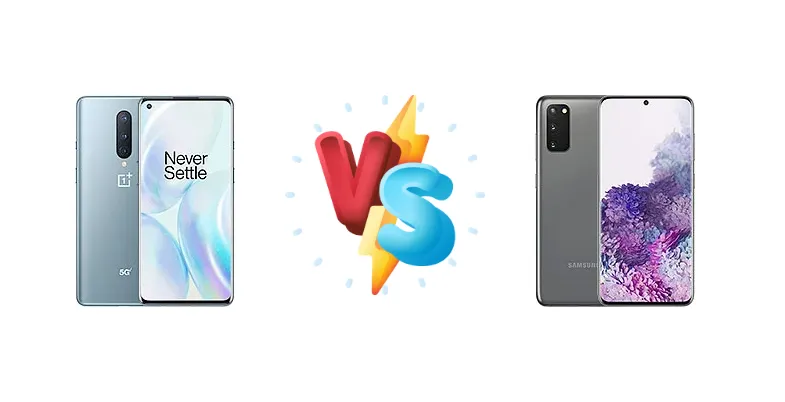
|
🏆 Quick Verdict
For the average user prioritizing a well-rounded experience with added convenience, the Samsung Galaxy S20 5G UW edges out the OnePlus 8 5G UW. While both share the Snapdragon 865, Samsung’s inclusion of wireless and reverse wireless charging, alongside a more mature camera software suite, provides a slight advantage.
| PHONES | ||
|---|---|---|
| Phone Names | OnePlus 8 5G UW (Verizon) | Samsung Galaxy S20 5G UW |
| Network | ||
|---|---|---|
| 2G bands | GSM 850 / 900 / 1800 / 1900 | GSM 850 / 900 / 1800 / 1900 |
| 3G bands | HSDPA 800 / 850 / 900 / 1700(AWS) / 1800 / 1900 / 2100 | HSDPA 850 / 900 / 1700(AWS) / 1900 / 2100 |
| 4G bands | 1, 2, 3, 4, 5, 7, 8, 12, 13, 17, 18, 19, 20, 25, 26, 28, 30, 38, 39, 40, 41, 46, 48, 66, 71 | 2, 3, 4, 5, 7, 8, 13, 18, 19, 20, 26, 28, 48, 66 |
| 5G bands | 2, 5, 66, 260, 261 mmWave | 260, 261 mmWave |
| Speed | HSPA 42.2/5.76 Mbps, LTE (5CA) Cat18 1200/150 Mbps, 5G 7.5 Gbps DL | HSPA 42.2/5.76 Mbps, LTE (7CA) Cat20 2000/200 Mbps, 5G (5+ Gbps DL) |
| Technology | GSM / HSPA / LTE / 5G | GSM / CDMA / HSPA / EVDO / LTE / 5G |
| - | CDMA2000 1xEV-DO | |
| Launch | ||
|---|---|---|
| Announced | 2020, April 14 | 2020, May 20 |
| Status | Available. Released 2020, April 29 | Available. Released 2020, June 04 |
| Body | ||
|---|---|---|
| Build | Glass front, glass back (Gorilla Glass 5), aluminum frame | Glass front (Gorilla Glass 6), glass back (Gorilla Glass 6), aluminum frame |
| Dimensions | 160.2 x 72.9 x 8 mm (6.31 x 2.87 x 0.31 in) | 151.7 x 69.1 x 8.1 mm (5.97 x 2.72 x 0.32 in) |
| SIM | Nano-SIM (pre-installed) | Nano-SIM (pre-installed) |
| Weight | 180 g (6.35 oz) | 168.1 g (5.93 oz) |
| IP68 dust/water resistant (up to 2m for 60 mins) | IP68 dust/water resistant (up to 1.5m for 30 min) | |
| Display | ||
|---|---|---|
| Protection | - | Corning Gorilla Glass 6 |
| Resolution | 1080 x 2400 pixels, 20:9 ratio (~402 ppi density) | 1440 x 3200 pixels, 20:9 ratio (~566 ppi density) |
| Size | 6.55 inches, 103.6 cm2 (~88.7% screen-to-body ratio) | 6.2 inches, 92.8 cm2 (~88.5% screen-to-body ratio) |
| Type | Fluid AMOLED, 90Hz, HDR10+ | Dynamic AMOLED 2X, 120Hz, HDR10+, 1200 nits (peak) |
| - | Always-on display 120Hz@FHD/60Hz@QHD refresh rate | |
| Platform | ||
|---|---|---|
| CPU | Octa-core (1x2.84 GHz Cortex-A77 & 3x2.42 GHz Cortex-A77 & 4x1.80 GHz Cortex-A55) | Octa-core (1x2.84 GHz Cortex-A77 & 3x2.42 GHz Cortex-A77 & 4x1.80 GHz Cortex-A55) |
| Chipset | Qualcomm SM8250 Snapdragon 865 5G (7 nm+) | Qualcomm SM8250 Snapdragon 865 5G (7 nm+) |
| GPU | Adreno 650 | Adreno 650 |
| OS | Android 10, OxygenOS 10.0 | Android 10, One UI 2.5 |
| Memory | ||
|---|---|---|
| Card slot | No | No |
| Internal | 128GB 8GB RAM | 128GB 8GB RAM |
| UFS 3.0, 2-LANE | UFS 3.0 | |
| Main Camera | ||
|---|---|---|
| Features | Dual-LED flash, HDR, panorama | LED flash, auto-HDR, panorama |
| Triple | 48 MP, f/1.8, 25mm (wide), 1/2.0", 0.8µm, PDAF, OIS 16 MP, f/2.2, 14mm, 116˚ (ultrawide) 2 MP (macro) | 12 MP, f/1.8, 26mm (wide), 1/1.76", 1.8µm, dual pixel PDAF, OIS 64 MP, f/2.0, 29mm (telephoto), 1/1.72", 0.8µm, PDAF, OIS, 1.1x optical zoom, 3x hybrid zoom 12 MP, f/2.2, 13mm, 120˚ (ultrawide), 1/2.55" 1.4µm, Super Steady video |
| Video | 4K@30/60fps, 1080p@30/60/240fps, Auto HDR, gyro-EIS | 8K@24fps, 4K@30/60fps, 1080p@30/60/240fps, 720p@960fps, HDR10+, stereo sound rec., gyro-EIS & OIS |
| Selfie camera | ||
|---|---|---|
| Features | HDR | HDR |
| Single | 16 MP, f/2.0, (wide), 1/3.06", 1.0µm | 10 MP, f/2.2, 26mm (wide), 1/3.24", 1.22µm, dual pixel PDAF |
| Video | 1080p@30fps, gyro-EIS | 4K@30/60fps, 1080p@30fps |
| Sound | ||
|---|---|---|
| 3.5mm jack | No | No |
| 35mm jack | No | No |
| Loudspeaker | Yes, with stereo speakers | Yes, with stereo speakers |
| - | 32-bit/384kHz audio Tuned by AKG | |
| Comms | ||
|---|---|---|
| Bluetooth | 5.1, A2DP, LE, aptX HD | 5.0, A2DP, LE |
| NFC | Yes | Yes |
| Positioning | GPS (L1+L5), GLONASS (G1), BDS (B1), GALILEO (E1+E5a) | GPS, GLONASS, BDS, GALILEO |
| Radio | No | FM radio |
| USB | USB Type-C 3.1, OTG | USB Type-C 3.2, OTG |
| WLAN | Wi-Fi 802.11 a/b/g/n/ac/6, dual-band, Wi-Fi Direct, DLNA | Wi-Fi 802.11 a/b/g/n/ac/6, dual-band, Wi-Fi Direct |
| Features | ||
|---|---|---|
| Sensors | Fingerprint (under display, optical), accelerometer, gyro, proximity, compass | Fingerprint (under display, ultrasonic), accelerometer, gyro, proximity, compass, barometer |
| - | Samsung DeX, Samsung Wireless DeX (desktop experience support) ANT+ Bixby natural language commands and dictation Samsung Pay (Visa, MasterCard certified) | |
| Battery | ||
|---|---|---|
| Charging | 30W wired, 50% in 22 min | 25W wired, PD3.0 15W wireless (Qi) 4.5W reverse wireless |
| Type | Li-Po 4300 mAh | Li-Ion 4000 mAh |
| Misc | ||
|---|---|---|
| Colors | Onyx Black, Polar Silver | Cloud Pink, Cosmic Grey, Cloud White |
| Models | - | SM-G981V |
| Price | About 740 EUR | About 880 EUR |
| SAR | 1.10 W/kg (head) 1.10 W/kg (body) | 0.91 W/kg (head) 1.05 W/kg (body) |
OnePlus 8 5G UW (Verizon)
- Faster 30W wired charging
- Clean and efficient OxygenOS software
- Potentially better sustained performance due to software optimization
- Lacks wireless and reverse wireless charging
- Camera software may not be as refined as Samsung's
- Less feature-rich overall
Samsung Galaxy S20 5G UW
- Wireless and reverse wireless charging
- More versatile camera system with advanced image processing
- PD3.0 support for wider charger compatibility
- Slower 25W wired charging
- Samsung’s One UI can be more resource-intensive
- Potentially more bloatware
Display Comparison
Both devices utilize the Qualcomm Snapdragon 865 5G (7nm+) chipset, meaning display performance will be largely similar. However, details beyond the provided specs are needed to compare panel quality. Given Samsung’s history, the S20 likely boasts a higher peak brightness and potentially more accurate color calibration. The OnePlus 8’s display, while excellent, typically focuses on refresh rate over absolute color accuracy. Bezels are expected to be comparable, reflecting the flagship status of both devices.
Camera Comparison
Without detailed sensor information, a precise camera comparison is difficult. However, Samsung historically prioritizes camera features and image processing. The S20 likely benefits from more sophisticated computational photography algorithms, resulting in more consistently pleasing images, particularly in challenging lighting conditions. The OnePlus 8, while capable, often leans towards a more natural, less processed look. The absence of details regarding sensor size and OIS capabilities prevents a definitive judgment, but Samsung’s experience in camera technology gives it an edge.
Performance
The shared Qualcomm SM8250 Snapdragon 865 5G (7 nm+) chipset and identical CPU configuration – an octa-core setup with 1x2.84 GHz Cortex-A77, 3x2.42 GHz Cortex-A77, and 4x1.80 GHz Cortex-A55 – guarantee similar raw processing power. Real-world performance differences will hinge on thermal management and software optimization. OnePlus is known for its efficient OxygenOS, potentially allowing for sustained peak performance. However, the S20’s larger chassis *could* offer slightly better heat dissipation. Both utilize LPDDR5 RAM, ensuring fast memory access.
Battery Life
The OnePlus 8 5G UW’s 30W wired charging is faster than the Samsung Galaxy S20 5G UW’s 25W wired charging, allowing for a 50% charge in 22 minutes versus an unspecified time for the Samsung. However, the S20 compensates with 15W wireless charging (Qi standard) and 4.5W reverse wireless charging – features absent on the OnePlus 8. While battery capacity isn’t specified, the S20’s wireless charging capabilities offer significant convenience, potentially offsetting a slightly smaller battery size. The inclusion of PD3.0 on the S20 also ensures compatibility with a wider range of chargers.
Buying Guide
Buy the OnePlus 8 5G UW (Verizon) if you prioritize a cleaner, faster software experience and are comfortable with a more streamlined feature set. Buy the Samsung Galaxy S20 5G UW if you prefer a more feature-rich experience, including wireless charging, reverse wireless charging, and a more versatile camera system with established image processing.