
OnePlus 8 5G UW vs Samsung Galaxy A71 5G UW: A Performance and Value Showdown
| Phones Images | |||||
|---|---|---|---|---|---|
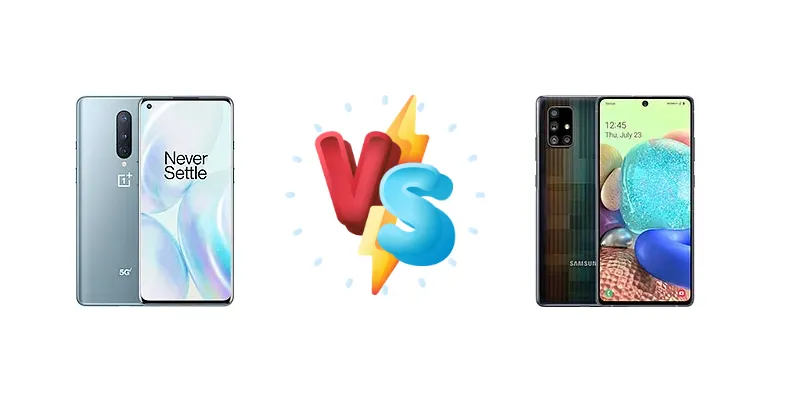
|
🏆 Quick Verdict
For users prioritizing raw performance and responsiveness, the OnePlus 8 5G UW is the clear winner. Its Snapdragon 865 chipset provides a significantly smoother experience for demanding tasks and gaming. However, the Samsung Galaxy A71 5G UW offers a compelling value proposition for those seeking 5G connectivity without breaking the bank.
| PHONES | ||
|---|---|---|
| Phone Names | OnePlus 8 5G UW (Verizon) | Samsung Galaxy A71 5G UW |
| Network | ||
|---|---|---|
| 2G bands | GSM 850 / 900 / 1800 / 1900 | GSM 850 / 900 / 1800 / 1900 |
| 3G bands | HSDPA 800 / 850 / 900 / 1700(AWS) / 1800 / 1900 / 2100 | HSDPA 850 / 900 / 1900 / 2100 |
| 4G bands | 1, 2, 3, 4, 5, 7, 8, 12, 13, 17, 18, 19, 20, 25, 26, 28, 30, 38, 39, 40, 41, 46, 48, 66, 71 | 2, 3, 4, 5, 7, 12, 13, 20, 28, 66 |
| 5G bands | 2, 5, 66, 260, 261 mmWave | 260, 261 SA/NSA/mmWave |
| Speed | HSPA 42.2/5.76 Mbps, LTE (5CA) Cat18 1200/150 Mbps, 5G 7.5 Gbps DL | HSPA, LTE, 5G |
| Technology | GSM / HSPA / LTE / 5G | GSM / HSPA / LTE / 5G |
| Launch | ||
|---|---|---|
| Announced | 2020, April 14 | 2020, July 07 |
| Status | Available. Released 2020, April 29 | Available. Released 2020, July 16 |
| Body | ||
|---|---|---|
| Build | Glass front, glass back (Gorilla Glass 5), aluminum frame | Glass front (Gorilla Glass 3), plastic back, aluminum frame |
| Dimensions | 160.2 x 72.9 x 8 mm (6.31 x 2.87 x 0.31 in) | 162.8 x 75.7 x 8.4 mm (6.41 x 2.98 x 0.33 in) |
| SIM | Nano-SIM (pre-installed) | Nano-SIM (pre-installed) |
| Weight | 180 g (6.35 oz) | 188 g (6.63 oz) |
| IP68 dust/water resistant (up to 2m for 60 mins) | - | |
| Display | ||
|---|---|---|
| Protection | - | Corning Gorilla Glass 3 |
| Resolution | 1080 x 2400 pixels, 20:9 ratio (~402 ppi density) | 1080 x 2400 pixels, 20:9 ratio (~393 ppi density) |
| Size | 6.55 inches, 103.6 cm2 (~88.7% screen-to-body ratio) | 6.7 inches, 108.4 cm2 (~87.9% screen-to-body ratio) |
| Type | Fluid AMOLED, 90Hz, HDR10+ | Super AMOLED Plus |
| Platform | ||
|---|---|---|
| CPU | Octa-core (1x2.84 GHz Cortex-A77 & 3x2.42 GHz Cortex-A77 & 4x1.80 GHz Cortex-A55) | Octa-core (1x2.4 GHz Kryo 475 Prime & 1x2.2 GHz Kryo 475 Gold & 6x1.8 GHz Kryo 475 Silver) |
| Chipset | Qualcomm SM8250 Snapdragon 865 5G (7 nm+) | Qualcomm SM7250 Snapdragon 765G 5G (7 nm) |
| GPU | Adreno 650 | Adreno 620 |
| OS | Android 10, OxygenOS 10.0 | Android 10, One UI 2.1 |
| Memory | ||
|---|---|---|
| Card slot | No | microSDXC (dedicated slot) |
| Internal | 128GB 8GB RAM | 128GB 8GB RAM |
| UFS 3.0, 2-LANE | UFS 2.1 | |
| Main Camera | ||
|---|---|---|
| Features | Dual-LED flash, HDR, panorama | LED flash, panorama, HDR |
| Quad | - | 64 MP, f/1.8, 26mm (wide), 1/1.72", 0.8µm, PDAF 12 MP, f/2.2, 123˚ (ultrawide) 5 MP (macro) Auxiliary lens |
| Triple | 48 MP, f/1.8, 25mm (wide), 1/2.0", 0.8µm, PDAF, OIS 16 MP, f/2.2, 14mm, 116˚ (ultrawide) 2 MP (macro) | - |
| Video | 4K@30/60fps, 1080p@30/60/240fps, Auto HDR, gyro-EIS | 4K@30fps, 1080p@30/240fps, 1080p@960fps; gyro-EIS |
| Selfie camera | ||
|---|---|---|
| Features | HDR | HDR |
| Single | 16 MP, f/2.0, (wide), 1/3.06", 1.0µm | 32 MP, f/2.2, 26mm (wide), 1/2.8", 0.8µm |
| Video | 1080p@30fps, gyro-EIS | 4K@30fps, 1080p@30fps |
| Sound | ||
|---|---|---|
| 3.5mm jack | No | Yes |
| 35mm jack | No | Yes |
| Loudspeaker | Yes, with stereo speakers | Yes |
| Comms | ||
|---|---|---|
| Bluetooth | 5.1, A2DP, LE, aptX HD | 5.0, A2DP, LE |
| NFC | Yes | No |
| Positioning | GPS (L1+L5), GLONASS (G1), BDS (B1), GALILEO (E1+E5a) | GPS, GLONASS, GALILEO, BDS |
| Radio | No | No |
| USB | USB Type-C 3.1, OTG | USB Type-C 2.0, OTG |
| WLAN | Wi-Fi 802.11 a/b/g/n/ac/6, dual-band, Wi-Fi Direct, DLNA | Wi-Fi 802.11 a/b/g/n/ac, dual-band, Wi-Fi Direct |
| Features | ||
|---|---|---|
| Sensors | Fingerprint (under display, optical), accelerometer, gyro, proximity, compass | Fingerprint (under display, optical), accelerometer, gyro, proximity, compass |
| - | ANT+ | |
| Battery | ||
|---|---|---|
| Charging | 30W wired, 50% in 22 min | 25W wired |
| Type | Li-Po 4300 mAh | Li-Po 4500 mAh |
| Misc | ||
|---|---|---|
| Colors | Onyx Black, Polar Silver | Prism Bricks Black |
| Models | - | SM-A716V |
| Price | About 740 EUR | - |
| SAR | 1.10 W/kg (head) 1.10 W/kg (body) | 0.50 W/kg (head) 0.78 W/kg (body) |
OnePlus 8 5G UW (Verizon)
- Significantly faster processor for demanding tasks
- Faster charging speeds (30W vs 25W)
- Likely superior camera performance
- Potentially higher price point
- May have a smaller display
Samsung Galaxy A71 5G UW
- More affordable price
- Likely larger display for media consumption
- Good overall 5G experience for everyday use
- Slower processor for demanding tasks
- Slower charging speeds
- Potentially lower camera quality
Display Comparison
While both phones feature displays suitable for everyday use, the specifics are absent in the provided data. However, given the OnePlus 8’s positioning, it likely boasts a higher refresh rate and potentially better color accuracy compared to the A71 5G UW. The A71 5G UW, being a larger device in general, may offer a more immersive viewing experience, but this comes at the cost of potentially lower pixel density. The OnePlus 8’s likely smaller form factor will appeal to users who prefer a more pocketable device.
Camera Comparison
Without detailed camera specifications, a direct comparison is limited. However, the OnePlus 8, being a flagship-adjacent device, likely incorporates a more advanced camera system with a larger primary sensor and potentially better image stabilization (OIS). The A71 5G UW will likely focus on versatility with multiple lenses, but image quality will likely fall behind the OnePlus 8 in challenging lighting conditions. The image processing algorithms will also differ, with OnePlus typically aiming for a more natural look, while Samsung often boosts saturation.
Performance
The core difference lies in the chipsets. The OnePlus 8 5G UW’s Snapdragon 865 (7nm+) is a significant leap over the Galaxy A71 5G UW’s Snapdragon 765G (7nm). The 865 features a more powerful CPU configuration – an octa-core setup with a prime Cortex-A77 clocked at 2.84 GHz versus the A71’s 2.4 GHz Kryo 475 Prime. This translates to faster app loading times, smoother multitasking, and a more responsive user interface on the OnePlus 8. The 865’s superior GPU will also deliver a noticeably better gaming experience. The 7nm+ node used in the 865 also suggests improved thermal efficiency, potentially leading to less throttling during sustained workloads.
Battery Life
The OnePlus 8 5G UW offers 30W wired charging, allowing for a 50% charge in just 22 minutes. The Samsung Galaxy A71 5G UW’s 25W charging is slower. While battery capacity isn’t specified, the faster charging speed of the OnePlus 8 mitigates any potential disadvantage from a slightly smaller battery. Real-world battery life will depend on usage patterns, but the more efficient Snapdragon 865 in the OnePlus 8 could contribute to comparable or even better endurance despite potentially having a smaller capacity.
Buying Guide
Buy the OnePlus 8 5G UW (Verizon) if you need a phone capable of handling demanding games, intensive multitasking, and future-proof performance. Buy the Samsung Galaxy A71 5G UW if you prioritize a lower price point, a larger display for media consumption, and a generally capable 5G experience for everyday tasks.