
OnePlus 8 5G UW vs LG V60 ThinQ 5G UW: A Deep Dive into Verizon's Snapdragon 865 Contenders
| Phones Images | |||||
|---|---|---|---|---|---|
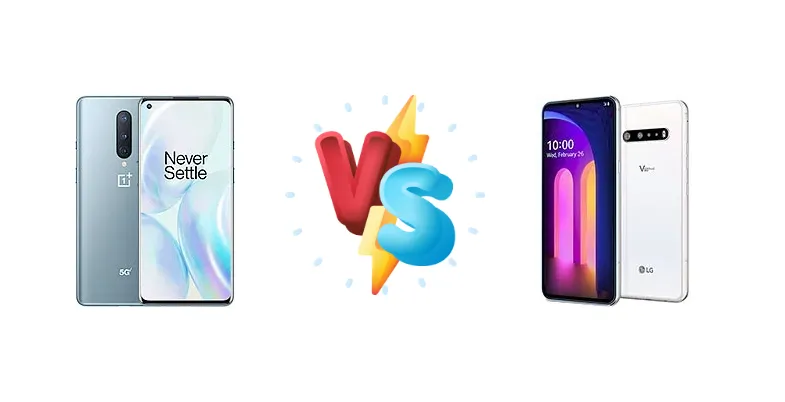
|
🏆 Quick Verdict
For the average user prioritizing faster charging and a cleaner software experience, the OnePlus 8 5G UW emerges as the winner. While the LG V60 ThinQ 5G UW offers wireless charging and a potentially more robust audio experience (based on LG's historical strengths), the OnePlus 8's 30W wired charging provides a significant convenience advantage.
| PHONES | ||
|---|---|---|
| Phone Names | OnePlus 8 5G UW (Verizon) | LG V60 ThinQ 5G UW |
| Network | ||
|---|---|---|
| 2G bands | GSM 850 / 900 / 1800 / 1900 | GSM 850 / 900 / 1800 / 1900 |
| 3G bands | HSDPA 800 / 850 / 900 / 1700(AWS) / 1800 / 1900 / 2100 | HSDPA 850 / 900 / 1700(AWS) / 1900 / 2100 |
| 4G bands | 1, 2, 3, 4, 5, 7, 8, 12, 13, 17, 18, 19, 20, 25, 26, 28, 30, 38, 39, 40, 41, 46, 48, 66, 71 | 2, 3, 4, 5, 7, 12, 13, 20, 28, 46, 48, 66 |
| 5G bands | 2, 5, 66, 260, 261 mmWave | 260, 261 mmWave |
| Speed | HSPA 42.2/5.76 Mbps, LTE (5CA) Cat18 1200/150 Mbps, 5G 7.5 Gbps DL | HSPA 42.2/5.76 Mbps, LTE (7CA) Cat22, 5G |
| Technology | GSM / HSPA / LTE / 5G | GSM / CDMA / HSPA / EVDO / LTE / 5G |
| - | CDMA2000 1xEV-DO | |
| Launch | ||
|---|---|---|
| Announced | 2020, April 14 | 2020, February 26. Released 2020, April 02 |
| Status | Available. Released 2020, April 29 | Discontinued |
| Body | ||
|---|---|---|
| Build | Glass front, glass back (Gorilla Glass 5), aluminum frame | Glass front (Gorilla Glass 5), glass back (Gorilla Glass 6), aluminum frame |
| Dimensions | 160.2 x 72.9 x 8 mm (6.31 x 2.87 x 0.31 in) | 169.3 x 77.6 x 8.9 mm (6.67 x 3.06 x 0.35 in) |
| SIM | Nano-SIM (pre-installed) | Nano-SIM (pre-installed) |
| Weight | 180 g (6.35 oz) | 218 g (7.69 oz) |
| IP68 dust/water resistant (up to 2m for 60 mins) | IP68 dust/water resistant (up to 1.5m for 30 min) MIL-STD-810G compliant* Method 516.6, Procedure IV "Transit Drop" *does not guarantee ruggedness or use in extreme conditions | |
| Display | ||
|---|---|---|
| Protection | - | Corning Gorilla Glass 5 |
| Resolution | 1080 x 2400 pixels, 20:9 ratio (~402 ppi density) | 1080 x 2460 pixels (~395 ppi density) |
| Size | 6.55 inches, 103.6 cm2 (~88.7% screen-to-body ratio) | 6.8 inches, 109.8 cm2 (~83.6% screen-to-body ratio) |
| Type | Fluid AMOLED, 90Hz, HDR10+ | P-OLED, HDR10+ |
| - | Always-on display | |
| Platform | ||
|---|---|---|
| CPU | Octa-core (1x2.84 GHz Cortex-A77 & 3x2.42 GHz Cortex-A77 & 4x1.80 GHz Cortex-A55) | Octa-core (1x2.84 GHz Cortex-A77 & 3x2.42 GHz Cortex-A77 & 4x1.80 GHz Cortex-A55) |
| Chipset | Qualcomm SM8250 Snapdragon 865 5G (7 nm+) | Qualcomm SM8250 Snapdragon 865 5G (7 nm+) |
| GPU | Adreno 650 | Adreno 650 |
| OS | Android 10, OxygenOS 10.0 | Android 10, upgradable to Android 13 |
| Memory | ||
|---|---|---|
| Card slot | No | microSDXC (uses shared SIM slot) - dual-SIM model |
| Internal | 128GB 8GB RAM | 128GB 8GB RAM |
| UFS 3.0, 2-LANE | UFS 2.1 | |
| Main Camera | ||
|---|---|---|
| Dual | - | 64 MP, f/1.8, 27mm (standard), 1/1.72", 0.8µm, dual pixel PDAF, OIS 13 MP, f/1.9, 12mm (ultrawide), 1/3.4", 1.0µm 0.3 MP, TOF 3D, f/1.4, (depth) |
| Features | Dual-LED flash, HDR, panorama | Dual-LED dual-tone flash, HDR, panorama |
| Triple | 48 MP, f/1.8, 25mm (wide), 1/2.0", 0.8µm, PDAF, OIS 16 MP, f/2.2, 14mm, 116˚ (ultrawide) 2 MP (macro) | - |
| Video | 4K@30/60fps, 1080p@30/60/240fps, Auto HDR, gyro-EIS | 8K@30fps, 4K@30/60fps, 1080p, HDR10+, 24-bit/192kHz stereo sound rec., gyro-EIS |
| Selfie camera | ||
|---|---|---|
| Features | HDR | HDR |
| Single | 16 MP, f/2.0, (wide), 1/3.06", 1.0µm | 10 MP, f/1.9, 30mm (standard), 1/3.1", 1.22µm |
| Video | 1080p@30fps, gyro-EIS | 4K@30fps, gyro-EIS |
| Sound | ||
|---|---|---|
| 3.5mm jack | No | Yes |
| 35mm jack | No | Yes |
| Loudspeaker | Yes, with stereo speakers | Yes, with stereo speakers |
| - | 32-bit/192kHz audio 24-bit/192kHz audio recording | |
| Comms | ||
|---|---|---|
| Bluetooth | 5.1, A2DP, LE, aptX HD | 5.1, A2DP, LE, aptX HD |
| NFC | Yes | Yes |
| Positioning | GPS (L1+L5), GLONASS (G1), BDS (B1), GALILEO (E1+E5a) | GPS, GLONASS, GALILEO, BDS |
| Radio | No | FM radio (USA model only) |
| USB | USB Type-C 3.1, OTG | USB Type-C 3.1, OTG |
| WLAN | Wi-Fi 802.11 a/b/g/n/ac/6, dual-band, Wi-Fi Direct, DLNA | Wi-Fi 802.11 a/b/g/n/ac/6, dual-band, Wi-Fi Direct, DLNA |
| Features | ||
|---|---|---|
| Sensors | Fingerprint (under display, optical), accelerometer, gyro, proximity, compass | Fingerprint (under display, optical), accelerometer, gyro, proximity, compass, barometer |
| Battery | ||
|---|---|---|
| Charging | 30W wired, 50% in 22 min | Wired, PD2.0, QC4 Wireless |
| Type | Li-Po 4300 mAh | Li-Po 5000 mAh |
| Misc | ||
|---|---|---|
| Colors | Onyx Black, Polar Silver | Classy Blue, Classy White |
| Models | - | LM-V600VML, LMV600VML |
| Price | About 740 EUR | About 870 EUR |
| SAR | 1.10 W/kg (head) 1.10 W/kg (body) | 0.85 W/kg (head) 1.12 W/kg (body) |
OnePlus 8 5G UW (Verizon)
- Faster 30W wired charging
- Streamlined OxygenOS software
- Potentially better sustained performance due to thermal management
- Lacks wireless charging
- May have less feature-rich camera software
LG V60 ThinQ 5G UW
- Wireless charging support
- Likely more advanced video recording features
- Potential for superior audio quality (based on LG's history)
- Slower wired charging (likely)
- Potentially more software bloat
Display Comparison
Both devices utilize the Qualcomm Snapdragon 865 chipset fabricated on a 7nm+ process, meaning display performance will be largely dictated by panel quality and software optimization. While specific display specs (resolution, refresh rate) aren't provided, both likely feature high refresh rate panels to complement the 5G capabilities. The LG V60, given LG's display expertise, may offer slightly better color accuracy and viewing angles, but without detailed specs, this remains speculative. Bezels are expected to be minimal on both, reflecting 2020 flagship design trends.
Camera Comparison
Without detailed camera specifications, a direct comparison is limited. However, both phones likely feature multi-camera systems centered around a primary sensor. The LG V60, building on LG's camera heritage, may offer more advanced video recording capabilities and a wider range of shooting modes. The image processing style will likely differ – OnePlus tends towards more vibrant, saturated images, while LG often aims for more natural color reproduction. The presence of OIS (Optical Image Stabilization) on the main sensor is expected on both, crucial for stable video and low-light photography.
Performance
The core performance is identical: both the OnePlus 8 5G UW and LG V60 ThinQ 5G UW are powered by the Qualcomm SM8250 Snapdragon 865 5G. The octa-core CPU configuration (1x2.84 GHz Cortex-A77, 3x2.42 GHz Cortex-A77, 4x1.80 GHz Cortex-A55) delivers comparable processing power. However, thermal management could differ. OnePlus historically prioritizes sustained performance, potentially leading to less aggressive throttling under prolonged load compared to LG, though this requires independent testing. Both devices utilize LPDDR5 RAM, ensuring fast application loading and multitasking.
Battery Life
Battery capacity isn't specified, but the charging capabilities highlight a key difference. The OnePlus 8 5G UW boasts 30W wired charging, capable of reaching 50% charge in just 22 minutes. The LG V60 ThinQ 5G UW offers wired charging with PD2.0 and QC4 support, *and* wireless charging. While the LG V60's wired charging speed isn't specified, it's unlikely to match the OnePlus 8's 30W. The inclusion of wireless charging on the LG V60 provides convenience, but typically comes at the cost of slower charging speeds. Real-world battery life will depend on usage patterns, but the OnePlus 8's faster charging could mitigate concerns about battery drain.
Buying Guide
Buy the OnePlus 8 5G UW (Verizon) if you need consistently fast charging, a streamlined Android experience with OxygenOS, and prioritize quick software updates. Buy the LG V60 ThinQ 5G UW if you prefer the flexibility of wireless charging, value a headphone jack (likely present given LG's audio focus), and appreciate a more feature-rich, albeit potentially more complex, software experience.