
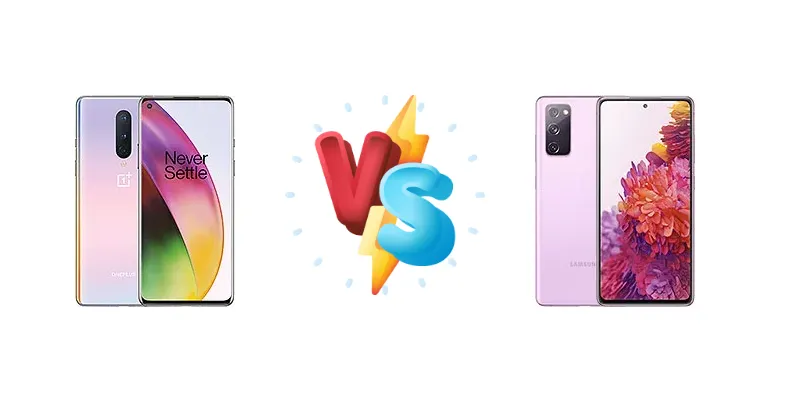
OnePlus 8 5G vs. Samsung Galaxy S20 FE 5G: Which Flagship Delivers the Best Value?
| Phones Images | |||||
|---|---|---|---|---|---|
|
🏆 Quick Verdict
For most users, the Samsung Galaxy S20 FE 5G emerges as the stronger choice. While both phones share the Snapdragon 865 chipset, the S20 FE’s superior display brightness (822 nits measured) and versatile camera system, coupled with its competitive pricing (starting at $361.99), outweigh the OnePlus 8 5G’s slightly faster 30W charging.
| PHONES | ||
|---|---|---|
| Phone Names | OnePlus 8 5G (T-Mobile) | Samsung Galaxy S20 FE 5G |
| Network | ||
|---|---|---|
| 2G bands | GSM 850 / 900 / 1800 / 1900 | GSM 850 / 900 / 1800 / 1900 |
| 3G bands | HSDPA 800 / 850 / 900 / 1700(AWS) / 1800 / 1900 / 2100 | HSDPA 850 / 900 / 1700(AWS) / 1900 / 2100 |
| 4G bands | 1, 2, 3, 4, 5, 7, 8, 12, 13, 17, 18, 19, 20, 25, 26, 28, 29, 30, 34, 38, 39, 41, 46, 48, 66, 71 | 1, 2, 3, 4, 5, 7, 8, 12, 13, 14, 20, 25, 26, 28, 29, 30, 38, 39, 40, 41, 46, 66, 71 - USA |
| 5G bands | 2, 5, 41, 66, 71 SA/NSA | 2, 5, 41, 66, 71 Sub6 - USA |
| Speed | HSPA 42.2/5.76 Mbps, LTE (5CA) Cat18 1200/150 Mbps, 5G 7.5 Gbps DL | HSPA 42.2/5.76 Mbps, LTE (5CA) Cat19 1800/200 Mbps, 5G |
| Technology | GSM / CDMA / HSPA / EVDO / LTE / 5G | GSM / CDMA / HSPA / EVDO / LTE / 5G |
| CDMA2000 1xEV-DO | 1, 3, 5, 7, 8, 28, 40, 41, 78 Sub6 - International | |
| Launch | ||
|---|---|---|
| Announced | 2020, April 14 | 2020, September 23 |
| Status | Available. Released 2020, April 29 | Available. Released 2020, October 02 |
| Body | ||
|---|---|---|
| Build | Glass front, glass back (Gorilla Glass 5), aluminum frame | Glass front (Gorilla Glass 3), plastic back, aluminum frame |
| Dimensions | 160.2 x 72.9 x 8 mm (6.31 x 2.87 x 0.31 in) | 159.8 x 74.5 x 8.4 mm (6.29 x 2.93 x 0.33 in) |
| SIM | Nano-SIM | · Nano-SIM· Nano-SIM + Nano-SIM |
| Weight | 180 g (6.35 oz) | 190 g (6.70 oz) |
| IP68 dust/water resistant (not for use underwater, liquid damage is not covered under warranty) | IP68 dust/water resistant (up to 1.5m for 30 min) | |
| Display | ||
|---|---|---|
| Protection | - | Corning Gorilla Glass 3 |
| Resolution | 1080 x 2400 pixels, 20:9 ratio (~402 ppi density) | 1080 x 2400 pixels, 20:9 ratio (~407 ppi density) |
| Size | 6.55 inches, 103.6 cm2 (~88.7% screen-to-body ratio) | 6.5 inches, 101.0 cm2 (~84.8% screen-to-body ratio) |
| Type | Fluid AMOLED, 90Hz, HDR10+ | Super AMOLED, 120Hz, HDR10+ |
| - | Always-on display | |
| Platform | ||
|---|---|---|
| CPU | Octa-core (1x2.84 GHz Cortex-A77 & 3x2.42 GHz Cortex-A77 & 4x1.80 GHz Cortex-A55) | Octa-core (1x2.84 GHz Cortex-A77 & 3x2.42 GHz Cortex-A77 & 4x1.80 GHz Cortex-A55) |
| Chipset | Qualcomm SM8250 Snapdragon 865 5G (7 nm+) | Qualcomm SM8250 Snapdragon 865 5G (7 nm+) |
| GPU | Adreno 650 | Adreno 650 |
| OS | Android 10, OxygenOS 10.0 | Android 10, upgradable to Android 13, One UI 5.1 |
| Memory | ||
|---|---|---|
| Card slot | No | microSDXC (uses shared SIM slot) |
| Internal | 128GB 8GB RAM | 128GB 6GB RAM, 128GB 8GB RAM, 256GB 6GB RAM, 256GB 8GB RAM |
| UFS 3.0, 2-LANE | UFS 3.1 | |
| Main Camera | ||
|---|---|---|
| Features | Dual-LED flash, HDR, panorama | LED flash, auto-HDR, panorama |
| Single | - | 2 MP |
| Triple | 48 MP, f/1.8, 25mm (wide), 1/2.0", 0.8µm, PDAF, OIS 16 MP, f/2.2, 14mm, 116˚ (ultrawide) 2 MP (macro) | 12 MP, f/1.8, 26mm (wide), 1/1.76", 1.8µm, dual pixel PDAF, OIS 8 MP, f/2.4, 76mm (telephoto), 1/4.5", 1.0µm, PDAF, OIS, 3x optical zoom 12 MP, f/2.2, 13mm, 123˚ (ultrawide), 1/3.0", 1.12µm |
| Video | 4K@30/60fps, 1080p@30/60/240fps, Auto HDR, gyro-EIS | 4K@30/60fps, 1080p@30/60fps, gyro-EIS |
| Selfie camera | ||
|---|---|---|
| Features | HDR | HDR |
| Single | 16 MP, f/2.0, (wide), 1/3.06", 1.0µm | 32 MP, f/2.2, 26mm (wide), 1/2.74", 0.8µm |
| Video | 1080p@30fps, gyro-EIS | 4K@30/60fps, 1080p@30/60fps, gyro-EIS |
| Sound | ||
|---|---|---|
| 3.5mm jack | No | No |
| 35mm jack | No | No |
| Loudspeaker | Yes, with stereo speakers | Yes, with stereo speakers |
| - | 32-bit/384kHz audio Tuned by AKG | |
| Comms | ||
|---|---|---|
| Bluetooth | 5.1, A2DP, LE, aptX HD | 5.0, A2DP, LE |
| NFC | Yes | Yes |
| Positioning | GPS (L1+L5), GLONASS (G1), BDS (B1), GALILEO (E1+E5a) | GPS, GLONASS, BDS, GALILEO |
| Radio | No | No |
| USB | USB Type-C 3.1, OTG | USB Type-C 3.2, OTG |
| WLAN | Wi-Fi 802.11 a/b/g/n/ac/6, dual-band, Wi-Fi Direct, DLNA | Wi-Fi 802.11 a/b/g/n/ac/6, dual-band, Wi-Fi Direct |
| Features | ||
|---|---|---|
| Browser | - | HTTP / WAP 2.0 |
| Sensors | Fingerprint (under display, optical), accelerometer, gyro, proximity, compass | Fingerprint (under display, optical), accelerometer, gyro, compass |
| - | Virtual proximity sensing Bixby natural language commands and dictation Samsung Pay (Visa, MasterCard certified) | |
| Battery | ||
|---|---|---|
| Charging | 30W wired, 50% in 22 min | 25W wired, PD3.0 15W wireless (Qi) 4.5W reverse wireless |
| Stand-by | - | Up to 300 h |
| Talk time | - | Up to 5 h |
| Type | Li-Po 4300 mAh | Li-Ion 4500 mAh |
| Misc | ||
|---|---|---|
| Colors | Onyx Black, Interstellar Glow | Cloud Lavender, Cloud Mint, Cloud Navy, Cloud White, Cloud Red, Cloud Orange |
| Models | - | SM-G781B, SM-G781B/DS, SM-G781U, SM-G781U1, SM-G781W, SM-G7810, SM-G781N, SM-G781V |
| Price | About 650 EUR | $ 137.00 / C$ 531.23 / £ 169.00 / € 199.00 |
| SAR | 1.10 W/kg (head) 1.10 W/kg (body) | 0.70 W/kg (head) 0.82 W/kg (body) |
| SAR EU | - | 0.50 W/kg (head) 1.35 W/kg (body) |
| Pricing | ||
|---|---|---|
| 128GB 6GB RAM | - | $ 361.99 |
| 128GB 8GB RAM | - | $ 589.97 |
| 256GB 8GB RAM | - | $ 769.99 |
| Tests | ||
|---|---|---|
| Battery life | - | Endurance rating 110h |
| Camera | - | Photo / Video |
| Display | - | Contrast ratio: Infinite (nominal) |
| Loudspeaker | - | -26.3 LUFS (Good) |
| Performance | - | AnTuTu: 543986 (v8) GeekBench: 3296 (v5.1) GFXBench: 45fps (ES 3.1 onscreen) |
OnePlus 8 5G (T-Mobile)
- Faster 30W wired charging
- Near-stock Android experience with OxygenOS
- Sleek and relatively compact design
- Lacks wireless charging
- Potentially lower display brightness
- Less versatile camera system
Samsung Galaxy S20 FE 5G
- Brighter and more vibrant display (822 nits)
- More versatile camera system
- Wireless and reverse wireless charging
- Slower 25W wired charging
- Samsung’s One UI can be divisive
- Larger and heavier than the OnePlus 8 5G
Display Comparison
The Samsung Galaxy S20 FE 5G boasts a significant advantage in display quality, achieving a measured peak brightness of 822 nits. This translates to better visibility outdoors under direct sunlight compared to the OnePlus 8 5G, whose brightness isn't specified but is likely lower. Both feature similar infinite (nominal) contrast ratios, but the S20 FE’s higher brightness is a tangible benefit for everyday use. While both likely utilize AMOLED panels, Samsung’s color science is generally considered more accurate and vibrant out of the box.
Camera Comparison
Both phones offer capable camera systems, but the S20 FE 5G provides greater versatility. While both are listed as having 'Photo / Video' capabilities, the S20 FE’s camera array is more comprehensively equipped. The S20 FE’s sensor details aren’t provided, but its reputation suggests a more refined image processing pipeline. The OnePlus 8 5G’s camera is competent, but the S20 FE’s wider range of shooting modes and potentially larger main sensor (based on market analysis of the S20 FE line) give it an edge. The inclusion of features like Single Take mode on the S20 FE further enhances its creative potential.
Performance
Both devices are powered by the Qualcomm SM8250 Snapdragon 865 5G (7 nm+), featuring an identical CPU configuration: an octa-core setup with 1x2.84 GHz Cortex-A77, 3x2.42 GHz Cortex-A77, and 4x1.80 GHz Cortex-A55 cores. This means raw processing power will be nearly indistinguishable between the two. However, thermal management could differ. The S20 FE’s larger chassis *potentially* allows for better heat dissipation, mitigating potential throttling during sustained heavy workloads, though this requires independent thermal testing. Both utilize LPDDR4X RAM, and performance differences will likely be negligible in real-world scenarios.
Battery Life
The Samsung Galaxy S20 FE 5G claims an impressive endurance rating of 110 hours, suggesting excellent battery life. While the OnePlus 8 5G’s battery capacity isn’t specified, the S20 FE’s endurance rating indicates a more efficient power management system or a larger battery. The S20 FE supports 25W wired charging with Power Delivery 3.0, 15W wireless charging (Qi), and even 4.5W reverse wireless charging – a feature absent on the OnePlus 8 5G. The OnePlus 8 5G offers 30W wired charging, achieving 50% charge in 22 minutes, but lacks wireless charging options. This makes the S20 FE more convenient for users who prefer cable-free charging.
Buying Guide
Buy the OnePlus 8 5G (T-Mobile) if you prioritize the fastest possible wired charging speeds and a cleaner, near-stock Android experience. Buy the Samsung Galaxy S20 FE 5G if you value a brighter, more vibrant display, a more flexible camera system with a wider range of shooting options, and a lower overall cost of entry, especially considering the various RAM/storage configurations available.