
OnePlus 8 5G (T-Mobile) vs. Samsung Galaxy A71 5G UW: A Performance and Value Showdown
| Phones Images | |||||
|---|---|---|---|---|---|
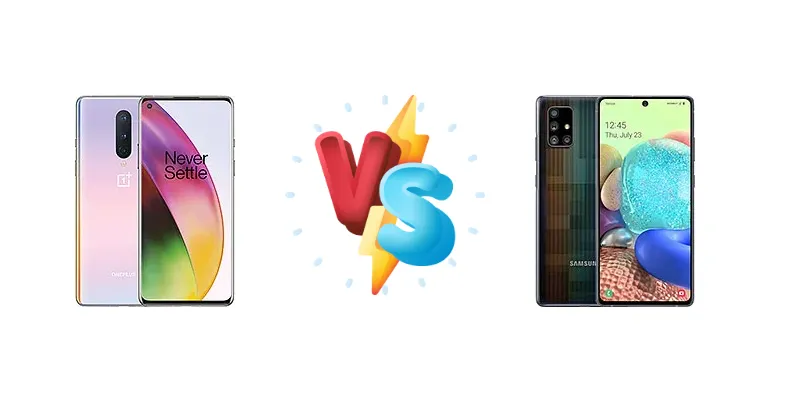
|
🏆 Quick Verdict
For users prioritizing raw performance and responsiveness, the OnePlus 8 5G is the clear winner. Its Snapdragon 865 chipset provides a significant advantage in demanding tasks. However, the Samsung Galaxy A71 5G UW offers a compelling value proposition for those seeking 5G connectivity without the flagship price tag.
| PHONES | ||
|---|---|---|
| Phone Names | OnePlus 8 5G (T-Mobile) | Samsung Galaxy A71 5G UW |
| Network | ||
|---|---|---|
| 2G bands | GSM 850 / 900 / 1800 / 1900 | GSM 850 / 900 / 1800 / 1900 |
| 3G bands | HSDPA 800 / 850 / 900 / 1700(AWS) / 1800 / 1900 / 2100 | HSDPA 850 / 900 / 1900 / 2100 |
| 4G bands | 1, 2, 3, 4, 5, 7, 8, 12, 13, 17, 18, 19, 20, 25, 26, 28, 29, 30, 34, 38, 39, 41, 46, 48, 66, 71 | 2, 3, 4, 5, 7, 12, 13, 20, 28, 66 |
| 5G bands | 2, 5, 41, 66, 71 SA/NSA | 260, 261 SA/NSA/mmWave |
| Speed | HSPA 42.2/5.76 Mbps, LTE (5CA) Cat18 1200/150 Mbps, 5G 7.5 Gbps DL | HSPA, LTE, 5G |
| Technology | GSM / CDMA / HSPA / EVDO / LTE / 5G | GSM / HSPA / LTE / 5G |
| CDMA2000 1xEV-DO | - | |
| Launch | ||
|---|---|---|
| Announced | 2020, April 14 | 2020, July 07 |
| Status | Available. Released 2020, April 29 | Available. Released 2020, July 16 |
| Body | ||
|---|---|---|
| Build | Glass front, glass back (Gorilla Glass 5), aluminum frame | Glass front (Gorilla Glass 3), plastic back, aluminum frame |
| Dimensions | 160.2 x 72.9 x 8 mm (6.31 x 2.87 x 0.31 in) | 162.8 x 75.7 x 8.4 mm (6.41 x 2.98 x 0.33 in) |
| SIM | Nano-SIM | Nano-SIM (pre-installed) |
| Weight | 180 g (6.35 oz) | 188 g (6.63 oz) |
| IP68 dust/water resistant (not for use underwater, liquid damage is not covered under warranty) | - | |
| Display | ||
|---|---|---|
| Protection | - | Corning Gorilla Glass 3 |
| Resolution | 1080 x 2400 pixels, 20:9 ratio (~402 ppi density) | 1080 x 2400 pixels, 20:9 ratio (~393 ppi density) |
| Size | 6.55 inches, 103.6 cm2 (~88.7% screen-to-body ratio) | 6.7 inches, 108.4 cm2 (~87.9% screen-to-body ratio) |
| Type | Fluid AMOLED, 90Hz, HDR10+ | Super AMOLED Plus |
| Platform | ||
|---|---|---|
| CPU | Octa-core (1x2.84 GHz Cortex-A77 & 3x2.42 GHz Cortex-A77 & 4x1.80 GHz Cortex-A55) | Octa-core (1x2.4 GHz Kryo 475 Prime & 1x2.2 GHz Kryo 475 Gold & 6x1.8 GHz Kryo 475 Silver) |
| Chipset | Qualcomm SM8250 Snapdragon 865 5G (7 nm+) | Qualcomm SM7250 Snapdragon 765G 5G (7 nm) |
| GPU | Adreno 650 | Adreno 620 |
| OS | Android 10, OxygenOS 10.0 | Android 10, One UI 2.1 |
| Memory | ||
|---|---|---|
| Card slot | No | microSDXC (dedicated slot) |
| Internal | 128GB 8GB RAM | 128GB 8GB RAM |
| UFS 3.0, 2-LANE | UFS 2.1 | |
| Main Camera | ||
|---|---|---|
| Features | Dual-LED flash, HDR, panorama | LED flash, panorama, HDR |
| Quad | - | 64 MP, f/1.8, 26mm (wide), 1/1.72", 0.8µm, PDAF 12 MP, f/2.2, 123˚ (ultrawide) 5 MP (macro) Auxiliary lens |
| Triple | 48 MP, f/1.8, 25mm (wide), 1/2.0", 0.8µm, PDAF, OIS 16 MP, f/2.2, 14mm, 116˚ (ultrawide) 2 MP (macro) | - |
| Video | 4K@30/60fps, 1080p@30/60/240fps, Auto HDR, gyro-EIS | 4K@30fps, 1080p@30/240fps, 1080p@960fps; gyro-EIS |
| Selfie camera | ||
|---|---|---|
| Features | HDR | HDR |
| Single | 16 MP, f/2.0, (wide), 1/3.06", 1.0µm | 32 MP, f/2.2, 26mm (wide), 1/2.8", 0.8µm |
| Video | 1080p@30fps, gyro-EIS | 4K@30fps, 1080p@30fps |
| Sound | ||
|---|---|---|
| 3.5mm jack | No | Yes |
| 35mm jack | No | Yes |
| Loudspeaker | Yes, with stereo speakers | Yes |
| Comms | ||
|---|---|---|
| Bluetooth | 5.1, A2DP, LE, aptX HD | 5.0, A2DP, LE |
| NFC | Yes | No |
| Positioning | GPS (L1+L5), GLONASS (G1), BDS (B1), GALILEO (E1+E5a) | GPS, GLONASS, GALILEO, BDS |
| Radio | No | No |
| USB | USB Type-C 3.1, OTG | USB Type-C 2.0, OTG |
| WLAN | Wi-Fi 802.11 a/b/g/n/ac/6, dual-band, Wi-Fi Direct, DLNA | Wi-Fi 802.11 a/b/g/n/ac, dual-band, Wi-Fi Direct |
| Features | ||
|---|---|---|
| Sensors | Fingerprint (under display, optical), accelerometer, gyro, proximity, compass | Fingerprint (under display, optical), accelerometer, gyro, proximity, compass |
| - | ANT+ | |
| Battery | ||
|---|---|---|
| Charging | 30W wired, 50% in 22 min | 25W wired |
| Type | Li-Po 4300 mAh | Li-Po 4500 mAh |
| Misc | ||
|---|---|---|
| Colors | Onyx Black, Interstellar Glow | Prism Bricks Black |
| Models | - | SM-A716V |
| Price | About 650 EUR | - |
| SAR | 1.10 W/kg (head) 1.10 W/kg (body) | 0.50 W/kg (head) 0.78 W/kg (body) |
OnePlus 8 5G (T-Mobile)
- Significantly faster processor (Snapdragon 865)
- Faster charging (30W)
- Likely superior display quality
- Potentially higher price
- May have less battery life than A71 5G UW
Samsung Galaxy A71 5G UW
- More affordable price
- Potentially larger battery capacity
- Good value for 5G connectivity
- Slower processor (Snapdragon 765G)
- Slower charging (25W)
- Likely less refined camera system
Display Comparison
While both devices feature displays suitable for everyday use, the specifics are not provided. However, given the OnePlus 8’s flagship positioning, it likely boasts a higher refresh rate and potentially better color accuracy compared to the A71 5G UW. The A71 5G UW, being a mid-range device, likely utilizes an AMOLED panel, but may have lower peak brightness and a less sophisticated color calibration process. Bezels are also likely slimmer on the OnePlus 8, contributing to a more immersive viewing experience.
Camera Comparison
Without detailed camera specs, a direct comparison is limited. However, the OnePlus 8, as a flagship, likely features a more advanced camera system with a larger main sensor and better image stabilization (OIS). The A71 5G UW likely prioritizes versatility with multiple lenses, but may compromise on image quality in low-light conditions. The aperture of the main lens is a critical factor; a wider aperture (lower f-number) allows more light to reach the sensor, resulting in better low-light performance. Image processing algorithms also play a crucial role, and OnePlus typically focuses on natural-looking images, while Samsung often boosts saturation and contrast.
Performance
The core difference lies in the chipsets: the OnePlus 8 5G utilizes the Qualcomm Snapdragon 865 5G (7nm+), while the Galaxy A71 5G UW features the Snapdragon 765G 5G (7nm). The 865’s octa-core CPU (1x2.84 GHz Cortex-A77, 3x2.42 GHz Cortex-A77, 4x1.80 GHz Cortex-A55) significantly outperforms the 765G’s (1x2.4 GHz Kryo 475 Prime, 1x2.2 GHz Kryo 475 Gold, 6x1.8 GHz Kryo 475 Silver). The 865’s architecture, with more powerful Cortex-A77 cores, translates to faster app loading times, smoother multitasking, and superior gaming performance. The 7nm+ node of the 865 also offers improved thermal efficiency, potentially reducing throttling during sustained workloads. The A71 5G UW will handle daily tasks adequately, but will struggle with graphically intensive games or demanding applications.
Battery Life
The OnePlus 8 5G supports 30W wired charging, achieving 50% charge in just 22 minutes. The Samsung Galaxy A71 5G UW offers 25W wired charging. While the A71 5G UW may have a larger battery capacity (not specified), the OnePlus 8’s faster charging speed provides a significant convenience advantage. A larger battery doesn’t always equate to longer real-world usage; software optimization and processor efficiency also play a vital role. The Snapdragon 865, despite its power, is relatively efficient, potentially offsetting the A71 5G UW’s larger battery.
Buying Guide
Buy the OnePlus 8 5G (T-Mobile) if you need a phone capable of handling intensive gaming, video editing, or other demanding applications, and value a smoother, more responsive user experience. Buy the Samsung Galaxy A71 5G UW if you prioritize battery life, a more affordable price point, and are comfortable with a less powerful processor for everyday tasks like browsing, social media, and casual gaming.