
OnePlus 8 5G vs. OnePlus 8T+ 5G: Is Faster Charging Worth the Upgrade?
| Phones Images | |||||
|---|---|---|---|---|---|
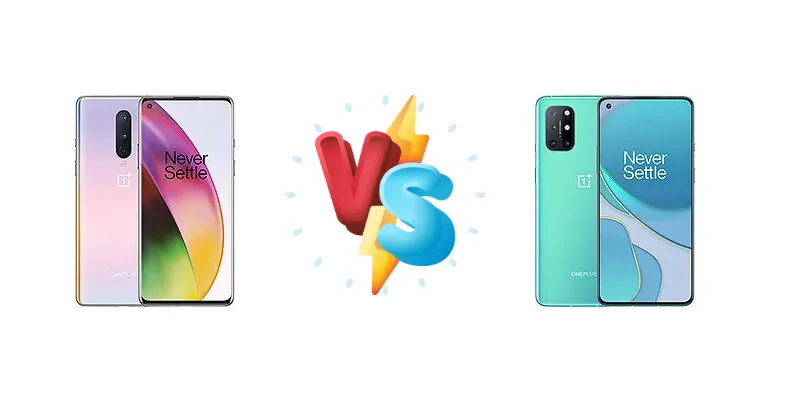
|
🏆 Quick Verdict
For most users, the OnePlus 8T+ 5G is the superior choice. Its 65W charging capability significantly reduces downtime, reaching 100% in just 39 minutes compared to the OnePlus 8 5G’s 30W charging which takes 22 minutes to reach 50%. The core performance remains identical, making the 8T+ a clear winner for those prioritizing convenience.
| PHONES | ||
|---|---|---|
| Phone Names | OnePlus 8 5G (T-Mobile) | OnePlus 8T+ 5G |
| Network | ||
|---|---|---|
| 2G bands | GSM 850 / 900 / 1800 / 1900 | GSM 850 / 900 / 1800 / 1900 |
| 3G bands | HSDPA 800 / 850 / 900 / 1700(AWS) / 1800 / 1900 / 2100 | HSDPA 850 / 900 / 1700(AWS) / 1900 / 2100 |
| 4G bands | 1, 2, 3, 4, 5, 7, 8, 12, 13, 17, 18, 19, 20, 25, 26, 28, 29, 30, 34, 38, 39, 41, 46, 48, 66, 71 | 1, 2, 3, 4, 5, 7, 8, 12, 13, 17, 18, 19, 20, 25, 26, 28, 29, 30, 34, 38, 39, 40, 41, 46, 48, 66, 71 |
| 5G bands | 2, 5, 41, 66, 71 SA/NSA | 2, 25, 41, 66, 71 Sub6/mmWave |
| Speed | HSPA 42.2/5.76 Mbps, LTE (5CA) Cat18 1200/150 Mbps, 5G 7.5 Gbps DL | HSPA 42.2/5.76 Mbps, LTE (5CA) Cat18 1200/200 Mbps, 5G 7.5 Gbps DL |
| Technology | GSM / CDMA / HSPA / EVDO / LTE / 5G | GSM / CDMA / HSPA / LTE / 5G |
| CDMA2000 1xEV-DO | - | |
| Launch | ||
|---|---|---|
| Announced | 2020, April 14 | 2020, October 14 |
| Status | Available. Released 2020, April 29 | Available. Released 2020, October 16 |
| Body | ||
|---|---|---|
| Build | Glass front, glass back (Gorilla Glass 5), aluminum frame | Glass front (Gorilla Glass 5), glass back (Gorilla Glass 5), aluminum frame |
| Dimensions | 160.2 x 72.9 x 8 mm (6.31 x 2.87 x 0.31 in) | 160.7 x 74.1 x 8.4 mm (6.33 x 2.92 x 0.33 in) |
| SIM | Nano-SIM | Nano-SIM |
| Weight | 180 g (6.35 oz) | - |
| IP68 dust/water resistant (not for use underwater, liquid damage is not covered under warranty) | - | |
| Display | ||
|---|---|---|
| Protection | - | Corning Gorilla Glass 5 |
| Resolution | 1080 x 2400 pixels, 20:9 ratio (~402 ppi density) | 1080 x 2400 pixels, 20:9 ratio (~402 ppi density) |
| Size | 6.55 inches, 103.6 cm2 (~88.7% screen-to-body ratio) | 6.55 inches, 103.6 cm2 (~87.0% screen-to-body ratio) |
| Type | Fluid AMOLED, 90Hz, HDR10+ | Fluid AMOLED, 120Hz, HDR10+ |
| Platform | ||
|---|---|---|
| CPU | Octa-core (1x2.84 GHz Cortex-A77 & 3x2.42 GHz Cortex-A77 & 4x1.80 GHz Cortex-A55) | Octa-core (1x2.84 GHz Cortex-A77 & 3x2.42 GHz Cortex-A77 & 4x1.80 GHz Cortex-A55) |
| Chipset | Qualcomm SM8250 Snapdragon 865 5G (7 nm+) | Qualcomm SM8250 Snapdragon 865 5G (7 nm+) |
| GPU | Adreno 650 | Adreno 650 |
| OS | Android 10, OxygenOS 10.0 | Android 11, OxygenOS 11 |
| Memory | ||
|---|---|---|
| Card slot | No | No |
| Internal | 128GB 8GB RAM | 256GB 12GB RAM |
| UFS 3.0, 2-LANE | - | |
| Main Camera | ||
|---|---|---|
| Features | Dual-LED flash, HDR, panorama | Dual-LED flash, HDR, panorama |
| Quad | - | 48 MP, f/1.7, 26mm (wide), 1/2.0", 0.8µm, PDAF, OIS 16 MP, f/2.2, 14mm, 123˚ (ultrawide), 1/3.6", 1.0µm 5 MP (macro) Auxiliary lens |
| Triple | 48 MP, f/1.8, 25mm (wide), 1/2.0", 0.8µm, PDAF, OIS 16 MP, f/2.2, 14mm, 116˚ (ultrawide) 2 MP (macro) | - |
| Video | 4K@30/60fps, 1080p@30/60/240fps, Auto HDR, gyro-EIS | 4K@30/60fps, 1080p@30/60/240fps, Auto HDR, gyro-EIS |
| Selfie camera | ||
|---|---|---|
| Features | HDR | HDR |
| Single | 16 MP, f/2.0, (wide), 1/3.06", 1.0µm | 16 MP, f/2.4, (wide), 1/3.06", 1.0µm |
| Video | 1080p@30fps, gyro-EIS | 1080p@30fps, gyro-EIS |
| Sound | ||
|---|---|---|
| 3.5mm jack | No | - |
| 35mm jack | No | No |
| Loudspeaker | Yes, with stereo speakers | Yes, with stereo speakers |
| Comms | ||
|---|---|---|
| Bluetooth | 5.1, A2DP, LE, aptX HD | 5.1, A2DP, LE, aptX HD |
| NFC | Yes | Yes |
| Positioning | GPS (L1+L5), GLONASS (G1), BDS (B1), GALILEO (E1+E5a) | GPS (L1+L5), GLONASS (G1), BDS (B1), GALILEO (E1+E5a) |
| Radio | No | No |
| USB | USB Type-C 3.1, OTG | USB Type-C 3.1, OTG |
| WLAN | Wi-Fi 802.11 a/b/g/n/ac/6, dual-band, Wi-Fi Direct, DLNA | Wi-Fi 802.11 a/b/g/n/ac/6, dual-band, Wi-Fi Direct, DLNA |
| Features | ||
|---|---|---|
| Sensors | Fingerprint (under display, optical), accelerometer, gyro, proximity, compass | Fingerprint (under display, optical), accelerometer, gyro, proximity, compass, barometer (market dependant) |
| Battery | ||
|---|---|---|
| Charging | 30W wired, 50% in 22 min | 65W wired, 100% in 39 min |
| Type | Li-Po 4300 mAh | Li-Po 4500 mAh |
| Misc | ||
|---|---|---|
| Colors | Onyx Black, Interstellar Glow | Aquamarine Green, Lunar Silver |
| Models | - | KB2007 |
| Price | About 650 EUR | About 640 EUR |
| SAR | 1.10 W/kg (head) 1.10 W/kg (body) | - |
OnePlus 8 5G (T-Mobile)
- Potentially lower price point due to being an older model.
- Reliable Snapdragon 865 performance.
- Established software support.
- Significantly slower 30W charging.
- May not receive software updates as long as the 8T+.
- Potentially less refined software experience.
OnePlus 8T+ 5G
- Blazing-fast 65W charging.
- Likely to receive longer software support.
- Potential for minor software and thermal optimizations.
- Higher initial purchase price.
- Core performance is identical to the OnePlus 8 5G.
- May not represent a massive upgrade for existing OnePlus 8 5G owners.
Display Comparison
Both the OnePlus 8 5G and 8T+ 5G feature Fluid AMOLED displays, but specific details like peak brightness and color accuracy aren't provided. Given OnePlus’s history, we can assume both offer vibrant colors and excellent viewing angles. The 8T+ likely benefits from minor refinements in color calibration, but the difference will be negligible for most users. The absence of LTPO technology in either model means refresh rate scaling isn't as power-efficient as newer displays.
Camera Comparison
Without detailed camera specifications, a direct comparison is challenging. However, both phones likely employ similar image processing algorithms. The OnePlus 8 series was known for its natural color reproduction. The 8T+ may have benefited from software optimizations, but the core imaging hardware is expected to be comparable. The absence of information regarding sensor size and OIS makes it difficult to assess any significant differences in low-light performance or video stabilization.
Performance
The heart of both devices is the Qualcomm SM8250 Snapdragon 865 5G (7 nm+). The CPU configuration – an octa-core setup with 1x2.84 GHz Cortex-A77, 3x2.42 GHz Cortex-A77, and 4x1.80 GHz Cortex-A55 – is identical. This means real-world performance in tasks like app launching, multitasking, and demanding games will be virtually indistinguishable. Thermal management will likely be similar, though the 8T+ might have slightly improved heat dissipation due to potential internal design tweaks. Both utilize LPDDR4X RAM, limiting the performance gains compared to newer LPDDR5X standards.
Battery Life
While the battery capacities aren't specified, the most significant difference lies in charging speed. The OnePlus 8 5G supports 30W wired charging, reaching 50% charge in 22 minutes. The OnePlus 8T+ 5G leaps ahead with 65W wired charging, achieving a full 100% charge in just 39 minutes. This difference is substantial, particularly for users who frequently need to top up their battery quickly. The faster charging of the 8T+ effectively mitigates any potential disadvantage from a slightly smaller battery capacity (if one exists).
Buying Guide
Buy the OnePlus 8 5G (T-Mobile) if you already own it and are satisfied with the charging speed, or if you find a significantly discounted price that makes it a better value. Buy the OnePlus 8T+ 5G if you prioritize minimizing charging time and want the latest iteration of OnePlus’s fast-charging technology, even if the core performance is the same.