
OnePlus 8 5G vs LG Velvet 5G UW: A Head-to-Head Performance and Value Showdown
| Phones Images | |||||
|---|---|---|---|---|---|
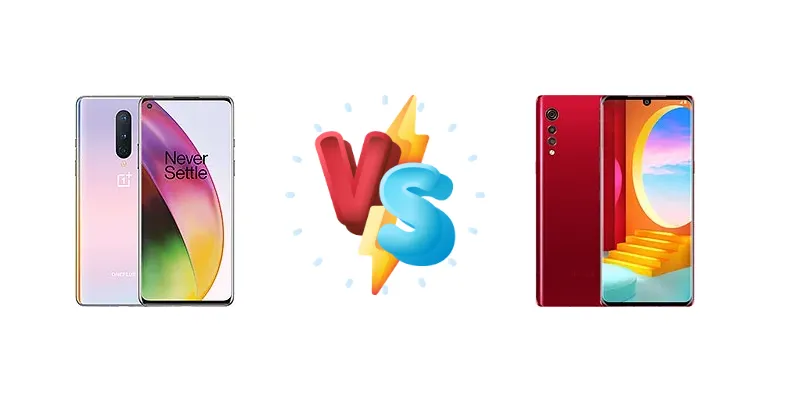
|
🏆 Quick Verdict
For users prioritizing raw performance and future-proofing, the OnePlus 8 5G is the clear winner. Its Snapdragon 865 chipset delivers significantly faster processing speeds. However, the LG Velvet 5G UW offers a compelling value proposition with a respectable feature set and a more affordable price, making it ideal for budget-conscious buyers.
| PHONES | ||
|---|---|---|
| Phone Names | OnePlus 8 5G (T-Mobile) | LG Velvet 5G UW |
| Network | ||
|---|---|---|
| 2G bands | GSM 850 / 900 / 1800 / 1900 | GSM 850 / 900 / 1800 / 1900 |
| 3G bands | HSDPA 800 / 850 / 900 / 1700(AWS) / 1800 / 1900 / 2100 | HSDPA 850 / 900 / 1700(AWS) / 1900 / 2100 |
| 4G bands | 1, 2, 3, 4, 5, 7, 8, 12, 13, 17, 18, 19, 20, 25, 26, 28, 29, 30, 34, 38, 39, 41, 46, 48, 66, 71 | 2, 3, 4, 5, 7, 12, 13, 20, 28, 46, 48, 66 |
| 5G bands | 2, 5, 41, 66, 71 SA/NSA | 260, 261 mmWave |
| Speed | HSPA 42.2/5.76 Mbps, LTE (5CA) Cat18 1200/150 Mbps, 5G 7.5 Gbps DL | HSPA 42.2/5.76 Mbps, LTE (5CA) Cat16 1000/75 Mbps, 5G 2Gbps |
| Technology | GSM / CDMA / HSPA / EVDO / LTE / 5G | GSM / CDMA / HSPA / LTE / 5G |
| CDMA2000 1xEV-DO | CDMA 800 / 1900 | |
| Launch | ||
|---|---|---|
| Announced | 2020, April 14 | 2020, August 19. Released 2020, August 21 |
| Status | Available. Released 2020, April 29 | Discontinued |
| Body | ||
|---|---|---|
| Build | Glass front, glass back (Gorilla Glass 5), aluminum frame | Glass front, glass back, aluminum frame |
| Dimensions | 160.2 x 72.9 x 8 mm (6.31 x 2.87 x 0.31 in) | 167.2 x 74.1 x 7.9 mm (6.58 x 2.92 x 0.31 in) |
| SIM | Nano-SIM | Nano-SIM (pre-installed) |
| Weight | 180 g (6.35 oz) | - |
| IP68 dust/water resistant (not for use underwater, liquid damage is not covered under warranty) | IP68 dust/water resistant (up to 1.5m for 30 mins) MIL-STD-810G compliant* *does not guarantee ruggedness or use in extreme conditions | |
| Display | ||
|---|---|---|
| Resolution | 1080 x 2400 pixels, 20:9 ratio (~402 ppi density) | 1080 x 2460 pixels (~395 ppi density) |
| Size | 6.55 inches, 103.6 cm2 (~88.7% screen-to-body ratio) | 6.8 inches, 109.8 cm2 (~88.6% screen-to-body ratio) |
| Type | Fluid AMOLED, 90Hz, HDR10+ | P-OLED |
| Platform | ||
|---|---|---|
| CPU | Octa-core (1x2.84 GHz Cortex-A77 & 3x2.42 GHz Cortex-A77 & 4x1.80 GHz Cortex-A55) | Octa-core (1x2.4 GHz Kryo 475 Prime & 1x2.2 GHz Kryo 475 Gold & 6x1.8 GHz Kryo 475 Silver) |
| Chipset | Qualcomm SM8250 Snapdragon 865 5G (7 nm+) | Qualcomm SM7250 Snapdragon 765G 5G (7 nm) |
| GPU | Adreno 650 | Adreno 620 |
| OS | Android 10, OxygenOS 10.0 | Android 10, upgradable to Android 11, LG UX |
| Memory | ||
|---|---|---|
| Card slot | No | microSDXC (uses shared SIM slot) |
| Internal | 128GB 8GB RAM | 128GB 6GB RAM |
| UFS 3.0, 2-LANE | UFS 2.1 | |
| Main Camera | ||
|---|---|---|
| Features | Dual-LED flash, HDR, panorama | LED flash, panorama, HDR |
| Triple | 48 MP, f/1.8, 25mm (wide), 1/2.0", 0.8µm, PDAF, OIS 16 MP, f/2.2, 14mm, 116˚ (ultrawide) 2 MP (macro) | 48 MP, f/1.8, 26mm (wide), 1/2.0", 0.8µm, PDAF 8 MP, f/2.2, 120˚, 15mm (ultrawide), 1/4.0", 1.12µm Auxiliary lens |
| Video | 4K@30/60fps, 1080p@30/60/240fps, Auto HDR, gyro-EIS | 4K@30fps, 1080p@30/60fps, gyro-EIS |
| Selfie camera | ||
|---|---|---|
| Features | HDR | HDR |
| Single | 16 MP, f/2.0, (wide), 1/3.06", 1.0µm | 16 MP, f/1.9, 29mm (standard), 1/3.06, 1.0µm |
| Video | 1080p@30fps, gyro-EIS | 1080p@30fps |
| Sound | ||
|---|---|---|
| 3.5mm jack | No | Yes |
| 35mm jack | No | Yes |
| Loudspeaker | Yes, with stereo speakers | Yes, with stereo speakers |
| Comms | ||
|---|---|---|
| Bluetooth | 5.1, A2DP, LE, aptX HD | 5.1, A2DP, LE, aptX HD |
| NFC | Yes | Yes |
| Positioning | GPS (L1+L5), GLONASS (G1), BDS (B1), GALILEO (E1+E5a) | GPS (L1+L5), GLONASS, BDS, GALILEO, QZSS |
| Radio | No | No |
| USB | USB Type-C 3.1, OTG | USB Type-C 2.0, OTG |
| WLAN | Wi-Fi 802.11 a/b/g/n/ac/6, dual-band, Wi-Fi Direct, DLNA | Wi-Fi 802.11 a/b/g/n/ac, dual-band, Wi-Fi Direct, DLNA |
| Features | ||
|---|---|---|
| Sensors | Fingerprint (under display, optical), accelerometer, gyro, proximity, compass | Fingerprint (under display, optical), accelerometer, gyro, proximity, compass, barometer |
| Battery | ||
|---|---|---|
| Charging | 30W wired, 50% in 22 min | 25W wired, PD3.0, QC4 9W wireless |
| Type | Li-Po 4300 mAh | Li-Po 4300 mAh |
| Misc | ||
|---|---|---|
| Colors | Onyx Black, Interstellar Glow | Aurora Red |
| Models | - | LM-G900V, LM-G900V |
| Price | About 650 EUR | About 590 EUR |
| SAR | 1.10 W/kg (head) 1.10 W/kg (body) | - |
OnePlus 8 5G (T-Mobile)
- Significantly faster processor with Snapdragon 865
- Faster 30W wired charging
- Potentially superior gaming performance
- Lacks wireless charging
- May be more expensive than the LG Velvet
LG Velvet 5G UW
- More affordable price point
- Wireless charging support (9W)
- Versatile camera system (likely)
- Slower Snapdragon 765G processor
- Slower 25W wired charging
Display Comparison
While both devices feature OLED displays, specific details like resolution and refresh rate aren't provided. However, the LG Velvet's emphasis on design suggests a potentially more visually refined experience. The Snapdragon 865 in the OnePlus 8 has the processing power to drive higher resolution or refresh rate panels smoothly, should they be implemented. The Velvet's inclusion of wireless charging (9W) suggests a focus on convenience, while the OnePlus 8 lacks this feature.
Camera Comparison
Without detailed sensor specifications, a direct comparison is challenging. However, LG historically emphasizes camera versatility, and the Velvet likely features a multi-camera system geared towards diverse shooting scenarios. The OnePlus 8, while capable, typically prioritizes image processing speed and clarity. The Snapdragon 865’s image signal processor (ISP) offers more advanced features and faster processing, potentially leading to better low-light performance and video recording capabilities. The absence of detailed sensor information makes it difficult to assess dynamic range or detail capture.
Performance
The core difference lies in the chipsets. The OnePlus 8 5G’s Snapdragon 865 (7nm+) boasts a significantly more powerful CPU configuration – an octa-core setup with a prime Cortex-A77 clocked at 2.84 GHz – compared to the LG Velvet 5G UW’s Snapdragon 765G (7nm) with its 2.4 GHz Kryo 475 Prime core. This translates to faster app loading times, smoother multitasking, and superior gaming performance on the OnePlus 8. The 765G is still capable, but the 865’s Adreno 650 GPU provides a substantial graphical advantage. The OnePlus 8 also benefits from potentially faster LPDDR5 RAM, further enhancing responsiveness.
Battery Life
The OnePlus 8 5G offers 30W wired charging, achieving a 50% charge in just 22 minutes, providing a significant convenience factor for users who need a quick power boost. The LG Velvet 5G UW, with its 25W wired charging (supporting PD3.0 and QC4) and 9W wireless charging, offers more charging flexibility but is slower overall. While battery capacity isn't specified, the more efficient Snapdragon 865 in the OnePlus 8 might offset a potentially smaller battery size, resulting in comparable real-world battery life.
Buying Guide
Buy the OnePlus 8 5G (T-Mobile) if you need uncompromising performance for demanding tasks like gaming or video editing, and value the fastest possible 5G speeds. Buy the LG Velvet 5G UW if you prefer a more balanced experience with a focus on design, a versatile camera system, and a lower overall cost, accepting a performance trade-off.