
OnePlus 8 5G (T-Mobile) vs. iPhone 12 Pro Max: A Head-to-Head Flagship Battle
| Phones Images | |||||
|---|---|---|---|---|---|
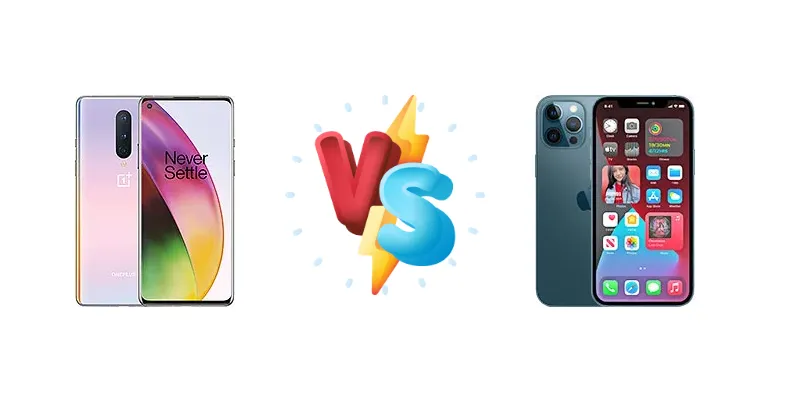
|
🏆 Quick Verdict
For the average user prioritizing a seamless ecosystem, long-term software support, and a consistently excellent camera experience, the iPhone 12 Pro Max is the superior choice. However, the OnePlus 8 5G offers compelling performance and faster charging at a significantly lower price, making it ideal for Android enthusiasts and budget-conscious buyers.
| PHONES | ||
|---|---|---|
| Phone Names | OnePlus 8 5G (T-Mobile) | Apple iPhone 12 Pro Max |
| Network | ||
|---|---|---|
| 2G bands | GSM 850 / 900 / 1800 / 1900 | GSM 850 / 900 / 1800 / 1900 |
| 3G bands | HSDPA 800 / 850 / 900 / 1700(AWS) / 1800 / 1900 / 2100 | HSDPA 850 / 900 / 1700(AWS) / 1900 / 2100 |
| 4G bands | 1, 2, 3, 4, 5, 7, 8, 12, 13, 17, 18, 19, 20, 25, 26, 28, 29, 30, 34, 38, 39, 41, 46, 48, 66, 71 | 1, 2, 3, 4, 5, 7, 8, 12, 13, 14, 17, 18, 19, 20, 25, 26, 28, 29, 30, 32, 34, 38, 39, 40, 41, 42, 46, 48, 66, 71 - A2342 |
| 5G bands | 2, 5, 41, 66, 71 SA/NSA | 1, 2, 3, 5, 7, 8, 12, 20, 25, 28, 38, 40, 41, 66, 71, 77, 78, 79, 260, 261 Sub6/mmWave - A2342 |
| Speed | HSPA 42.2/5.76 Mbps, LTE (5CA) Cat18 1200/150 Mbps, 5G 7.5 Gbps DL | HSPA, LTE, 5G, EV-DO Rev.A 3.1 Mbps |
| Technology | GSM / CDMA / HSPA / EVDO / LTE / 5G | GSM / CDMA / HSPA / EVDO / LTE / 5G |
| CDMA2000 1xEV-DO | 1, 2, 3, 5, 7, 8, 12, 20, 25, 28, 38, 40, 41, 66, 77, 78, 79 Sub6 - A2410, A2411, A2412 | |
| Launch | ||
|---|---|---|
| Announced | 2020, April 14 | 2020, October 13 |
| Status | Available. Released 2020, April 29 | Available. Released 2020, November 13 |
| Body | ||
|---|---|---|
| Build | Glass front, glass back (Gorilla Glass 5), aluminum frame | Glass front, glass back, stainless steel frame |
| Dimensions | 160.2 x 72.9 x 8 mm (6.31 x 2.87 x 0.31 in) | 160.8 x 78.1 x 7.4 mm (6.33 x 3.07 x 0.29 in) |
| SIM | Nano-SIM | · Nano-SIM + eSIM· Nano-SIM + Nano-SIM (China) |
| Weight | 180 g (6.35 oz) | 228 g (8.04 oz) |
| IP68 dust/water resistant (not for use underwater, liquid damage is not covered under warranty) | IP68 dust/water resistant (up to 6m for 30 min) Apple Pay (Visa, MasterCard, AMEX certified) | |
| Display | ||
|---|---|---|
| Protection | - | Ceramic Shield glass |
| Resolution | 1080 x 2400 pixels, 20:9 ratio (~402 ppi density) | 1284 x 2778 pixels, 19.5:9 ratio (~458 ppi density) |
| Size | 6.55 inches, 103.6 cm2 (~88.7% screen-to-body ratio) | 6.7 inches, 109.8 cm2 (~87.4% screen-to-body ratio) |
| Type | Fluid AMOLED, 90Hz, HDR10+ | Super Retina XDR OLED, HDR10, Dolby Vision, 800 nits (HBM), 1200 nits (peak) |
| Platform | ||
|---|---|---|
| CPU | Octa-core (1x2.84 GHz Cortex-A77 & 3x2.42 GHz Cortex-A77 & 4x1.80 GHz Cortex-A55) | Hexa-core (2x3.1 GHz Firestorm + 4x1.8 GHz Icestorm) |
| Chipset | Qualcomm SM8250 Snapdragon 865 5G (7 nm+) | Apple A14 Bionic (5 nm) |
| GPU | Adreno 650 | Apple GPU (4-core graphics) |
| OS | Android 10, OxygenOS 10.0 | iOS 14.1, upgradable to iOS 26.1 |
| Memory | ||
|---|---|---|
| Card slot | No | No |
| Internal | 128GB 8GB RAM | 128GB 6GB RAM, 256GB 6GB RAM, 512GB 6GB RAM |
| UFS 3.0, 2-LANE | NVMe | |
| Main Camera | ||
|---|---|---|
| Features | Dual-LED flash, HDR, panorama | Dual-LED dual-tone flash, HDR (photo/panorama) |
| Triple | 48 MP, f/1.8, 25mm (wide), 1/2.0", 0.8µm, PDAF, OIS 16 MP, f/2.2, 14mm, 116˚ (ultrawide) 2 MP (macro) | 12 MP, f/1.6, 26mm (wide), 1/1.9", 1.7µm, dual pixel PDAF, sensor-shift OIS 12 MP, f/2.2, 65mm (telephoto), 1/3.4", 1.0µm, PDAF, OIS, 2.5x optical zoom 12 MP, f/2.4, 13mm, 120˚ (ultrawide), 1/3.4", 1.0µm TOF 3D LiDAR scanner (depth) |
| Video | 4K@30/60fps, 1080p@30/60/240fps, Auto HDR, gyro-EIS | 4K@24/25/30/60fps, 1080p@25/30/60/120/240fps, 10‑bit HDR, Dolby Vision HDR (up to 60fps), stereo sound rec. |
| Selfie camera | ||
|---|---|---|
| Features | HDR | HDR |
| Single | 16 MP, f/2.0, (wide), 1/3.06", 1.0µm | 12 MP, f/2.2, 23mm (wide), 1/3.6", 1.0µm SL 3D, (depth/biometrics sensor) |
| Video | 1080p@30fps, gyro-EIS | 4K@24/25/30/60fps, 1080p@25/30/60/120fps, gyro-EIS |
| Sound | ||
|---|---|---|
| 3.5mm jack | No | No |
| 35mm jack | No | No |
| Loudspeaker | Yes, with stereo speakers | Yes, with stereo speakers |
| Comms | ||
|---|---|---|
| Bluetooth | 5.1, A2DP, LE, aptX HD | 5.0, A2DP, LE |
| NFC | Yes | Yes |
| Positioning | GPS (L1+L5), GLONASS (G1), BDS (B1), GALILEO (E1+E5a) | GPS, GLONASS, GALILEO, QZSS |
| Radio | No | No |
| USB | USB Type-C 3.1, OTG | Lightning, USB 2.0 |
| WLAN | Wi-Fi 802.11 a/b/g/n/ac/6, dual-band, Wi-Fi Direct, DLNA | Wi-Fi 802.11 a/b/g/n/ac/6, dual-band, hotspot |
| Features | ||
|---|---|---|
| Sensors | Fingerprint (under display, optical), accelerometer, gyro, proximity, compass | Face ID, accelerometer, gyro, proximity, compass, barometer |
| - | Ultra Wideband (UWB) support | |
| Battery | ||
|---|---|---|
| Charging | 30W wired, 50% in 22 min | Wired, PD2.0, 50% in 30 min 15W wireless (MagSafe) 15W wireless (Qi2) - requires iOS 17.4 update |
| Type | Li-Po 4300 mAh | Li-Ion 3687 mAh (14.13 Wh) |
| Misc | ||
|---|---|---|
| Colors | Onyx Black, Interstellar Glow | Silver, Graphite, Gold, Pacific Blue |
| Models | - | A2411, A2342, A2410, A2412, iPhone13,4 |
| Price | About 650 EUR | $ 328.00 / C$ 549.75 / £ 270.67 / € 339.00 |
| SAR | 1.10 W/kg (head) 1.10 W/kg (body) | - |
| SAR EU | - | 0.99 W/kg (head) 0.99 W/kg (body) |
| Pricing | ||
|---|---|---|
| 128GB 6GB RAM | - | $ 599.99 |
| 256GB 6GB RAM | - | $ 728.45 |
| 512GB 6GB RAM | - | $ 886.67 |
| RENEWED | - | $ 627.00 |
| Tests | ||
|---|---|---|
| Battery life | - | Endurance rating 95h |
| Camera | - | Photo / Video |
| Display | - | Contrast ratio: Infinite (nominal) |
| Loudspeaker | - | -23.8 LUFS (Very good) |
| Performance | - | AnTuTu: 638584 (v8) GeekBench: 4240 (v5.1) GFXBench: 55fps (ES 3.1 onscreen) |
OnePlus 8 5G (T-Mobile)
- Faster 30W wired charging
- More affordable price point
- Customizable Android OS
- Less refined camera processing
- Shorter software support lifespan
- Snapdragon 865 is older generation
Apple iPhone 12 Pro Max
- Superior camera system and image processing
- Long-term software support and updates
- Strong ecosystem integration
- Slower wired charging (30 minutes to 50%)
- Higher price tag
- Less customizable iOS
Display Comparison
The iPhone 12 Pro Max boasts a significantly brighter display, reaching a measured 822 nits, compared to an unspecified peak brightness for the OnePlus 8 5G. While the OnePlus 8 5G likely offers a vibrant AMOLED panel, the iPhone’s higher brightness translates to better outdoor visibility. The iPhone’s 'infinite' contrast ratio, typical of OLED displays, provides deeper blacks and more dynamic visuals. Both devices likely utilize high refresh rate panels, though the OnePlus 8 5G is known for its 120Hz display, which wasn't available on the iPhone 12 Pro Max. This difference impacts scrolling smoothness and responsiveness, favoring the OnePlus 8 5G for users who prioritize fluid animations.
Camera Comparison
Both devices excel in camera performance, but approach it differently. The iPhone 12 Pro Max’s camera system is renowned for its computational photography, delivering consistently accurate colors and excellent dynamic range. While specific sensor sizes aren’t provided, Apple’s image processing pipeline prioritizes realism and detail. The OnePlus 8 5G, while capable, relies more on hardware specifications and offers a different aesthetic, often leaning towards more saturated colors. Both phones offer excellent video recording capabilities, but the iPhone 12 Pro Max’s ProRes video format (available on later models) provides professional-grade video quality. The absence of detailed camera specs for the OnePlus 8 5G makes a direct sensor comparison difficult, but the iPhone’s overall image processing and video capabilities give it an edge.
Performance
The Apple A14 Bionic, fabricated on a 5nm process, demonstrably outperforms the Qualcomm Snapdragon 865 (7nm+) in both CPU and GPU benchmarks. The A14’s hexa-core architecture, with its 2x3.1 GHz Firestorm cores, delivers superior single-core performance, crucial for responsive app launches and UI navigation. While the Snapdragon 865’s octa-core configuration offers multi-core prowess, the A14’s efficiency and architectural advantages provide a smoother, more sustained performance experience. The iPhone 12 Pro Max’s 6GB of RAM is comparable to the OnePlus 8 5G, but Apple’s memory management is optimized for iOS, resulting in efficient multitasking. Thermal management is also a key differentiator; the A14’s 5nm process contributes to lower heat generation, minimizing throttling during prolonged intensive tasks.
Battery Life
Both the OnePlus 8 5G and iPhone 12 Pro Max achieve an endurance rating of 95 hours, indicating similar overall battery life. However, their charging approaches differ significantly. The OnePlus 8 5G supports 30W wired charging, achieving 50% charge in just 22 minutes, while the iPhone 12 Pro Max takes 30 minutes to reach 50% with wired PD2.0 charging. The iPhone also offers 15W wireless charging via MagSafe and Qi2 (with iOS 17.4), providing convenient charging options. While the iPhone’s endurance is comparable, the OnePlus 8 5G’s faster wired charging is a significant advantage for users who prioritize quick top-ups.
Buying Guide
Buy the OnePlus 8 5G (T-Mobile) if you need a powerful Android phone with 5G connectivity, prioritize fast 30W charging, and prefer a more customizable software experience. Buy the Apple iPhone 12 Pro Max if you prefer iOS, value Apple’s ecosystem integration, demand a top-tier camera system, and prioritize long-term software updates and resale value.