
OnePlus 7T vs Xiaomi Mi 9T Pro: A Deep Dive into Performance and Battery Life
| Phones Images | |||||
|---|---|---|---|---|---|
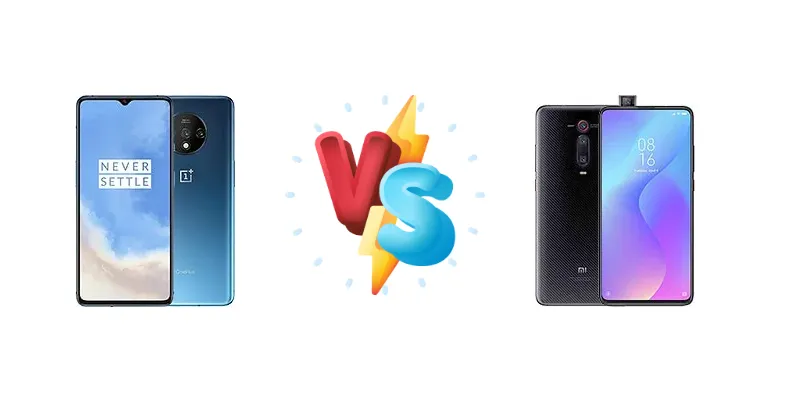
|
🏆 Quick Verdict
For most users, the Xiaomi Mi 9T Pro emerges as the slightly better value. Its larger 103-hour endurance battery and 27W Quick Charge 4 support offset the marginally slower processor, offering longer usage and faster top-ups. However, the OnePlus 7T remains a strong contender, particularly for those prioritizing a refined software experience.
| PHONES | ||
|---|---|---|
| Phone Names | OnePlus 7T | Xiaomi Mi 9T Pro |
| Network | ||
|---|---|---|
| 2G bands | GSM 850 / 900 / 1800 / 1900 | GSM 850 / 900 / 1800 / 1900 |
| 3G bands | HSDPA 800 / 850 / 900 / 1700(AWS) / 1800 / 1900 / 2100 | HSDPA 850 / 900 / 1700(AWS) / 1900 / 2100 |
| 4G bands | 1, 2, 3, 4, 5, 7, 8, 12, 13, 17, 18, 19, 20, 25, 26, 28, 29, 32, 34, 38, 39, 40, 41, 66 - EU | 1, 2, 3, 4, 5, 7, 8, 20, 28, 38, 40 |
| Speed | HSPA 42.2/5.76 Mbps, LTE (5CA) Cat18 1200/150 Mbps | HSPA, LTE |
| Technology | GSM / CDMA / HSPA / LTE | GSM / HSPA / LTE |
| 1, 2, 3, 4, 5, 7, 8, 12, 13, 17, 18, 19, 20, 26, 28, 29, 34, 38, 39, 40, 41 - CN, IN | - | |
| Launch | ||
|---|---|---|
| Announced | 2019, September 26 | 2019, August 21. Released 2019, August 21 |
| Status | Available. Released 2019, September 27 | Discontinued |
| Body | ||
|---|---|---|
| Build | Glass front (Gorilla Glass 5), glass back (Gorilla Glass 5), aluminum frame | Glass front (Gorilla Glass 5), glass back (Gorilla Glass 5), aluminum frame |
| Dimensions | 160.9 x 74.4 x 8.1 mm (6.33 x 2.93 x 0.32 in) | 156.7 x 74.3 x 8.8 mm (6.17 x 2.93 x 0.35 in) |
| SIM | Nano-SIM + Nano-SIM | Nano-SIM + Nano-SIM |
| Weight | 190 g (6.70 oz) | 191 g (6.74 oz) |
| Display | ||
|---|---|---|
| Protection | Corning Gorilla Glass 5 | Corning Gorilla Glass 5 |
| Resolution | 1080 x 2400 pixels, 20:9 ratio (~402 ppi density) | 1080 x 2340 pixels, 19.5:9 ratio (~403 ppi density) |
| Size | 6.55 inches, 103.6 cm2 (~86.5% screen-to-body ratio) | 6.39 inches, 100.2 cm2 (~86.1% screen-to-body ratio) |
| Type | Fluid AMOLED, 90Hz, HDR10+ | Super AMOLED, HDR |
| Platform | ||
|---|---|---|
| CPU | Octa-core (1x2.96 GHz Kryo 485 & 3x2.42 GHz Kryo 485 & 4x1.78 GHz Kryo 485) | Octa-core (1x2.84 GHz Kryo 485 & 3x2.42 GHz Kryo 485 & 4x1.78 GHz Kryo 485) |
| Chipset | Qualcomm SM8150 Snapdragon 855+ (7 nm) | Qualcomm SM8150 Snapdragon 855 (7 nm) |
| GPU | Adreno 640 (700 MHz) | Adreno 640 |
| OS | Android 10, upgradable to Android 12, OxygenOS 12.1 | Android 9.0 (Pie), upgradable to Android 11, MIUI 12.5 |
| Memory | ||
|---|---|---|
| Card slot | No | No |
| Internal | 128GB 8GB RAM, 256GB 8GB RAM | 64GB 6GB RAM, 128GB 6GB RAM, 256GB 8GB RAM |
| UFS 3.0 | UFS 2.1 | |
| Main Camera | ||
|---|---|---|
| Features | Dual-LED flash, HDR, panorama | Laser AF, Dual-LED flash, HDR, panorama |
| Triple | 48 MP, f/1.6, 26mm (wide), 1/2.0", 0.8µm, PDAF, OIS 12 MP, f/2.2, 51mm (telephoto), 1.0µm, PDAF, 2x optical zoom 16 MP, f/2.2, 17mm (ultrawide), AF | 48 MP, f/1.8, 26mm (wide), 1/2.0", 0.8µm, PDAF 8 MP, f/2.4, 53mm (telephoto), 1/4.0", 1.12µm, PDAF, 2x optical zoom 13 MP, f/2.4, 12mm (ultrawide), 1/3.1", 1.12µm |
| Video | 4K@30/60fps, 1080p@30/60/240fps, 720p@960fps, Auto HDR, gyro-EIS | 4K@30/60fps, 1080p@30/120/240fps, 1080p@960fps |
| Selfie camera | ||
|---|---|---|
| Features | HDR | HDR |
| Single | 16 MP, f/2.0, 25mm (wide), 1/3.06", 1.0µm | Motorized pop-up 20 MP, f/2.2, (wide), 1/3.4", 0.8µm |
| Video | 1080p@30fps, gyro-EIS | 1080p@30fps |
| Sound | ||
|---|---|---|
| 3.5mm jack | No | Yes |
| 35mm jack | No | Yes |
| Loudspeaker | Yes, with stereo speakers | Yes |
| - | 24-bit/192kHz audio | |
| Comms | ||
|---|---|---|
| Bluetooth | 5.0, A2DP, LE, aptX HD | 5.0, A2DP, LE, aptX HD |
| NFC | Yes | Yes |
| Positioning | GPS (L1+L5), GLONASS (G1), BDS (B1), GALILEO (E1+E5a) | GPS (L1+L5), GLONASS (G1), BDS (B1), GALILEO (E1+E5a) |
| Radio | No | Yes |
| USB | USB Type-C 3.1, OTG | USB Type-C 2.0, OTG |
| WLAN | Wi-Fi 802.11 a/b/g/n/ac, dual-band, Wi-Fi Direct, DLNA | Wi-Fi 802.11 a/b/g/n/ac, dual-band, Wi-Fi Direct |
| Features | ||
|---|---|---|
| Sensors | Fingerprint (under display, optical), accelerometer, gyro, compass | Fingerprint (under display, optical), accelerometer, gyro, proximity, compass |
| Virtual proximity sensing | - | |
| Battery | ||
|---|---|---|
| Charging | 30W wired | 27W wired, QC4 |
| Type | Li-Po 3800 mAh, non-removable | Li-Po 4000 mAh, non-removable |
| Misc | ||
|---|---|---|
| Colors | Frosted Silver, Glacier Blue, White | Carbon black, Red flame, Glacier blue |
| Models | HD1901, HD1903, HD1900, HD1907, HD1905 | M1903F11G |
| Price | About 130 EUR | About 150 EUR |
| SAR | - | 1.03 W/kg (head) 0.72 W/kg (body) |
| SAR EU | - | 1.30 W/kg (head) 1.51 W/kg (body) |
| Pricing | ||
|---|---|---|
| 128GB 8GB RAM | $ 399.99 | - |
| 256GB 8GB RAM | $ 280.49 | - |
| RENEWED | $ 191.00 | - |
| Tests | ||
|---|---|---|
| Audio quality | Noise -94.0dB / Crosstalk -93.6dB | Noise -93.9dB / Crosstalk -94.2dB |
| Battery life | Endurance rating 90h | Endurance rating 103h |
| Camera | Photo / Video | - |
| Display | - | Contrast ratio: Infinite (nominal) |
| Loudspeaker | Voice 79dB / Noise 77dB / Ring 91dB | -26.9 LUFS (Good) |
| Performance | AnTuTu: 391545 (v7), 485585 (v8) GeekBench: 11394 (v4.4), 2858 (v5.1) GFXBench: 41fps (ES 3.1 onscreen) | AnTuTu: 368846 (v7), 437823 (v8) GeekBench: 10684 (v4.4), 2732 (v5.1) GFXBench: 36fps (ES 3.1 onscreen) |
OnePlus 7T
- Slightly faster processor (Snapdragon 855+)
- Refined OxygenOS software experience
- Generally faster software updates
- Lower battery endurance (90h vs 103h)
- Slower charging speed (30W vs 27W with QC4)
- Potentially higher price depending on storage configuration
Xiaomi Mi 9T Pro
- Superior battery life (103h endurance)
- Faster charging with Quick Charge 4 (27W)
- Often more affordable than the OnePlus 7T
- MIUI software can be bloated and less refined
- Slightly slower processor (Snapdragon 855)
- Software update schedule can be less consistent
Display Comparison
Both phones feature displays with an 'Infinite' contrast ratio, suggesting excellent black levels typical of OLED panels. However, detailed specifications like peak brightness and color accuracy are missing. Given Xiaomi's history with vibrant displays, it's likely the Mi 9T Pro leans towards a more saturated look, while OnePlus typically aims for greater color accuracy. The lack of high refresh rate panels (90Hz or 120Hz) is a commonality, placing both phones behind newer offerings. Bezels are comparable, offering an immersive viewing experience for the time.
Camera Comparison
Both phones are listed as having 'Photo / Video' capabilities, lacking specific details. Given the era, both likely feature multi-camera setups. Without sensor size or aperture information, a direct comparison is difficult. However, Xiaomi often emphasizes camera features, suggesting the Mi 9T Pro might offer more software-driven enhancements. The absence of detail regarding OIS (Optical Image Stabilization) is a significant omission; its presence would be a major advantage for video recording and low-light photography. We can assume both phones include standard modes like portrait and night mode, but image quality will depend heavily on the underlying hardware and software processing.
Performance
The core difference lies in the chipset: the OnePlus 7T boasts the Snapdragon 855+, while the Mi 9T Pro uses the standard Snapdragon 855. While both are 7nm chips with an identical CPU core configuration (Octa-core: 1x2.84/2.96 GHz Kryo 485, 3x2.42 GHz Kryo 485, 4x1.78 GHz Kryo 485), the 855+ features a slightly higher clock speed and an improved GPU. This translates to a modest performance advantage for the 7T in sustained gaming and demanding tasks. However, the difference is unlikely to be noticeable in everyday use. Both phones benefit from 8GB of RAM, ensuring smooth multitasking.
Battery Life
The Xiaomi Mi 9T Pro clearly wins in battery endurance with a rating of 103 hours, compared to the OnePlus 7T's 90 hours. This 14-hour difference is substantial and translates to a noticeable advantage for the Mi 9T Pro in real-world usage. Furthermore, the Mi 9T Pro supports 27W wired charging with Quick Charge 4, while the OnePlus 7T offers 30W Warp Charge. While 30W is nominally faster, Quick Charge 4's efficiency and compatibility with a wider range of chargers could provide a more consistent charging experience. The Mi 9T Pro's larger battery capacity combined with efficient charging gives it a clear edge.
Buying Guide
Buy the OnePlus 7T if you prioritize a clean, optimized software experience with OxygenOS and are willing to trade a bit of battery life for it. It's ideal for users who frequently switch between apps and value a smooth, responsive interface. Buy the Xiaomi Mi 9T Pro if you prioritize maximum battery life and faster charging, and don't mind MIUI's more feature-rich, but sometimes cluttered, software. This phone is perfect for power users and those who heavily rely on their phone throughout the day.