
OnePlus 7T vs Samsung Galaxy S10 Lite: A Detailed Comparison
| Phones Images | |||||
|---|---|---|---|---|---|
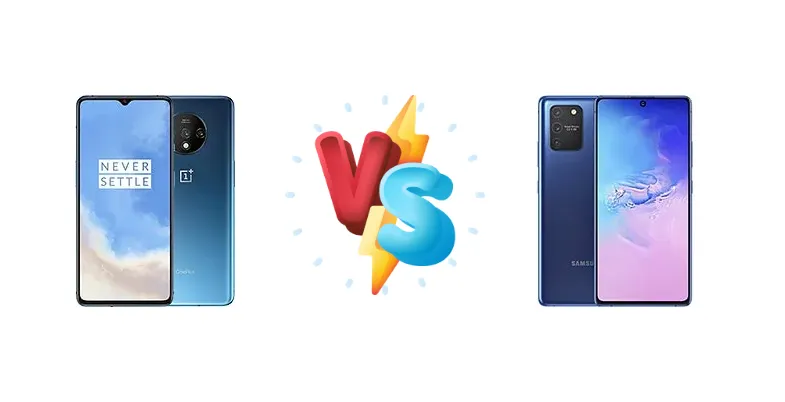
|
🏆 Quick Verdict
For most users, the Samsung Galaxy S10 Lite emerges as the better choice. Its significantly larger 110-hour endurance rating and 45W fast charging capability outweigh the OnePlus 7T’s slightly faster processor, offering a more reliable and convenient daily experience. However, the 7T remains a strong contender for those seeking a slightly more affordable option.
| PHONES | ||
|---|---|---|
| Phone Names | OnePlus 7T | Samsung Galaxy S10 Lite |
| Network | ||
|---|---|---|
| 2G bands | GSM 850 / 900 / 1800 / 1900 | GSM 850 / 900 / 1800 / 1900 |
| 3G bands | HSDPA 800 / 850 / 900 / 1700(AWS) / 1800 / 1900 / 2100 | HSDPA 850 / 900 / 1700(AWS) / 1900 / 2100 |
| 4G bands | 1, 2, 3, 4, 5, 7, 8, 12, 13, 17, 18, 19, 20, 25, 26, 28, 29, 32, 34, 38, 39, 40, 41, 66 - EU | 1, 2, 3, 4, 5, 7, 8, 12, 13, 17, 20, 26, 28, 38, 40, 41, 66 |
| Speed | HSPA 42.2/5.76 Mbps, LTE (5CA) Cat18 1200/150 Mbps | HSPA, LTE |
| Technology | GSM / CDMA / HSPA / LTE | GSM / HSPA / LTE |
| 1, 2, 3, 4, 5, 7, 8, 12, 13, 17, 18, 19, 20, 26, 28, 29, 34, 38, 39, 40, 41 - CN, IN | - | |
| Launch | ||
|---|---|---|
| Announced | 2019, September 26 | 2020, January 03 |
| Status | Available. Released 2019, September 27 | Available. Released 2020, February 03 |
| Body | ||
|---|---|---|
| Build | Glass front (Gorilla Glass 5), glass back (Gorilla Glass 5), aluminum frame | Glass front (Gorilla Glass 3+), aluminum frame, plastic back |
| Dimensions | 160.9 x 74.4 x 8.1 mm (6.33 x 2.93 x 0.32 in) | 162.5 x 75.6 x 8.1 mm (6.40 x 2.98 x 0.32 in) |
| SIM | Nano-SIM + Nano-SIM | · Nano-SIM· Nano-SIM + Nano-SIM |
| Weight | 190 g (6.70 oz) | 186 g (6.56 oz) |
| Display | ||
|---|---|---|
| Protection | Corning Gorilla Glass 5 | Corning Gorilla Glass 3+ |
| Resolution | 1080 x 2400 pixels, 20:9 ratio (~402 ppi density) | 1080 x 2400 pixels, 20:9 ratio (~394 ppi density) |
| Size | 6.55 inches, 103.6 cm2 (~86.5% screen-to-body ratio) | 6.7 inches, 107.8 cm2 (~87.8% screen-to-body ratio) |
| Type | Fluid AMOLED, 90Hz, HDR10+ | Super AMOLED Plus, HDR10+ |
| - | Always-on display | |
| Platform | ||
|---|---|---|
| CPU | Octa-core (1x2.96 GHz Kryo 485 & 3x2.42 GHz Kryo 485 & 4x1.78 GHz Kryo 485) | Octa-core (1x2.84 GHz Kryo 485 & 3x2.42 GHz Kryo 485 & 4x1.78 GHz Kryo 485) |
| Chipset | Qualcomm SM8150 Snapdragon 855+ (7 nm) | Qualcomm SM8150 Snapdragon 855 (7 nm) |
| GPU | Adreno 640 (700 MHz) | Adreno 640 |
| OS | Android 10, upgradable to Android 12, OxygenOS 12.1 | Android 10, upgradable to Android 13, One UI 5 |
| Memory | ||
|---|---|---|
| Card slot | No | microSDXC (uses shared SIM slot) |
| Internal | 128GB 8GB RAM, 256GB 8GB RAM | 128GB 6GB RAM, 128GB 8GB RAM, 512GB 8GB RAM |
| UFS 3.0 | UFS 2.1 | |
| Main Camera | ||
|---|---|---|
| Features | Dual-LED flash, HDR, panorama | LED flash, panorama, HDR |
| Triple | 48 MP, f/1.6, 26mm (wide), 1/2.0", 0.8µm, PDAF, OIS 12 MP, f/2.2, 51mm (telephoto), 1.0µm, PDAF, 2x optical zoom 16 MP, f/2.2, 17mm (ultrawide), AF | 48 MP, f/2.0, 26mm (wide), 1/2.0", 0.8µm, PDAF, Super Steady OIS 12 MP, f/2.2, 12mm (ultrawide) 5 MP (macro) |
| Video | 4K@30/60fps, 1080p@30/60/240fps, 720p@960fps, Auto HDR, gyro-EIS | 4K@30/60fps, 1080p@30/60/240fps; gyro-EIS |
| Selfie camera | ||
|---|---|---|
| Features | HDR | HDR |
| Single | 16 MP, f/2.0, 25mm (wide), 1/3.06", 1.0µm | 32 MP, f/2.2, 25mm (wide), 1/2.8", 0.8µm |
| Video | 1080p@30fps, gyro-EIS | 1080p@30fps |
| Sound | ||
|---|---|---|
| 3.5mm jack | No | No |
| 35mm jack | No | No |
| Loudspeaker | Yes, with stereo speakers | Yes |
| Comms | ||
|---|---|---|
| Bluetooth | 5.0, A2DP, LE, aptX HD | 5.0, A2DP, LE |
| NFC | Yes | Yes |
| Positioning | GPS (L1+L5), GLONASS (G1), BDS (B1), GALILEO (E1+E5a) | GPS, GLONASS, GALILEO, BDS |
| Radio | No | FM radio (market/region dependent) |
| USB | USB Type-C 3.1, OTG | USB Type-C 2.0 |
| WLAN | Wi-Fi 802.11 a/b/g/n/ac, dual-band, Wi-Fi Direct, DLNA | Wi-Fi 802.11 a/b/g/n/ac, dual-band, Wi-Fi Direct |
| Features | ||
|---|---|---|
| Sensors | Fingerprint (under display, optical), accelerometer, gyro, compass | Fingerprint (under display, optical), accelerometer, gyro, proximity, compass |
| Virtual proximity sensing | ANT+ | |
| Battery | ||
|---|---|---|
| Charging | 30W wired | 45W wired |
| Type | Li-Po 3800 mAh, non-removable | Li-Po 4500 mAh, non-removable |
| Misc | ||
|---|---|---|
| Colors | Frosted Silver, Glacier Blue, White | Prism White, Prism Black, Prism Blue |
| Models | HD1901, HD1903, HD1900, HD1907, HD1905 | SM-G770F, SM-G770F/DS, SM-G770F/DSM, SM-G770U1 |
| Price | About 130 EUR | About 380 EUR |
| SAR | - | 0.69 W/kg (head) 0.93 W/kg (body) |
| SAR EU | - | 0.49 W/kg (head) 1.52 W/kg (body) |
| Pricing | ||
|---|---|---|
| 128GB 8GB RAM | $ 399.99 | - |
| 256GB 8GB RAM | $ 280.49 | - |
| RENEWED | $ 191.00 | - |
| Tests | ||
|---|---|---|
| Audio quality | Noise -94.0dB / Crosstalk -93.6dB | Noise -93.7dB / Crosstalk -94.7dB |
| Battery life | Endurance rating 90h | Endurance rating 110h |
| Camera | Photo / Video | Photo / Video |
| Display | - | Contrast ratio: Infinite (nominal) |
| Loudspeaker | Voice 79dB / Noise 77dB / Ring 91dB | -27.2 LUFS (Good) |
| Performance | AnTuTu: 391545 (v7), 485585 (v8) GeekBench: 11394 (v4.4), 2858 (v5.1) GFXBench: 41fps (ES 3.1 onscreen) | AnTuTu: 370751 (v7), 459497 (v8) GeekBench: 11151 (v4.4), 2732 (v5.1) GFXBench: 56fps (ES 3.1 onscreen) |
OnePlus 7T
- Slightly faster processor (Snapdragon 855+)
- Potentially more affordable price point
- Clean OxygenOS software experience
- Lower battery endurance (90h vs 110h)
- Slower charging speed (30W vs 45W)
- Less detailed display specifications
Samsung Galaxy S10 Lite
- Superior battery life (110h endurance)
- Faster 45W charging
- Brighter display (705 nits)
- Slightly slower processor (Snapdragon 855)
- Samsung’s One UI software can be divisive
- Potentially higher price
Display Comparison
The Samsung Galaxy S10 Lite boasts a notably brighter display, reaching a measured 705 nits, compared to the OnePlus 7T’s unspecified peak brightness. This difference is significant for outdoor visibility. While both feature similar 'infinite' contrast ratios (typical for OLED panels), the S10 Lite’s higher peak brightness provides a more vibrant and readable experience in direct sunlight. The OnePlus 7T’s display specifications are less detailed, making a direct comparison of color accuracy and panel technology difficult, but it’s reasonable to assume the S10 Lite offers a superior visual experience.
Camera Comparison
Both devices offer capable photo and video recording, but detailed camera specifications are lacking. Without sensor size or aperture information, a definitive comparison is challenging. However, the S10 Lite’s marketing emphasized its camera capabilities, suggesting a potentially more refined image processing pipeline. The presence of Optical Image Stabilization (OIS) on both devices is a positive, contributing to sharper images and smoother video. The inclusion of a 2MP macro camera on both phones is largely a marketing gimmick and unlikely to significantly impact image quality.
Performance
Both phones utilize the Qualcomm Snapdragon 855 series, but the OnePlus 7T features the Snapdragon 855+ (7nm), a slightly overclocked version of the Snapdragon 855 (7nm) found in the S10 Lite. The 7T’s CPU clocks at 2.96 GHz versus the S10 Lite’s 2.84 GHz. While this translates to a marginal performance increase in benchmarks, the real-world difference is often negligible for most users. Both devices are equipped with 8GB of RAM, ensuring smooth multitasking. Thermal management will likely be similar, though the 7T’s slightly faster processor *could* lead to marginally higher temperatures under sustained load.
Battery Life
The Samsung Galaxy S10 Lite’s 110-hour endurance rating significantly surpasses the OnePlus 7T’s 90-hour rating. This translates to a substantial difference in real-world battery life, allowing the S10 Lite to comfortably last a full day even with heavy usage. Furthermore, the S10 Lite supports 45W wired charging, enabling significantly faster charging speeds compared to the OnePlus 7T’s 30W charging. This means the S10 Lite can replenish its battery much quicker, minimizing downtime.
Buying Guide
Buy the OnePlus 7T if you prioritize raw processing speed for demanding tasks and are comfortable with a slightly shorter battery life. It’s ideal for users who frequently edit videos or play graphically intensive games and don’t mind topping up the battery more often. Buy the Samsung Galaxy S10 Lite if you value all-day battery life, incredibly fast charging, and a brighter display. This phone is perfect for power users, travelers, or anyone who needs a phone that can reliably last through a full day of heavy use.