
OnePlus 7T vs. Google Pixel 4a 5G: A Deep Dive into Performance and Value
| Phones Images | |||||
|---|---|---|---|---|---|
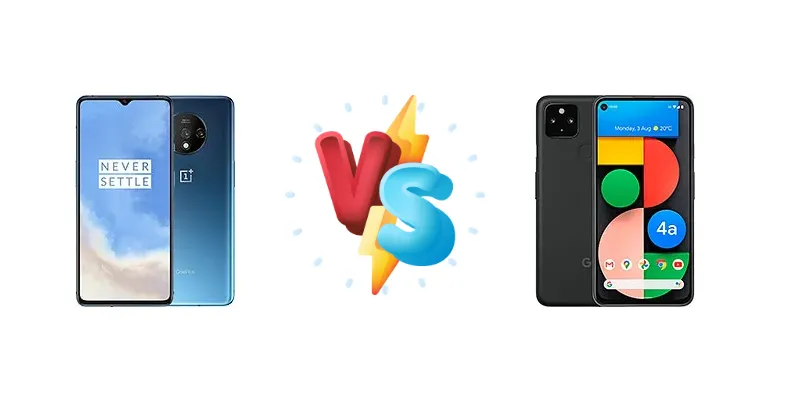
|
🏆 Quick Verdict
For the average user prioritizing raw performance and faster charging, the OnePlus 7T emerges as the better value. Its Snapdragon 855+ chipset still delivers a noticeable performance edge, and the 30W charging is significantly quicker than the Pixel 4a 5G’s 18W. However, the Pixel 4a 5G’s camera and guaranteed software support remain compelling advantages.
| PHONES | ||
|---|---|---|
| Phone Names | OnePlus 7T | Google Pixel 4a 5G |
| Network | ||
|---|---|---|
| 2G bands | GSM 850 / 900 / 1800 / 1900 | GSM 850 / 900 / 1800 / 1900 |
| 3G bands | HSDPA 800 / 850 / 900 / 1700(AWS) / 1800 / 1900 / 2100 | HSDPA 850 / 900 / 1700(AWS) / 1900 / 2100 |
| 4G bands | 1, 2, 3, 4, 5, 7, 8, 12, 13, 17, 18, 19, 20, 25, 26, 28, 29, 32, 34, 38, 39, 40, 41, 66 - EU | 1, 2, 3, 4, 5, 7, 8, 12, 13, 14, 17, 18, 19, 20, 25, 26, 28, 29, 30, 32, 38, 39, 40, 41, 42, 46, 48, 66, 71 |
| 5G bands | - | 1, 2, 3, 5, 7, 8, 12, 28, 41, 66, 71, 77, 78 Sub6, mmWave (market dependant) |
| Speed | HSPA 42.2/5.76 Mbps, LTE (5CA) Cat18 1200/150 Mbps | HSPA, LTE, 5G |
| Technology | GSM / CDMA / HSPA / LTE | GSM / HSPA / LTE / 5G |
| 1, 2, 3, 4, 5, 7, 8, 12, 13, 17, 18, 19, 20, 26, 28, 29, 34, 38, 39, 40, 41 - CN, IN | - | |
| Launch | ||
|---|---|---|
| Announced | 2019, September 26 | 2020, September 30 |
| Status | Available. Released 2019, September 27 | Available. Released 2020, November 05 |
| Body | ||
|---|---|---|
| Build | Glass front (Gorilla Glass 5), glass back (Gorilla Glass 5), aluminum frame | Glass front (Gorilla Glass 3), plastic back, plastic frame |
| Dimensions | 160.9 x 74.4 x 8.1 mm (6.33 x 2.93 x 0.32 in) | 153.9 x 74 x 8.2 mm (Sub-6) or 8.5 mm (Sub-6 and mmWave) |
| SIM | Nano-SIM + Nano-SIM | Nano-SIM + eSIM |
| Weight | 190 g (6.70 oz) | 168 g (5G Sub-6); 171 g ( 5G Sub-6 and mmWave) (5.93 oz) |
| Display | ||
|---|---|---|
| Protection | Corning Gorilla Glass 5 | Corning Gorilla Glass 3 |
| Resolution | 1080 x 2400 pixels, 20:9 ratio (~402 ppi density) | 1080 x 2340 pixels, 19.5:9 ratio (~413 ppi density) |
| Size | 6.55 inches, 103.6 cm2 (~86.5% screen-to-body ratio) | 6.2 inches, 95.7 cm2 (~84.1% screen-to-body ratio) |
| Type | Fluid AMOLED, 90Hz, HDR10+ | OLED, HDR |
| - | Always-on display | |
| Platform | ||
|---|---|---|
| CPU | Octa-core (1x2.96 GHz Kryo 485 & 3x2.42 GHz Kryo 485 & 4x1.78 GHz Kryo 485) | Octa-core (1x2.4 GHz Kryo 475 Prime & 1x2.2 GHz Kryo 475 Gold & 6x1.8 GHz Kryo 475 Silver) |
| Chipset | Qualcomm SM8150 Snapdragon 855+ (7 nm) | Qualcomm SM7250 Snapdragon 765G 5G (7 nm) |
| GPU | Adreno 640 (700 MHz) | Adreno 620 |
| OS | Android 10, upgradable to Android 12, OxygenOS 12.1 | Android 11, upgradable to Android 14 |
| Memory | ||
|---|---|---|
| Card slot | No | No |
| Internal | 128GB 8GB RAM, 256GB 8GB RAM | 128GB 6GB RAM |
| UFS 3.0 | UFS 2.1 | |
| Main Camera | ||
|---|---|---|
| Dual | - | 12.2 MP, f/1.7, 27mm (wide), 1/2.55", 1.4µm, dual pixel PDAF, OIS 16 MP, f/2.2, 107˚ (ultrawide), 1.0µm |
| Features | Dual-LED flash, HDR, panorama | LED flash, Pixel Shift, Auto-HDR, panorama |
| Triple | 48 MP, f/1.6, 26mm (wide), 1/2.0", 0.8µm, PDAF, OIS 12 MP, f/2.2, 51mm (telephoto), 1.0µm, PDAF, 2x optical zoom 16 MP, f/2.2, 17mm (ultrawide), AF | - |
| Video | 4K@30/60fps, 1080p@30/60/240fps, 720p@960fps, Auto HDR, gyro-EIS | 4K@30/60fps, 1080p@30/60/120/240fps; gyro-EIS |
| Selfie camera | ||
|---|---|---|
| Features | HDR | HDR |
| Single | 16 MP, f/2.0, 25mm (wide), 1/3.06", 1.0µm | 8 MP, f/2.0, 24mm (wide), 1/4.0", 1.12µm |
| Video | 1080p@30fps, gyro-EIS | 1080p@30fps |
| Sound | ||
|---|---|---|
| 3.5mm jack | No | Yes |
| 35mm jack | No | Yes |
| Loudspeaker | Yes, with stereo speakers | Yes, with stereo speakers |
| Comms | ||
|---|---|---|
| Bluetooth | 5.0, A2DP, LE, aptX HD | 5.0, A2DP, LE, aptX HD |
| NFC | Yes | Yes |
| Positioning | GPS (L1+L5), GLONASS (G1), BDS (B1), GALILEO (E1+E5a) | GPS, GLONASS, GALILEO, QZSS, BDS |
| Radio | No | No |
| USB | USB Type-C 3.1, OTG | USB Type-C 3.1 |
| WLAN | Wi-Fi 802.11 a/b/g/n/ac, dual-band, Wi-Fi Direct, DLNA | Wi-Fi 802.11 a/b/g/n/ac, dual-band, Wi-Fi Direct |
| Features | ||
|---|---|---|
| Sensors | Fingerprint (under display, optical), accelerometer, gyro, compass | Fingerprint (rear-mounted), accelerometer, gyro, proximity, compass, barometer |
| Virtual proximity sensing | - | |
| Battery | ||
|---|---|---|
| Charging | 30W wired | 18W wired, PD2.0 |
| Type | Li-Po 3800 mAh, non-removable | Li-Po 3885 mAh |
| Misc | ||
|---|---|---|
| Colors | Frosted Silver, Glacier Blue, White | Just Black, Clearly White |
| Models | HD1901, HD1903, HD1900, HD1907, HD1905 | GD1YQ, G025I, G025E, G025H, G6QU3 |
| Price | About 130 EUR | About 140 EUR |
| Pricing | ||
|---|---|---|
| 128GB 8GB RAM | $ 399.99 | - |
| 256GB 8GB RAM | $ 280.49 | - |
| RENEWED | $ 191.00 | - |
| Tests | ||
|---|---|---|
| Audio quality | Noise -94.0dB / Crosstalk -93.6dB | - |
| Battery life | Endurance rating 90h | - |
| Camera | Photo / Video | - |
| Loudspeaker | Voice 79dB / Noise 77dB / Ring 91dB | - |
| Performance | AnTuTu: 391545 (v7), 485585 (v8) GeekBench: 11394 (v4.4), 2858 (v5.1) GFXBench: 41fps (ES 3.1 onscreen) | - |
OnePlus 7T
- Superior processing power with Snapdragon 855+
- Faster 30W Warp Charge charging
- Potentially smoother 90Hz display
- Older device, potentially limited software support
- Camera may not match Pixel's computational photography
Google Pixel 4a 5G
- Excellent camera with Google’s image processing
- Guaranteed software updates from Google
- 5G connectivity
- Slower Snapdragon 765G processor
- Slower 18W charging
- Potentially lower peak display brightness
Display Comparison
While specific display specs aren't provided, the OnePlus 7T likely features a 90Hz AMOLED panel, a feature absent on the Pixel 4a 5G’s 6.4-inch FHD+ OLED display. This higher refresh rate translates to smoother scrolling and animations, enhancing the user experience for everyday tasks and gaming. The 7T’s panel likely boasts higher peak brightness, improving visibility in direct sunlight. Bezels are expected to be slimmer on the 7T, reflecting its flagship positioning at launch.
Camera Comparison
Both phones offer capable cameras, but approach image processing differently. The Pixel 4a 5G leverages Google’s computational photography expertise, excelling in dynamic range and low-light performance. While the 7T’s camera is competent, it relies more on hardware and less on software trickery. The Pixel 4a 5G’s image processing is known for its natural look, while the 7T may produce more saturated images. Sensor sizes are unknown, but the Pixel’s software algorithms often compensate for smaller sensors. The 7T’s video capabilities are likely more robust due to the 855+’s superior image signal processor (ISP).
Performance
The core difference lies in the chipsets. The OnePlus 7T’s Qualcomm Snapdragon 855+ (7nm) is a flagship-tier processor with an octa-core configuration peaking at 2.96 GHz. This contrasts with the Pixel 4a 5G’s Snapdragon 765G (7nm), a mid-range 5G-enabled chip with a lower peak clock speed of 2.4 GHz. The 855+’s Kryo 485 cores offer superior sustained performance, particularly in CPU-intensive tasks and graphically demanding games. While the 765G is capable, the 855+ provides a more responsive and fluid experience. The 7T’s potential for higher RAM speeds (likely LPDDR4X) further contributes to its performance advantage.
Battery Life
The OnePlus 7T boasts an endurance rating of 90 hours, suggesting a larger battery capacity than the Pixel 4a 5G. While the Pixel 4a 5G’s battery capacity is not specified, its 18W charging is significantly slower than the 7T’s 30W Warp Charge. This means the 7T can replenish its battery much faster, minimizing downtime. The 7T’s more efficient chipset also contributes to better battery life under heavy load. The Pixel 4a 5G supports PD2.0, offering some level of fast charging compatibility, but it doesn’t match the speed of OnePlus’s proprietary solution.
Buying Guide
Buy the OnePlus 7T if you need a phone for demanding tasks like gaming or video editing, and value fast charging speeds. Its older chipset is still a powerhouse. Buy the Google Pixel 4a 5G if you prioritize camera quality, clean software experience with timely updates, and 5G connectivity, even if it means sacrificing some raw processing power and charging speed.