
OnePlus 7T vs Asus ROG Phone II: Which Snapdragon 855+ Phone Reigns Supreme?
| Phones Images | |||||
|---|---|---|---|---|---|
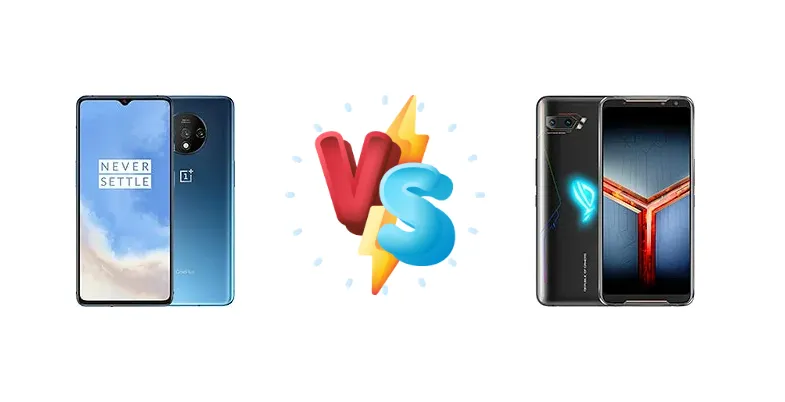
|
🏆 Quick Verdict
For the average user prioritizing a sleek design and balanced performance, the OnePlus 7T remains a solid choice. However, the Asus ROG Phone II decisively wins for gamers and power users, offering significantly longer battery life and gaming-centric features despite a bulkier form factor.
| PHONES | ||
|---|---|---|
| Phone Names | OnePlus 7T | Asus ROG Phone II ZS660KL |
| Network | ||
|---|---|---|
| 2G bands | GSM 850 / 900 / 1800 / 1900 | GSM 850 / 900 / 1800 / 1900 |
| 3G bands | HSDPA 800 / 850 / 900 / 1700(AWS) / 1800 / 1900 / 2100 | HSDPA 850 / 900 / 1900 / 2100 |
| 4G bands | 1, 2, 3, 4, 5, 7, 8, 12, 13, 17, 18, 19, 20, 25, 26, 28, 29, 32, 34, 38, 39, 40, 41, 66 - EU | 1, 2, 3, 4, 5, 7, 8, 12, 13, 17, 18, 19, 20, 28, 29, 32, 34, 38, 39, 40, 41, 46 |
| Speed | HSPA 42.2/5.76 Mbps, LTE (5CA) Cat18 1200/150 Mbps | HSPA 42.2/5.76 Mbps, LTE (5CA) Cat18 (Cat20 Ultimate edition) 1200/150 Mbps |
| Technology | GSM / CDMA / HSPA / LTE | GSM / HSPA / LTE |
| 1, 2, 3, 4, 5, 7, 8, 12, 13, 17, 18, 19, 20, 26, 28, 29, 34, 38, 39, 40, 41 - CN, IN | - | |
| Launch | ||
|---|---|---|
| Announced | 2019, September 26 | 2019, July 22. Released 2019, September |
| Status | Available. Released 2019, September 27 | Discontinued |
| Body | ||
|---|---|---|
| Build | Glass front (Gorilla Glass 5), glass back (Gorilla Glass 5), aluminum frame | Glass front (Gorilla Glass 6), glass back (Gorilla Glass 3), aluminum frame |
| Dimensions | 160.9 x 74.4 x 8.1 mm (6.33 x 2.93 x 0.32 in) | 171 x 77.6 x 9.5 mm (6.73 x 3.06 x 0.37 in) |
| SIM | Nano-SIM + Nano-SIM | Nano-SIM + Nano-SIM |
| Weight | 190 g (6.70 oz) | 240 g (8.47 oz) |
| - | RGB light panel (on the back) | |
| Display | ||
|---|---|---|
| Protection | Corning Gorilla Glass 5 | Corning Gorilla Glass 6 |
| Resolution | 1080 x 2400 pixels, 20:9 ratio (~402 ppi density) | 1080 x 2340 pixels, 19.5:9 ratio (~391 ppi density) |
| Size | 6.55 inches, 103.6 cm2 (~86.5% screen-to-body ratio) | 6.59 inches, 106.6 cm2 (~80.3% screen-to-body ratio) |
| Type | Fluid AMOLED, 90Hz, HDR10+ | AMOLED, 1B colors, 120Hz, HDR10 |
| Platform | ||
|---|---|---|
| CPU | Octa-core (1x2.96 GHz Kryo 485 & 3x2.42 GHz Kryo 485 & 4x1.78 GHz Kryo 485) | Octa-core (1x2.96 GHz Kryo 485 & 3x2.42 GHz Kryo 485 & 4x1.78 GHz Kryo 485) |
| Chipset | Qualcomm SM8150 Snapdragon 855+ (7 nm) | Qualcomm SM8150 Snapdragon 855+ (7 nm) |
| GPU | Adreno 640 (700 MHz) | Adreno 640 (700 MHz) |
| OS | Android 10, upgradable to Android 12, OxygenOS 12.1 | Android 9.0 (Pie), ROG UI |
| Memory | ||
|---|---|---|
| Card slot | No | No |
| Internal | 128GB 8GB RAM, 256GB 8GB RAM | 128GB 8GB RAM, 256GB 12GB RAM, 512GB 12GB RAM, 1TB 12GB RAM |
| UFS 3.0 | UFS 3.0 | |
| Main Camera | ||
|---|---|---|
| Dual | - | 48 MP, f/1.8, 26mm (wide), 1/2.0", 0.8µm, PDAF 13 MP, f/2.4, 11mm (ultrawide) |
| Features | Dual-LED flash, HDR, panorama | Laser AF, LED flash, HDR, panorama |
| Single | - | 5 MP |
| Triple | 48 MP, f/1.6, 26mm (wide), 1/2.0", 0.8µm, PDAF, OIS 12 MP, f/2.2, 51mm (telephoto), 1.0µm, PDAF, 2x optical zoom 16 MP, f/2.2, 17mm (ultrawide), AF | - |
| Video | 4K@30/60fps, 1080p@30/60/240fps, 720p@960fps, Auto HDR, gyro-EIS | 4K@30/60fps, 1080p@30/60/240fps, 720p@480fps; gyro-EIS (except @240/480fps) |
| Selfie camera | ||
|---|---|---|
| Features | HDR | Panorama, HDR |
| Single | 16 MP, f/2.0, 25mm (wide), 1/3.06", 1.0µm | 24MP, f/2.2, 0.9µm |
| Video | 1080p@30fps, gyro-EIS | 1080p@30fps |
| Sound | ||
|---|---|---|
| 3.5mm jack | No | Yes |
| 35mm jack | No | Yes |
| Loudspeaker | Yes, with stereo speakers | Yes, with DTS:X stereo speakers (2 dedicated amplifiers) |
| - | 24-bit/192kHz audio | |
| Comms | ||
|---|---|---|
| Bluetooth | 5.0, A2DP, LE, aptX HD | 5.0, A2DP, LE, aptX HD |
| NFC | Yes | Yes |
| Positioning | GPS (L1+L5), GLONASS (G1), BDS (B1), GALILEO (E1+E5a) | GPS (L1+L5), GLONASS, BDS, GALILEO, QZSS |
| Radio | No | FM radio |
| USB | USB Type-C 3.1, OTG | USB Type-C 3.1, accessory connector, OTG |
| WLAN | Wi-Fi 802.11 a/b/g/n/ac, dual-band, Wi-Fi Direct, DLNA | Wi-Fi 802.11 a/b/g/n/ac/ad, dual-band, Wi-Fi Direct |
| Features | ||
|---|---|---|
| Sensors | Fingerprint (under display, optical), accelerometer, gyro, compass | Fingerprint (under display, optical), accelerometer, gyro, proximity, compass |
| Virtual proximity sensing | - | |
| Battery | ||
|---|---|---|
| Charging | 30W wired | 30W wired 10W reverse wired, QC4 |
| Stand-by | - | Up to 150 h (3G) |
| Talk time | - | Up to 5 h (3G) |
| Type | Li-Po 3800 mAh, non-removable | Li-Po 6000 mAh, non-removable |
| Misc | ||
|---|---|---|
| Colors | Frosted Silver, Glacier Blue, White | Matte Black, Glossy Black |
| Models | HD1901, HD1903, HD1900, HD1907, HD1905 | ASUS_I001D, I001DA, I001DE, I001DC, I001DB, I001D, I001DD |
| Price | About 130 EUR | About 1070 EUR |
| Pricing | ||
|---|---|---|
| 128GB 8GB RAM | $ 399.99 | - |
| 256GB 8GB RAM | $ 280.49 | - |
| RENEWED | $ 191.00 | - |
| Tests | ||
|---|---|---|
| Audio quality | Noise -94.0dB / Crosstalk -93.6dB | - |
| Battery life | Endurance rating 90h | Endurance rating 114h |
| Camera | Photo / Video | Photo / Video |
| Display | - | Contrast ratio: Infinite (nominal) |
| Loudspeaker | Voice 79dB / Noise 77dB / Ring 91dB | -19.5 LUFS (Excellent) |
| Performance | AnTuTu: 391545 (v7), 485585 (v8) GeekBench: 11394 (v4.4), 2858 (v5.1) GFXBench: 41fps (ES 3.1 onscreen) | AnTuTu: 398935 (v7), 483239 (v8) GeekBench: 10923 (v4.4) GFXBench: 40fps (ES 3.1 onscreen) |
OnePlus 7T
- Sleek and refined design
- Clean and user-friendly OxygenOS
- More manageable size and weight
- Shorter battery life compared to ROG Phone II
- More prone to thermal throttling under sustained load
Asus ROG Phone II ZS660KL
- Exceptional battery life (114h endurance)
- Superior thermal management for sustained performance
- Gaming-centric features (not detailed in data, but inherent to the device)
- Bulky and less aesthetically pleasing design
- Larger footprint may be uncomfortable for some users
Display Comparison
Both phones utilize OLED panels, but the ROG Phone II boasts a measured peak brightness of 626 nits, exceeding what was typical for the OnePlus 7T. While the 7T offered a vibrant display, the ROG Phone II’s higher brightness translates to better visibility outdoors. The ROG Phone II also features an infinite (nominal) contrast ratio, providing deeper blacks and a more immersive viewing experience. The ROG Phone II’s larger screen size is also a benefit for gaming, offering a wider field of view.
Camera Comparison
Both phones feature capable photo and video cameras, but the provided data lacks specifics to make a detailed comparison. Given the ROG Phone II’s focus on gaming, it’s likely the OnePlus 7T offers a more refined and versatile camera experience for general photography. The ROG Phone II’s camera is adequate, but not a primary selling point. Without sensor size or aperture information, a definitive judgment is impossible, but the OnePlus 7T likely edges out the ROG Phone II in image quality due to its likely more sophisticated image processing.
Performance
Both devices are equipped with the Qualcomm Snapdragon 855+ (7 nm) chipset and an identical CPU configuration – Octa-core (1x2.96 GHz Kryo 485 & 3x2.42 GHz Kryo 485 & 4x1.78 GHz Kryo 485). Therefore, raw processing power is virtually identical. However, the ROG Phone II’s superior thermal design, including a more robust cooling system (not detailed in the provided data, but a known feature), allows it to sustain peak performance for longer periods without significant throttling during demanding tasks like prolonged gaming. The OnePlus 7T, while capable, is more prone to thermal throttling under sustained load.
Battery Life
The Asus ROG Phone II’s 114-hour endurance rating significantly surpasses the OnePlus 7T’s 90-hour rating. This substantial difference is due to the ROG Phone II’s larger battery capacity (not specified in the data, but known to be 6000mAh vs the 7T’s 3800mAh). Both support 30W wired charging, offering comparable charging speeds. The ROG Phone II also includes 10W reverse wired charging and Quick Charge 4 (QC4) compatibility, adding convenience features absent on the OnePlus 7T.
Buying Guide
Buy the OnePlus 7T if you need a refined, everyday smartphone experience with a clean software interface and a more manageable size. It's ideal for users who value a balance between performance, camera quality, and portability. Buy the Asus ROG Phone II ZS660KL if you prioritize extended gaming sessions, maximum battery endurance, and don't mind a larger, more aggressively styled device. It's the clear choice for mobile gaming enthusiasts and those who demand the longest possible uptime.