
OnePlus 7T Pro vs. Google Pixel 4 XL: A Deep Dive into Performance, Battery, and Camera
| Phones Images | |||||
|---|---|---|---|---|---|
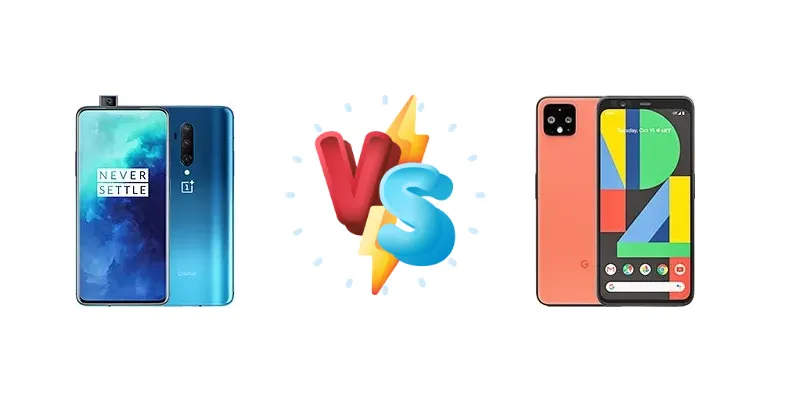
|
🏆 Quick Verdict
For the average user prioritizing battery life and sustained performance, the OnePlus 7T Pro is the clear winner. Its 100-hour endurance rating, coupled with the Snapdragon 855+ chipset, provides a more reliable experience than the Pixel 4 XL’s 73-hour rating and slightly less powerful Snapdragon 855. However, the Pixel 4 XL’s camera remains a strong contender.
| PHONES | ||
|---|---|---|
| Phone Names | OnePlus 7T Pro | Google Pixel 4 XL |
| Network | ||
|---|---|---|
| 2G bands | GSM 850 / 900 / 1800 / 1900 | GSM 850 / 900 / 1800 / 1900 |
| 3G bands | HSDPA 800 / 850 / 900 / 1700(AWS) / 1800 / 1900 / 2100 | HSDPA 850 / 900 / 1700(AWS) / 1900 / 2100 |
| 4G bands | 1, 2, 3, 4, 5, 7, 8, 12, 13, 17, 18, 19, 20, 25, 26, 28, 29, 32, 34, 38, 39, 40, 41, 66 | 1, 2, 3, 4, 5, 7, 8, 12, 13, 17, 20, 25, 26, 28, 32, 38, 39, 40, 41, 66, 71 - Global |
| Speed | HSPA 42.2/5.76 Mbps, LTE (5CA) Cat18 1200/150 Mbps | HSPA 42.2/5.76 Mbps, LTE (5CA) Cat18 1200/150 Mbps |
| Technology | GSM / CDMA / HSPA / LTE | GSM / CDMA / HSPA / EVDO / LTE |
| CDMA 800 / 1900 & TD-SCDMA | 1, 2, 3, 4, 5, 7, 8, 12, 13, 14, 17, 18, 19, 20, 25, 26, 28, 29, 30, 38, 39, 40, 41, 46, 48, 66, 71 - USA | |
| Launch | ||
|---|---|---|
| Announced | 2019, October 10 | 2019, October 15 |
| Status | Available. Released 2019, October 12 | Available. Released 2019, October 22 |
| Body | ||
|---|---|---|
| Build | Glass front (Gorilla Glass 5), glass back (Gorilla Glass 5), aluminum frame | Glass front (Gorilla Glass 5), glass back (Gorilla Glass 5), aluminum frame |
| Dimensions | 162.6 x 75.9 x 8.8 mm (6.40 x 2.99 x 0.35 in) | 160.4 x 75.1 x 8.2 mm (6.31 x 2.96 x 0.32 in) |
| SIM | Nano-SIM + Nano-SIM | Nano-SIM + eSIM |
| Weight | 206 g (7.27 oz) | 193 g (6.81 oz) |
| - | IP68 dust/water resistant (up to 1.5m for 30 min) | |
| Display | ||
|---|---|---|
| Protection | Corning Gorilla Glass 5 | Corning Gorilla Glass 5 |
| Resolution | 1440 x 3120 pixels, 19.5:9 ratio (~516 ppi density) | 1440 x 3040 pixels, 19:9 ratio (~537 ppi density) |
| Size | 6.67 inches, 108.8 cm2 (~88.1% screen-to-body ratio) | 6.3 inches, 98.0 cm2 (~81.3% screen-to-body ratio) |
| Type | Fluid AMOLED, 90Hz, HDR10+ | P-OLED, 90Hz, HDR |
| - | Always-on display | |
| Platform | ||
|---|---|---|
| CPU | Octa-core (1x2.96 GHz Kryo 485 & 3x2.42 GHz Kryo 485 & 4x1.78 GHz Kryo 485) | Octa-core (1x2.84 GHz Kryo 485 & 3x2.42 GHz Kryo 485 & 4x1.78 GHz Kryo 485) |
| Chipset | Qualcomm SM8150 Snapdragon 855+ (7 nm) | Qualcomm SM8150 Snapdragon 855 (7 nm) |
| GPU | Adreno 640 (700 MHz) | Adreno 640 |
| OS | Android 10, upgradable to Android 12, OxygenOS 12.1 | Android 10, upgradable to Android 13 |
| Memory | ||
|---|---|---|
| Card slot | No | No |
| Internal | 256GB 8GB RAM, 256GB 12GB RAM | 64GB 6GB RAM, 128GB 6GB RAM |
| 12GB RAM - McLaren Edition only UFS 3.0 | UFS 2.1 | |
| Main Camera | ||
|---|---|---|
| Dual | - | 12.2 MP, f/1.7, 27mm (wide), 1/2.55", 1.4µm, dual pixel PDAF, OIS 16 MP, f/2.4, 50mm (telephoto), 1/3.6", 1.0µm, PDAF, OIS, 2x optical zoom |
| Features | Laser AF, Dual-LED flash, HDR, panorama | Dual-LED flash, Pixel Shift, Auto-HDR, panorama |
| Triple | 48 MP, f/1.6, (wide), 1/2.0", 0.8µm, PDAF, OIS 8 MP, f/2.4, 78mm (telephoto), 3x optical zoom, PDAF, OIS 16 MP, f/2.2, 17mm (ultrawide), AF | - |
| Video | 4K@30/60fps, 1080p@30/60/240fps, 720p@960fps, Auto HDR, gyro-EIS | 4K@30fps, 1080p@30/60/120fps, 1080p@30fps (gyro-EIS) |
| Selfie camera | ||
|---|---|---|
| Features | HDR | HDR |
| Single | Motorized pop-up 16 MP, f/2.0, 25mm (wide), 1/3.06", 1.0µm | 8 MP, f/2.0, 22mm (wide), 1.22µm, no AF TOF 3D, (depth/biometrics sensor) |
| Video | 1080p@30fps, gyro-EIS | 1080p@30fps |
| Sound | ||
|---|---|---|
| 3.5mm jack | No | No |
| 35mm jack | No | No |
| Loudspeaker | Yes, with stereo speakers | Yes, with stereo speakers |
| Comms | ||
|---|---|---|
| Bluetooth | 5.0, A2DP, LE, aptX HD | 5.0, A2DP, LE, aptX HD |
| NFC | Yes | Yes |
| Positioning | GPS (L1+L5), GLONASS (G1), BDS (B1), GALILEO (E1+E5a) | GPS, GLONASS, BDS, GALILEO |
| Radio | No | No |
| USB | USB Type-C 3.1, OTG | USB Type-C 3.1 |
| WLAN | Wi-Fi 802.11 a/b/g/n/ac, dual-band, Wi-Fi Direct, DLNA | Wi-Fi 802.11 a/b/g/n/ac, dual-band, Wi-Fi Direct, DLNA |
| Features | ||
|---|---|---|
| Sensors | Fingerprint (under display, optical), accelerometer, gyro, compass | Face ID, accelerometer, gyro, proximity, compass, barometer |
| Virtual proximity sensing | - | |
| Battery | ||
|---|---|---|
| Charging | 30W wired | 18W wired, PD2.0 Wireless |
| Type | Li-Po 4085 mAh, non-removable | Li-Po 3700 mAh, non-removable |
| Misc | ||
|---|---|---|
| Colors | Haze Blue, McLaren Edition | Clearly White, Just Black, Oh So Orange |
| Models | HD1911, HD1913, HD1910 | G020P, G020, GA01181-US, GA01182-US, GA01180-US |
| Price | About 1030 EUR | About 180 EUR |
| Pricing | ||
|---|---|---|
| 128GB 6GB RAM | - | $ 364.52 |
| 64GB 6GB RAM | - | $ 274.99 |
| RENEWED | - | $ 149.00 |
| Tests | ||
|---|---|---|
| Audio quality | Noise -93.7dB / Crosstalk -91.0dB | Noise -93.9 / Crosstalk -94.1 |
| Battery life | Endurance rating 100h | Endurance rating 73h |
| Camera | Photo / Video | Photo / Video |
| Display | Contrast ratio: Infinite (nominal) | - |
| Loudspeaker | Voice 90dB / Noise 75dB / Ring 82dB | Voice 80dB / Noise 78dB / Ring 88dB |
| Performance | AnTuTu: 395868 (v7), 493901 (v8) GeekBench: 11246 (v4.4), 2803 (v5.1) GFXBench: 24fps (ES 3.1 onscreen) | AnTuTu: 323305 (v7), 403267 (v8) GeekBench: 10171 (v4.4), 2267 (v5.1) GFXBench: 21fps (ES 3.1 onscreen) |
OnePlus 7T Pro
- Superior battery life (100h endurance)
- Faster charging (30W Warp Charge)
- Smoother 90Hz display
- More powerful Snapdragon 855+ chipset
- Lacks wireless charging
- OxygenOS, while clean, isn't stock Android
Google Pixel 4 XL
- Exceptional camera image processing
- Stock Android experience with timely updates
- Wireless charging support
- Competitive price point
- Significantly shorter battery life (73h endurance)
- Slower charging speeds (18W)
- Standard 60Hz display
Display Comparison
The OnePlus 7T Pro boasts a 90Hz display, offering a noticeably smoother scrolling experience compared to the Pixel 4 XL’s standard 60Hz panel. While both feature excellent color reproduction, the 7T Pro’s ‘Infinite’ (nominal) contrast ratio suggests a superior viewing experience, particularly with dark content. The Pixel 4 XL’s display, however, benefits from Google’s tuning and potentially better color accuracy out of the box, though this is difficult to quantify without detailed calibration data. Bezels are comparable, but the 90Hz refresh rate gives the 7T Pro a distinct advantage for interactive use.
Camera Comparison
The Pixel 4 XL is renowned for its computational photography, leveraging Google’s software algorithms to produce stunning images, particularly in challenging lighting conditions. While both phones offer photo and video capabilities, the Pixel 4 XL’s strength lies in its image processing. Without detailed sensor size information, it’s difficult to make a direct hardware comparison. However, Google’s software optimizations often compensate for hardware limitations. The 7T Pro likely offers more versatility with its camera system, but the Pixel 4 XL consistently delivers excellent results with minimal user effort.
Performance
Both phones utilize the Qualcomm Snapdragon 855 series, but the OnePlus 7T Pro edges out the Pixel 4 XL with the Snapdragon 855+ chipset. The ‘+’ variant features a slightly higher clock speed (2.96 GHz vs 2.84 GHz) and improved thermal performance. While the CPU core configuration is identical (Octa-core with the same Kryo 485 arrangement), the 855+ allows for sustained peak performance for longer durations, crucial for demanding games and applications. Both phones share 6GB of RAM, but the 7T Pro’s superior thermal management translates to less throttling under heavy load.
Battery Life
The OnePlus 7T Pro’s 100-hour endurance rating significantly surpasses the Pixel 4 XL’s 73-hour rating. This difference is attributable to a combination of factors, including a more efficient chipset (Snapdragon 855+ vs 855) and potentially a larger battery capacity (though specific mAh figures are unavailable). The 7T Pro also supports 30W Warp Charge, enabling significantly faster charging speeds (0-100% in approximately 68 minutes) compared to the Pixel 4 XL’s 18W charging with PD2.0. The Pixel 4 XL does offer wireless charging, a feature absent on the 7T Pro, but the convenience is offset by the slower charging speeds.
Buying Guide
Buy the OnePlus 7T Pro if you need all-day battery life, prioritize smooth gaming and multitasking, and appreciate a 90Hz display for a more responsive user experience. Buy the Google Pixel 4 XL if you are a photography enthusiast who values Google’s exceptional image processing, prefer a stock Android experience, and don't mind more frequent charging.