
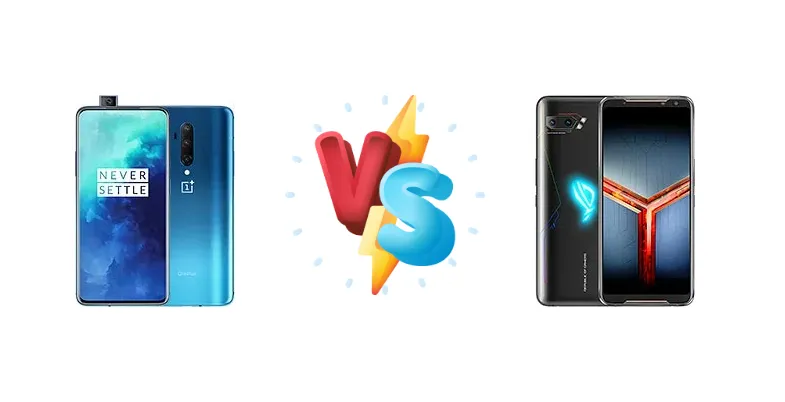
OnePlus 7T Pro vs. Asus ROG Phone II: Which Flagship Reigns Supreme?
| Phones Images | |||||
|---|---|---|---|---|---|
|
🏆 Quick Verdict
For the average user prioritizing a balanced experience, the Asus ROG Phone II emerges as the stronger choice. Its 114-hour endurance rating, coupled with 30W wired charging and the addition of 10W reverse wireless charging, provides a significant advantage over the OnePlus 7T Pro’s 100-hour rating. While both share the same Snapdragon 855+ chipset, the ROG Phone II’s gaming-focused features and superior battery life make it the better pick.
| PHONES | ||
|---|---|---|
| Phone Names | OnePlus 7T Pro | Asus ROG Phone II ZS660KL |
| Network | ||
|---|---|---|
| 2G bands | GSM 850 / 900 / 1800 / 1900 | GSM 850 / 900 / 1800 / 1900 |
| 3G bands | HSDPA 800 / 850 / 900 / 1700(AWS) / 1800 / 1900 / 2100 | HSDPA 850 / 900 / 1900 / 2100 |
| 4G bands | 1, 2, 3, 4, 5, 7, 8, 12, 13, 17, 18, 19, 20, 25, 26, 28, 29, 32, 34, 38, 39, 40, 41, 66 | 1, 2, 3, 4, 5, 7, 8, 12, 13, 17, 18, 19, 20, 28, 29, 32, 34, 38, 39, 40, 41, 46 |
| Speed | HSPA 42.2/5.76 Mbps, LTE (5CA) Cat18 1200/150 Mbps | HSPA 42.2/5.76 Mbps, LTE (5CA) Cat18 (Cat20 Ultimate edition) 1200/150 Mbps |
| Technology | GSM / CDMA / HSPA / LTE | GSM / HSPA / LTE |
| CDMA 800 / 1900 & TD-SCDMA | - | |
| Launch | ||
|---|---|---|
| Announced | 2019, October 10 | 2019, July 22. Released 2019, September |
| Status | Available. Released 2019, October 12 | Discontinued |
| Body | ||
|---|---|---|
| Build | Glass front (Gorilla Glass 5), glass back (Gorilla Glass 5), aluminum frame | Glass front (Gorilla Glass 6), glass back (Gorilla Glass 3), aluminum frame |
| Dimensions | 162.6 x 75.9 x 8.8 mm (6.40 x 2.99 x 0.35 in) | 171 x 77.6 x 9.5 mm (6.73 x 3.06 x 0.37 in) |
| SIM | Nano-SIM + Nano-SIM | Nano-SIM + Nano-SIM |
| Weight | 206 g (7.27 oz) | 240 g (8.47 oz) |
| - | RGB light panel (on the back) | |
| Display | ||
|---|---|---|
| Protection | Corning Gorilla Glass 5 | Corning Gorilla Glass 6 |
| Resolution | 1440 x 3120 pixels, 19.5:9 ratio (~516 ppi density) | 1080 x 2340 pixels, 19.5:9 ratio (~391 ppi density) |
| Size | 6.67 inches, 108.8 cm2 (~88.1% screen-to-body ratio) | 6.59 inches, 106.6 cm2 (~80.3% screen-to-body ratio) |
| Type | Fluid AMOLED, 90Hz, HDR10+ | AMOLED, 1B colors, 120Hz, HDR10 |
| Platform | ||
|---|---|---|
| CPU | Octa-core (1x2.96 GHz Kryo 485 & 3x2.42 GHz Kryo 485 & 4x1.78 GHz Kryo 485) | Octa-core (1x2.96 GHz Kryo 485 & 3x2.42 GHz Kryo 485 & 4x1.78 GHz Kryo 485) |
| Chipset | Qualcomm SM8150 Snapdragon 855+ (7 nm) | Qualcomm SM8150 Snapdragon 855+ (7 nm) |
| GPU | Adreno 640 (700 MHz) | Adreno 640 (700 MHz) |
| OS | Android 10, upgradable to Android 12, OxygenOS 12.1 | Android 9.0 (Pie), ROG UI |
| Memory | ||
|---|---|---|
| Card slot | No | No |
| Internal | 256GB 8GB RAM, 256GB 12GB RAM | 128GB 8GB RAM, 256GB 12GB RAM, 512GB 12GB RAM, 1TB 12GB RAM |
| 12GB RAM - McLaren Edition only UFS 3.0 | UFS 3.0 | |
| Main Camera | ||
|---|---|---|
| Dual | - | 48 MP, f/1.8, 26mm (wide), 1/2.0", 0.8µm, PDAF 13 MP, f/2.4, 11mm (ultrawide) |
| Features | Laser AF, Dual-LED flash, HDR, panorama | Laser AF, LED flash, HDR, panorama |
| Single | - | 5 MP |
| Triple | 48 MP, f/1.6, (wide), 1/2.0", 0.8µm, PDAF, OIS 8 MP, f/2.4, 78mm (telephoto), 3x optical zoom, PDAF, OIS 16 MP, f/2.2, 17mm (ultrawide), AF | - |
| Video | 4K@30/60fps, 1080p@30/60/240fps, 720p@960fps, Auto HDR, gyro-EIS | 4K@30/60fps, 1080p@30/60/240fps, 720p@480fps; gyro-EIS (except @240/480fps) |
| Selfie camera | ||
|---|---|---|
| Features | HDR | Panorama, HDR |
| Single | Motorized pop-up 16 MP, f/2.0, 25mm (wide), 1/3.06", 1.0µm | 24MP, f/2.2, 0.9µm |
| Video | 1080p@30fps, gyro-EIS | 1080p@30fps |
| Sound | ||
|---|---|---|
| 3.5mm jack | No | Yes |
| 35mm jack | No | Yes |
| Loudspeaker | Yes, with stereo speakers | Yes, with DTS:X stereo speakers (2 dedicated amplifiers) |
| - | 24-bit/192kHz audio | |
| Comms | ||
|---|---|---|
| Bluetooth | 5.0, A2DP, LE, aptX HD | 5.0, A2DP, LE, aptX HD |
| NFC | Yes | Yes |
| Positioning | GPS (L1+L5), GLONASS (G1), BDS (B1), GALILEO (E1+E5a) | GPS (L1+L5), GLONASS, BDS, GALILEO, QZSS |
| Radio | No | FM radio |
| USB | USB Type-C 3.1, OTG | USB Type-C 3.1, accessory connector, OTG |
| WLAN | Wi-Fi 802.11 a/b/g/n/ac, dual-band, Wi-Fi Direct, DLNA | Wi-Fi 802.11 a/b/g/n/ac/ad, dual-band, Wi-Fi Direct |
| Features | ||
|---|---|---|
| Sensors | Fingerprint (under display, optical), accelerometer, gyro, compass | Fingerprint (under display, optical), accelerometer, gyro, proximity, compass |
| Virtual proximity sensing | - | |
| Battery | ||
|---|---|---|
| Charging | 30W wired | 30W wired 10W reverse wired, QC4 |
| Stand-by | - | Up to 150 h (3G) |
| Talk time | - | Up to 5 h (3G) |
| Type | Li-Po 4085 mAh, non-removable | Li-Po 6000 mAh, non-removable |
| Misc | ||
|---|---|---|
| Colors | Haze Blue, McLaren Edition | Matte Black, Glossy Black |
| Models | HD1911, HD1913, HD1910 | ASUS_I001D, I001DA, I001DE, I001DC, I001DB, I001D, I001DD |
| Price | About 1030 EUR | About 1070 EUR |
| Tests | ||
|---|---|---|
| Audio quality | Noise -93.7dB / Crosstalk -91.0dB | - |
| Battery life | Endurance rating 100h | Endurance rating 114h |
| Camera | Photo / Video | Photo / Video |
| Display | Contrast ratio: Infinite (nominal) | Contrast ratio: Infinite (nominal) |
| Loudspeaker | Voice 90dB / Noise 75dB / Ring 82dB | -19.5 LUFS (Excellent) |
| Performance | AnTuTu: 395868 (v7), 493901 (v8) GeekBench: 11246 (v4.4), 2803 (v5.1) GFXBench: 24fps (ES 3.1 onscreen) | AnTuTu: 398935 (v7), 483239 (v8) GeekBench: 10923 (v4.4) GFXBench: 40fps (ES 3.1 onscreen) |
OnePlus 7T Pro
- Sleek and refined design
- Smooth user experience (OxygenOS)
- Potentially better camera image processing
- Lower battery endurance (100h)
- No reverse wireless charging
- Lower display brightness
Asus ROG Phone II ZS660KL
- Superior battery life (114h)
- Brighter display (626 nits)
- Reverse wireless charging and QC4 support
- Larger and bulkier design
- Gaming-focused aesthetics may not appeal to everyone
- Potentially less refined camera experience
Display Comparison
Both devices feature displays with an 'Infinite' (nominal) contrast ratio, suggesting excellent black levels. However, the Asus ROG Phone II distinguishes itself with a measured peak brightness of 626 nits, significantly exceeding what’s available on the OnePlus 7T Pro. This brighter display translates to better visibility in direct sunlight, a crucial benefit for outdoor gaming. While both likely utilize AMOLED technology, the ROG Phone II’s higher brightness provides a more vibrant and usable experience in various lighting conditions. The lack of refresh rate data for both phones means we can't compare smoothness, but both were considered high-end for their time.
Camera Comparison
Both phones offer 'Photo / Video' capabilities, but detailed camera specifications are absent. Given the ROG Phone II’s gaming focus, it’s reasonable to assume the OnePlus 7T Pro may have prioritized camera quality slightly more. However, without sensor size, aperture, or image processing details, a definitive comparison is impossible. The absence of information suggests neither phone was a standout in the camera department compared to other flagships of the era.
Performance
Both the OnePlus 7T Pro and Asus ROG Phone II are powered by the Qualcomm SM8150 Snapdragon 855+ (7 nm) chipset, featuring an identical octa-core CPU configuration. This means raw processing power will be nearly indistinguishable between the two. However, the ROG Phone II’s larger chassis and more robust cooling system likely allow it to sustain peak performance for longer periods, mitigating potential thermal throttling during extended gaming sessions. While both utilize the same chipset, the ROG Phone II’s thermal design gives it an edge in sustained performance.
Battery Life
The Asus ROG Phone II boasts a clear advantage in battery endurance, achieving a rating of 114 hours compared to the OnePlus 7T Pro’s 100 hours. This 14-hour difference translates to a noticeable improvement in real-world usage, particularly for power users and gamers. Both support 30W wired charging, but the ROG Phone II adds the convenience of 10W reverse wired charging and Quick Charge 4 (QC4) compatibility, allowing it to charge other devices. This versatility is a significant benefit for users who frequently travel or rely on multiple devices.
Buying Guide
Buy the OnePlus 7T Pro if you need a sleek, refined flagship with a smooth user experience and prioritize a more understated design. It’s ideal for users who value a balance of features and don’t require the specialized gaming extras. Buy the Asus ROG Phone II ZS660KL if you prioritize extended gaming sessions, demand maximum battery life, and appreciate features like reverse wireless charging and a brighter display. This phone is built for power users and mobile gaming enthusiasts.