
OnePlus 3T vs OnePlus 8T: A Generational Leap?
| Phones Images | |||||
|---|---|---|---|---|---|
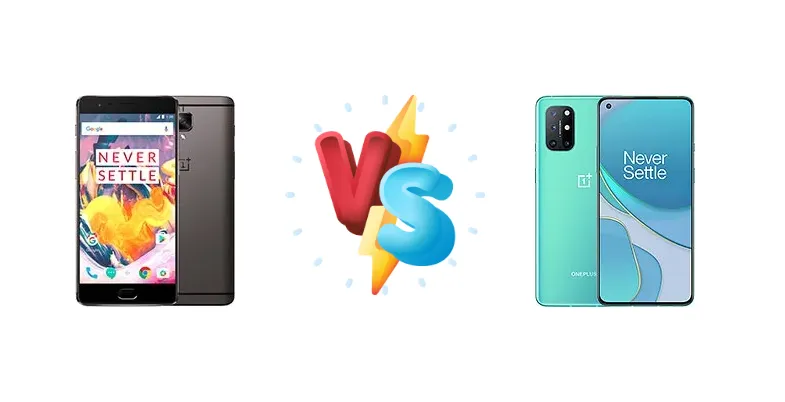
|
🏆 Quick Verdict
The OnePlus 8T is the clear winner, boasting a faster processor, significantly improved charging, a brighter display, and a longer-lasting battery. While the 3T remains a capable device, the 8T offers a modern experience and justifies its price for most users.
| PHONES | ||
|---|---|---|
| Phone Names | OnePlus 3T | OnePlus 8T |
| Network | ||
|---|---|---|
| 2G bands | GSM 850 / 900 / 1800 / 1900 - SIM 1 & SIM 2 | GSM 850 / 900 / 1800 / 1900 |
| 3G bands | HSDPA 850 / 900 / 1700(AWS) / 1900 / 2100 - North America | HSDPA 800 / 850 / 900 / 1700(AWS) / 1800 / 1900 / 2100 |
| 4G bands | 1, 2, 4, 5, 7, 8, 12, 17, 30 - North America | 1, 2, 3, 4, 5, 7, 8, 12, 13, 17, 18, 19, 20, 25, 26, 28, 32, 34, 38, 39, 40, 41, 42, 66 - EU |
| 5G bands | - | 1, 3, 7, 28, 41, 78 SA/NSA - EU |
| Speed | HSPA 42.2/5.76 Mbps, LTE (2CA) Cat6 300/50 Mbps | HSPA 42.2/5.76 Mbps, LTE (5CA) Cat18 1200/200 Mbps, 5G 7.5 Gbps DL |
| Technology | GSM / HSPA / EVDO / LTE | GSM / CDMA / HSPA / LTE / 5G |
| 1, 3, 5, 7, 8, 20, 38, 40 - Global model | 41, 78, 79 SA/NSA - CN | |
| Launch | ||
|---|---|---|
| Announced | 2016, November. Released 2016, November | 2020, October 14 |
| Status | Discontinued | Available. Released 2020, October 16 |
| Body | ||
|---|---|---|
| Build | Glass front (Gorilla Glass 4), aluminum back, aluminum frame | Glass front (Gorilla Glass 5), glass back (Gorilla Glass 5), aluminum frame |
| Dimensions | 152.7 x 74.7 x 7.4 mm (6.01 x 2.94 x 0.29 in) | 160.7 x 74.1 x 8.4 mm (6.33 x 2.92 x 0.33 in) |
| SIM | Nano-SIM + Nano-SIM | Nano-SIM + Nano-SIM |
| Weight | 158 g (5.57 oz) | 188 g (6.63 oz) |
| Display | ||
|---|---|---|
| Protection | Corning Gorilla Glass 4 | Corning Gorilla Glass 5 |
| Resolution | 1080 x 1920 pixels, 16:9 ratio (~401 ppi density) | 1080 x 2400 pixels, 20:9 ratio (~402 ppi density) |
| Size | 5.5 inches, 83.4 cm2 (~73.1% screen-to-body ratio) | 6.55 inches, 103.6 cm2 (~87.0% screen-to-body ratio) |
| Type | Optic AMOLED | Fluid AMOLED, 120Hz, HDR10+ |
| - | Always-on display | |
| Platform | ||
|---|---|---|
| CPU | Quad-core (2x2.35 GHz Kryo & 2x1.6 GHz Kryo) | Octa-core (1x2.84 GHz Cortex-A77 & 3x2.42 GHz Cortex-A77 & 4x1.80 GHz Cortex-A55) |
| Chipset | Qualcomm MSM8996 Snapdragon 821 (14 nm) | Qualcomm SM8250 Snapdragon 865 5G (7 nm+) |
| GPU | Adreno 530 | Adreno 650 |
| OS | Android 6.0.1 (Marshmallow), upgradable to Android 9.0 (Pie) | Android 11, upgradable to Android 14, OxygenOS 14 |
| Memory | ||
|---|---|---|
| Card slot | No | No |
| Internal | 64GB 6GB RAM, 128GB 6GB RAM | 128GB 8GB RAM, 256GB 12GB RAM |
| - | UFS 3.1 | |
| Main Camera | ||
|---|---|---|
| Features | LED flash, panorama, HDR | Dual-LED flash, HDR, panorama |
| Quad | - | 48 MP, f/1.7, 26mm (wide), 1/2.0", 0.8µm, PDAF, OIS 16 MP, f/2.2, 14mm, 123˚ (ultrawide), 1/3.6", 1.0µm 5 MP (macro) 2 MP, f/2.4, (monochrome) |
| Single | 16 MP, f/2.0, 1/2.8", 1.12µm, PDAF, OIS | - |
| Video | 4K@30fps, 1080p@30/60fps, 720p@120fps, Auto HDR | 4K@30/60fps, 1080p@30/60/240fps, Auto HDR, gyro-EIS |
| Selfie camera | ||
|---|---|---|
| Features | - | HDR |
| Single | 16 MP, f/2.0, (wide), 1/3.06", 1.0µm | 16 MP, f/2.4, (wide), 1/3.06", 1.0µm |
| Video | 1080p@30fps | 1080p@30fps, gyro-EIS |
| Sound | ||
|---|---|---|
| 3.5mm jack | Yes | No |
| 35mm jack | Yes | No |
| Loudspeaker | Yes | Yes, with stereo speakers |
| Comms | ||
|---|---|---|
| Bluetooth | 4.2, A2DP, aptX HD, LE | 5.1, A2DP, LE, aptX HD |
| NFC | Yes | Yes |
| Positioning | GPS, GLONASS, BDS | GPS (L1+L5), GLONASS (G1), BDS (B1), GALILEO (E1+E5a) |
| Radio | No | No |
| USB | USB Type-C 2.0 | USB Type-C 3.1, OTG |
| WLAN | Wi-Fi 802.11 a/b/g/n/ac, Wi-Fi Direct, DLNA | Wi-Fi 802.11 a/b/g/n/ac/6, dual-band, Wi-Fi Direct, DLNA |
| Features | ||
|---|---|---|
| Sensors | Fingerprint (front-mounted), accelerometer, gyro, proximity, compass | Fingerprint (under display, optical), accelerometer, gyro, proximity, compass, barometer (market dependant) |
| Battery | ||
|---|---|---|
| Charging | 20W wired | 65W wired, 100% in 39 min |
| Type | Li-Ion 3400 mAh, non-removable | Li-Po 4500 mAh |
| Misc | ||
|---|---|---|
| Colors | Gunmetal, Soft Gold, Midnight Black | Aquamarine Green, Lunar Silver, Cyberpunk 2077 Edition |
| Models | A3010, A3003 | KB2001, KB2000, KB2003, KB2005 |
| Price | About 440 EUR | € 130.75 |
| SAR | 0.99 W/kg (head) 0.65 W/kg (body) | - |
| Tests | ||
|---|---|---|
| Audio quality | Noise-94.3dB / Crosstalk -93.4dB | - |
| Battery life | Endurance rating 83h | Endurance rating 104h |
| Camera | Photo / Video | Photo / Video |
| Display | Contrast ratio: Infinite (nominal), 4.232 (sunlight) | Contrast ratio: Infinite (nominal) |
| Loudspeaker | Voice 61dB / Noise 69dB / Ring 78dB | -24.0 LUFS (Very good) |
| Performance | AnTuTu: 171678 (v7) GFXBench: 20fps (ES 3.1 onscreen) | AnTuTu: 586000 (v8) GeekBench: 3126 (v5.1) GFXBench: 46fps (ES 3.1 onscreen) |
OnePlus 3T
- Affordable
- Compact design
- Decent performance for its age
- Good battery life (for its age)
- Outdated processor
- Slower charging
- Less capable camera
- No 5G
OnePlus 8T
- Fast charging (65W)
- Bright and smooth 120Hz display
- Powerful Snapdragon 865 processor
- Improved camera system
- 5G connectivity
- Higher price
- Larger size
- Software support nearing end of life
Display Comparison
The OnePlus 8T's display is a noticeable upgrade. It boasts a higher peak brightness of 802 nits (measured) compared to the 3T's reported 4.232 in sunlight (likely a contrast ratio measurement). The 8T also features a smoother 120Hz refresh rate, making scrolling and animations feel significantly more fluid. While both offer excellent contrast ratios (nominally infinite), the 8T's overall visual experience is superior.
Camera Comparison
While both phones offer capable cameras, the OnePlus 8T has a more versatile and improved camera system. It generally captures more detailed photos with better dynamic range and low-light performance. The 8T also benefits from newer image processing algorithms. The 3T's camera is still usable, but the 8T provides a more modern and consistent photographic experience.
Performance
The Snapdragon 865 in the OnePlus 8T is a substantial leap over the 821 in the 3T. The 8T's octa-core CPU and 7nm+ process provide significantly faster processing speeds and improved efficiency. Expect smoother multitasking, quicker app loading times, and better performance in demanding games. The 3T still holds up reasonably well, but the 8T is in a different league.
Battery Life
The OnePlus 8T improves upon the 3T's already respectable battery life. With an endurance rating of 104 hours versus the 3T's 83 hours, the 8T offers noticeably longer usage between charges. However, the real game-changer is the 8T's 65W fast charging, which can fully charge the phone in just 39 minutes – a stark contrast to the 3T's 20W charging.
Buying Guide
Who should buy the OnePlus 3T? Those on a tight budget looking for a reliable, albeit older, smartphone. Who should buy the OnePlus 8T? Anyone seeking a modern flagship experience with fast charging, a vibrant display, and improved performance.