
OnePlus 15 vs vivo X200 Pro mini: A Compact Flagship Showdown
| Phones Images | |||||
|---|---|---|---|---|---|
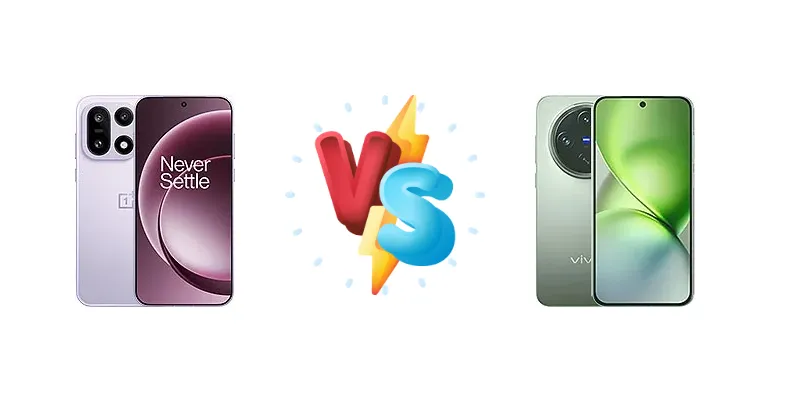
|
🏆 Quick Verdict
For the average user prioritizing sustained performance and all-day battery life, the OnePlus 15 emerges as the winner. Its Snapdragon 8 Elite Gen 5, coupled with a larger battery and faster charging speeds, provides a more robust and reliable experience, despite the vivo's impressive Dimensity 9400.
| PHONES | ||
|---|---|---|
| Phone Names | OnePlus 15 | vivo X200 Pro mini |
| Network | ||
|---|---|---|
| 2G bands | GSM 850 / 900 / 1800 / 1900 | GSM 850 / 900 / 1800 / 1900 |
| 3G bands | HSDPA 800 / 850 / 900 / 1700(AWS) / 1900 / 2100 - International | HSDPA 800 / 850 / 900 / 1700(AWS) / 1900 / 2100 |
| 4G bands | 1, 2, 3, 4, 5, 7, 8, 12, 13, 17, 18, 19, 20, 25, 26, 28, 30, 32, 34, 38, 39, 40, 41, 42, 48, 66, 71 - International | 1, 2, 3, 4, 5, 7, 8, 18, 19, 26, 28, 34, 38, 39, 40, 41, 66 |
| 5G bands | 1, 2, 3, 5, 7, 8, 12, 13, 20, 25, 26, 28, 30, 38, 40, 41, 48, 66, 71, 75, 77, 78 SA/NSA/Sub6 - International | 1, 3, 5, 8, 28, 38, 40, 41, 77, 78 SA/NSA |
| Speed | HSPA, LTE, 5G | HSPA, LTE, 5G |
| Technology | GSM / HSPA / LTE / 5G | GSM / HSPA / LTE / 5G |
| Launch | ||
|---|---|---|
| Announced | 2025, October 27 | 2024, October 14 |
| Status | Available. Released 2025, October 28 | Available. Released 2024, October 25 |
| Body | ||
|---|---|---|
| Build | Glass front (Gorilla Glass Victus 2), aluminum alloy frame, glass back (Gorilla Glass 7i or Crystal Shield Glass) or fiber-reinforced plastic back | Glass front, aluminum alloy frame |
| Dimensions | 161.4 x 76.7 x 8.1 mm (6.35 x 3.02 x 0.32 in) | 150.8 x 71.8 x 8.2 mm (5.94 x 2.83 x 0.32 in) |
| SIM | · Nano-SIM + Nano-SIM + eSIM (max 2 at a time)· Nano-SIM + Nano-SIM | Nano-SIM + Nano-SIM |
| Weight | 211 g or 215 g (7.44 oz) | 187 g (6.60 oz) |
| Display | ||
|---|---|---|
| Protection | Corning Gorilla Glass Victus 2, Mohs level 5 | - |
| Resolution | 1272 x 2772 pixels, 19.5:9 ratio (~450 ppi density) | 1216 x 2640 pixels, 19.5:9 ratio (~460 ppi density) |
| Size | 6.78 inches, 112.4 cm2 (~90.8% screen-to-body ratio) | 6.31 inches, 98.0 cm2 (~90.5% screen-to-body ratio) |
| Type | LTPO AMOLED, 1B colors, 165Hz, PWM, Dolby Vision, HDR10+, HDR Vivid, 800 nits (typ), 1800 nits (HBM) | LTPO AMOLED, 1B colors, 120Hz, 2160Hz PWM, HDR10+, 4500 nits (peak) |
| Platform | ||
|---|---|---|
| CPU | Octa-core (2x4.6 GHz Oryon V3 Phoenix L + 6x3.62 GHz Oryon V3 Phoenix M) | Octa-core (1x3.63 GHz Cortex-X925 & 3x3.3 GHz Cortex-X4 & 4x2.4 GHz Cortex-A720) |
| Chipset | Qualcomm SM8850-AC Snapdragon 8 Elite Gen 5 (3 nm) | Mediatek Dimensity 9400 (3 nm) |
| GPU | Adreno 840 | Immortalis-G925 |
| OS | Android 16, OxygenOS 16 (Global), ColorOS 16 (China) | Android 15, OriginOS 5 (China) |
| Memory | ||
|---|---|---|
| Card slot | No | No |
| Internal | 256GB 12GB RAM, 256GB 16GB RAM, 512GB 12GB RAM, 512GB 16GB RAM, 1TB 16GB RAM | 256GB 12GB RAM, 512GB 12GB RAM, 512GB 16GB RAM, 1TB 16GB RAM |
| Main Camera | ||
|---|---|---|
| Features | Laser focus, color spectrum sensor, LED flash, HDR, panorama, LUT preview | Laser AF, Zeiss optics, Zeiss T* lens coating, LED flash, panorama, HDR |
| Triple | 50 MP, f/1.8, 24mm (wide), 1/1.56", 1.0µm, multi-directional PDAF, OIS 50 MP, f/2.8, 80mm (periscope telephoto), 1/2.76", 0.64µm, 3.5x optical zoom, PDAF, OIS 50 MP, f/2.0, 16mm, 116˚ (ultrawide), 1/2.88", 0.61µm, PDAF | 50 MP, f/1.6, 23mm (wide), 1/1.28", 1.22µm, PDAF, OIS 50 MP, f/2.6, 70mm (periscope telephoto), 1/1.95", PDAF, OIS, 3x optical zoom 50 MP, f/2.0, 15mm, 119˚ (ultrawide), 1/2.76", 0.64µm, AF |
| Video | 8K@30fps, 4K@30/60/120fps, 1080p@30/60/240fps, Auto HDR, gyro-EIS, Dolby Vision, LUT | 4K@30/60fps, 1080p@30/60/120fps, gyro-EIS, HDR |
| Selfie camera | ||
|---|---|---|
| Features | HDR, panorama | HDR |
| Single | 32 MP, f/2.4, 21mm (wide), 1/2.74", 0.8µm, AF | 32 MP, f/2.0, 20mm (ultrawide) |
| Video | 4K@30/60fps, 1080p@30/60fps, gyro-EIS, HDR | 4K, 1080p |
| Sound | ||
|---|---|---|
| 35mm jack | No | No |
| Loudspeaker | Yes, with stereo speakers | Yes, with stereo speakers |
| Comms | ||
|---|---|---|
| Bluetooth | 6.0, A2DP, LE, aptX HD, aptX Adaptive, LHDC 5 | 5.4, A2DP, LE, aptX HD, LHDC 5 |
| Infrared port | Yes | Yes |
| NFC | Yes | Yes |
| Positioning | GPS (L1+L5), GLONASS (G1), BDS (B1I+B1c+B2a), GALILEO (E1+E5a), QZSS (L1+L5), NavIC (L5) | GPS (L1+L5), GLONASS (L1), BDS (B1I+B1c+B2a+B2b), GALILEO (E1+E5a+E5b), QZSS (L1+L5), NavIC (L5) |
| Radio | No | No |
| USB | USB Type-C 3.2, OTG | USB Type-C 2.0, OTG |
| WLAN | Wi-Fi 802.11 a/b/g/n/ac/6/7, dual or tri-band, Wi-Fi Direct | Wi-Fi 802.11 a/b/g/n/ac/6/7, dual-band |
| Features | ||
|---|---|---|
| Sensors | Fingerprint (under display, ultrasonic), accelerometer, proximity, gyro (UAV-grade), compass, barometer (exc. China) | Fingerprint (under display, optical), accelerometer, gyro, proximity, compass |
| Battery | ||
|---|---|---|
| Charging | 120W wired, 120W UFCS, 55W PPS, 36W PD, 36W QC, 50% in 15 min, 100% in 40 min 50W wireless 10W reverse wireless 5W reverse wired Bypass charging | 90W wired 30W wireless Reverse wired |
| Type | Si/C Li-Ion 7300 mAh | Si/C Li-Ion 5700 mAh |
| Misc | ||
|---|---|---|
| Colors | Infinite Black, Ultra Violet, Sand Storm | Black, White, Green, Pink |
| Models | CPH2747, CPH2745, PLK110 | V2419A |
| Price | £ 849.00 / € 949.00 / ₹ 72,999 | About 610 EUR |
| SAR | 1.17 W/kg (head) 1.00 W/kg (body) | - |
| EU LABEL | ||
|---|---|---|
| Battery | 74:25h endurance, 1100 cycles | - |
| Energy | Class A | - |
| Free fall | Class C (90 falls) | - |
| Repairability | Class B | - |
OnePlus 15
- Superior Battery Life (74:25h endurance)
- Faster Charging Speeds (120W wired, 50W wireless)
- Potentially Higher Sustained Performance (Snapdragon 8 Elite Gen 5)
- Potentially Larger Footprint (due to larger battery)
- Price may be higher
vivo X200 Pro mini
- Compact Form Factor
- Efficient Dimensity 9400 CPU Architecture
- Potentially Lower Price
- Slower Charging (90W wired)
- Lower Battery Endurance (estimated)
- Less Powerful GPU (compared to Snapdragon)
Display Comparison
The OnePlus 15 boasts a significantly brighter display, reaching a measured peak of 2187 nits, ensuring excellent visibility even in direct sunlight. While the vivo X200 Pro mini’s display specs are not provided, OnePlus’s high peak brightness is a clear advantage for outdoor use. Both devices utilize a 3nm chipset, suggesting a focus on efficiency, which could translate to optimized display power consumption. However, without knowing the panel technology (LTPO or not) or refresh rate of the vivo, it’s difficult to assess its overall display quality beyond brightness.
Camera Comparison
Unfortunately, detailed camera specifications for both devices are absent. However, given the flagship positioning, both are expected to feature advanced camera systems. The absence of information regarding sensor sizes, OIS, and lens apertures makes a direct comparison impossible. We can assume both will offer high-resolution main sensors and sophisticated image processing algorithms, but the OnePlus’s brand history suggests a focus on natural color reproduction, while vivo often leans towards more vibrant, saturated images. Without further data, this remains speculative.
Performance
The core of the battle lies in the chipsets. The OnePlus 15’s Snapdragon 8 Elite Gen 5, built on a 3nm process, features a unique octa-core configuration with Oryon V3 Phoenix cores – two high-performance 'L' cores clocked at 4.6 GHz and six efficiency 'M' cores at 3.62 GHz. This architecture is designed for both peak performance and sustained efficiency. The vivo X200 Pro mini counters with the MediaTek Dimensity 9400, also on 3nm, employing a more traditional core arrangement: one Cortex-X925, three Cortex-X4, and four Cortex-A720. While the X925 offers strong single-core performance, the Snapdragon’s Oryon cores are expected to deliver superior multi-core and sustained performance, particularly in graphically intensive tasks. The Snapdragon’s architecture is geared towards a more consistent high-performance level.
Battery Life
The OnePlus 15 demonstrates a clear advantage in battery endurance with a measured 74:25h rating and 1100 charge cycles, alongside an active use score of 23:07h. This suggests a larger battery capacity and optimized power management. The vivo X200 Pro mini’s battery capacity is unknown, but its 90W wired charging is slower than the OnePlus 15’s 120W wired, 120W UFCS, 55W PPS, 36W PD, and 36W QC options. The OnePlus 15 also offers 50W wireless and 10W reverse wireless charging, alongside a convenient bypass charging feature, providing greater versatility. The OnePlus 15 can reach 50% charge in 15 minutes and 100% in 40 minutes, significantly faster than the vivo’s charging speed.
Buying Guide
Buy the OnePlus 15 if you need a phone that can handle demanding tasks like gaming and video editing for extended periods, and if you value the convenience of extremely fast wired and wireless charging. Buy the vivo X200 Pro mini if you prioritize a slightly more compact design and are willing to trade some battery endurance and charging speed for a potentially more efficient CPU architecture in specific workloads.