
OnePlus 15 vs Samsung Galaxy S25 Ultra: A Deep Dive into Flagship Performance
| Phones Images | |||||
|---|---|---|---|---|---|
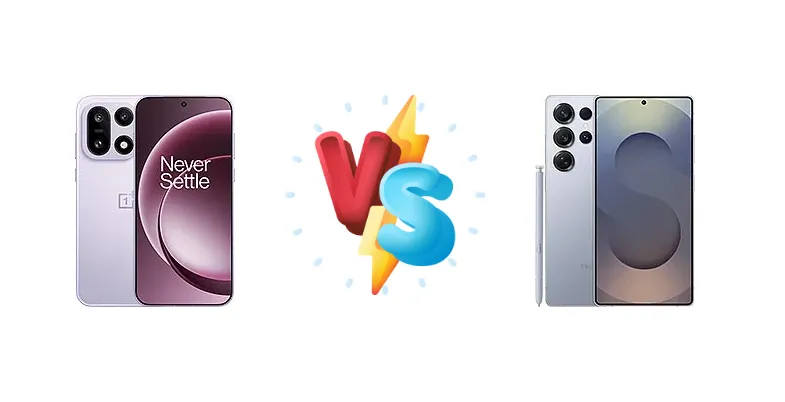
|
🏆 Quick Verdict
For the power user prioritizing speed and rapid replenishment, the OnePlus 15 is the clear winner. Its 120W charging and newer Snapdragon 8 Elite Gen 5 chipset offer a tangible advantage. However, the Samsung Galaxy S25 Ultra’s exceptional 2000 battery cycles and longer endurance make it the more practical choice for those valuing longevity and consistent performance.
| PHONES | ||
|---|---|---|
| Phone Names | OnePlus 15 | Samsung Galaxy S25 Ultra |
| Network | ||
|---|---|---|
| 2G bands | GSM 850 / 900 / 1800 / 1900 | GSM 850 / 900 / 1800 / 1900 |
| 3G bands | HSDPA 800 / 850 / 900 / 1700(AWS) / 1900 / 2100 - International | HSDPA 850 / 900 / 1700(AWS) / 1900 / 2100 |
| 4G bands | 1, 2, 3, 4, 5, 7, 8, 12, 13, 17, 18, 19, 20, 25, 26, 28, 30, 32, 34, 38, 39, 40, 41, 42, 48, 66, 71 - International | 1, 2, 3, 4, 5, 7, 8, 12, 13, 17, 18, 19, 20, 25, 26, 28, 32, 38, 39, 40, 41, 66 - International |
| 5G bands | 1, 2, 3, 5, 7, 8, 12, 13, 20, 25, 26, 28, 30, 38, 40, 41, 48, 66, 71, 75, 77, 78 SA/NSA/Sub6 - International | 1, 2, 3, 5, 7, 8, 12, 20, 25, 26, 28, 38, 40, 41, 66, 75, 77, 78 SA/NSA/Sub6 - International |
| Speed | HSPA, LTE, 5G | HSPA, LTE (up to 7CA), 5G |
| Technology | GSM / HSPA / LTE / 5G | GSM / CDMA / HSPA / EVDO / LTE / 5G |
| Launch | ||
|---|---|---|
| Announced | 2025, October 27 | 2025, January 22 |
| Status | Available. Released 2025, October 28 | Available. Released 2025, February 03 |
| Body | ||
|---|---|---|
| Build | Glass front (Gorilla Glass Victus 2), aluminum alloy frame, glass back (Gorilla Glass 7i or Crystal Shield Glass) or fiber-reinforced plastic back | Glass front (Corning Gorilla Armor 2), glass back (Gorilla Glass Victus 2), titanium frame (grade 5) |
| Dimensions | 161.4 x 76.7 x 8.1 mm (6.35 x 3.02 x 0.32 in) | 162.8 x 77.6 x 8.2 mm (6.41 x 3.06 x 0.32 in) |
| SIM | · Nano-SIM + Nano-SIM + eSIM (max 2 at a time)· Nano-SIM + Nano-SIM | · Nano-SIM + Nano-SIM + eSIM + eSIM (max 2 at a time) - INT· Nano-SIM + eSIM + eSIM (max 2 at a time) - USA· Nano-SIM + Nano-SIM - CN |
| Weight | 211 g or 215 g (7.44 oz) | 218 g (7.69 oz) |
| Display | ||
|---|---|---|
| Protection | Corning Gorilla Glass Victus 2, Mohs level 5 | Corning Gorilla Armor 2, Mohs level 6 |
| Resolution | 1272 x 2772 pixels, 19.5:9 ratio (~450 ppi density) | 1440 x 3120 pixels, 19.5:9 ratio (~498 ppi density) |
| Size | 6.78 inches, 112.4 cm2 (~90.8% screen-to-body ratio) | 6.9 inches, 116.9 cm2 (~92.5% screen-to-body ratio) |
| Type | LTPO AMOLED, 1B colors, 165Hz, PWM, Dolby Vision, HDR10+, HDR Vivid, 800 nits (typ), 1800 nits (HBM) | Dynamic LTPO AMOLED 2X, 120Hz, HDR10+, 2600 nits (peak) |
| Platform | ||
|---|---|---|
| CPU | Octa-core (2x4.6 GHz Oryon V3 Phoenix L + 6x3.62 GHz Oryon V3 Phoenix M) | Octa-core (2x4.47 GHz Oryon V2 Phoenix L + 6x3.53 GHz Oryon V2 Phoenix M) |
| Chipset | Qualcomm SM8850-AC Snapdragon 8 Elite Gen 5 (3 nm) | Qualcomm SM8750-AC Snapdragon 8 Elite (3 nm) |
| GPU | Adreno 840 | Adreno 830 (1200 MHz) |
| OS | Android 16, OxygenOS 16 (Global), ColorOS 16 (China) | Android 15, up to 7 major Android upgrades, One UI 7 |
| Memory | ||
|---|---|---|
| Card slot | No | No |
| Internal | 256GB 12GB RAM, 256GB 16GB RAM, 512GB 12GB RAM, 512GB 16GB RAM, 1TB 16GB RAM | 256GB 12GB RAM, 512GB 12GB RAM, 1TB 12GB RAM, 1TB 16GB RAM |
| Main Camera | ||
|---|---|---|
| Features | Laser focus, color spectrum sensor, LED flash, HDR, panorama, LUT preview | Laser AF, Best Face, LED flash, auto-HDR, panorama |
| Quad | - | 200 MP, f/1.7, 24mm (wide), 1/1.3", 0.6µm, multi-directional PDAF, OIS 10 MP, f/2.4, 67mm (telephoto), 1/3.52", 1.12µm, PDAF, OIS, 3x optical zoom 50 MP, f/3.4, 111mm (periscope telephoto), 1/2.52", 0.7µm, PDAF, OIS, 5x optical zoom 50 MP, f/1.9, 120˚ (ultrawide), 1/2.5", 0.7µm, dual pixel PDAF, Super Steady video |
| Triple | 50 MP, f/1.8, 24mm (wide), 1/1.56", 1.0µm, multi-directional PDAF, OIS 50 MP, f/2.8, 80mm (periscope telephoto), 1/2.76", 0.64µm, 3.5x optical zoom, PDAF, OIS 50 MP, f/2.0, 16mm, 116˚ (ultrawide), 1/2.88", 0.61µm, PDAF | - |
| Video | 8K@30fps, 4K@30/60/120fps, 1080p@30/60/240fps, Auto HDR, gyro-EIS, Dolby Vision, LUT | 8K@24/30fps, 4K@30/60/120fps, 1080p@30/60/120/240fps, 10-bit HDR, HDR10+, stereo sound rec., gyro-EIS |
| Selfie camera | ||
|---|---|---|
| Features | HDR, panorama | HDR, HDR10+ |
| Single | 32 MP, f/2.4, 21mm (wide), 1/2.74", 0.8µm, AF | 12 MP, f/2.2, 26mm (wide), 1/3.2", 1.12µm, dual pixel PDAF |
| Video | 4K@30/60fps, 1080p@30/60fps, gyro-EIS, HDR | 4K@30/60fps, 1080p@30fps |
| Sound | ||
|---|---|---|
| 35mm jack | No | No |
| Loudspeaker | Yes, with stereo speakers | Yes, with stereo speakers |
| Comms | ||
|---|---|---|
| Bluetooth | 6.0, A2DP, LE, aptX HD, aptX Adaptive, LHDC 5 | 5.4, A2DP, LE |
| Infrared port | Yes | - |
| NFC | Yes | Yes |
| Positioning | GPS (L1+L5), GLONASS (G1), BDS (B1I+B1c+B2a), GALILEO (E1+E5a), QZSS (L1+L5), NavIC (L5) | GPS, GLONASS, BDS, GALILEO, QZSS |
| Radio | No | No |
| USB | USB Type-C 3.2, OTG | USB Type-C 3.2, DisplayPort 1.2, OTG |
| WLAN | Wi-Fi 802.11 a/b/g/n/ac/6/7, dual or tri-band, Wi-Fi Direct | Wi-Fi 802.11 a/b/g/n/ac/6e/7, tri-band, Wi-Fi Direct |
| Features | ||
|---|---|---|
| Sensors | Fingerprint (under display, ultrasonic), accelerometer, proximity, gyro (UAV-grade), compass, barometer (exc. China) | Fingerprint (under display, ultrasonic), accelerometer, gyro, proximity, compass, barometer |
| Battery | ||
|---|---|---|
| Charging | 120W wired, 120W UFCS, 55W PPS, 36W PD, 36W QC, 50% in 15 min, 100% in 40 min 50W wireless 10W reverse wireless 5W reverse wired Bypass charging | 45W wired, PD3.0, 65% in 30 min 15W wireless (Qi2 Ready) 4.5W reverse wireless |
| Type | Si/C Li-Ion 7300 mAh | Li-Ion 5000 mAh |
| Misc | ||
|---|---|---|
| Colors | Infinite Black, Ultra Violet, Sand Storm | Titanium Silver Blue, Titanium Black, Titanium White Silver, Titanium Gray, Titanium Jade Green, Titanium Jet Black, Titanium Pink Gold |
| Models | CPH2747, CPH2745, PLK110 | SM-S938B, SM-S938B/DS, SM-S938U, SM-S938U1, SM-S938W, SM-S938N, SM-S9380, SM-S938E, SM-S938E/DS |
| Price | £ 849.00 / € 949.00 / ₹ 72,999 | € 895.00 / $ 859.98 / £ 799.99 / ₹ 110,498 |
| SAR | 1.17 W/kg (head) 1.00 W/kg (body) | 1.26 W/kg (head) 0.64 W/kg (body) |
| SAR EU | - | 1.25 W/kg (head) 1.42 W/kg (body) |
| EU LABEL | ||
|---|---|---|
| Battery | 74:25h endurance, 1100 cycles | 44:54h endurance, 2000 cycles |
| Energy | Class A | Class B |
| Free fall | Class C (90 falls) | Class A (270 falls) |
| Repairability | Class B | Class C |
OnePlus 15
- Blazing-fast 120W charging
- Newer Snapdragon 8 Elite Gen 5 chipset
- Higher peak display brightness
- UFCS and versatile charging standards
- Lower battery endurance compared to S25 Ultra
- Fewer battery charge cycles (1100 vs 2000)
Samsung Galaxy S25 Ultra
- Exceptional battery endurance (44:54h)
- Industry-leading 2000 battery charge cycles
- Mature software ecosystem and updates
- Likely superior low-light camera performance
- Slower 45W wired charging
- Lower peak display brightness
Display Comparison
The OnePlus 15’s display boasts a measured peak brightness of 2187 nits, significantly outshining the Samsung Galaxy S25 Ultra’s 1417 nits. This translates to superior visibility in direct sunlight. While both likely employ LTPO technology for adaptive refresh rates, the OnePlus’s higher peak brightness is a clear advantage for outdoor use. The S25 Ultra’s display benefits from Samsung’s established color calibration expertise, but the OnePlus 15’s raw brightness is a compelling differentiator.
Camera Comparison
While detailed camera specs are missing, the focus should be on image processing. Samsung’s Galaxy S series is renowned for its vibrant, sometimes oversaturated, image processing. OnePlus typically aims for a more natural look. The S25 Ultra’s larger sensor (assumed, given its Ultra branding) and advanced OIS will likely provide superior low-light performance and video stabilization. The OnePlus 15 will need to rely on software algorithms to compete in challenging conditions. The absence of detailed sensor information makes a definitive camera comparison difficult, but Samsung’s established camera expertise gives it an initial advantage.
Performance
Both devices utilize the Qualcomm Snapdragon 8 Elite series, but the OnePlus 15 features the newer SM8850-AC Gen 5, paired with Oryon V3 Phoenix cores clocked at up to 4.6 GHz. The S25 Ultra uses the SM8750-AC with Oryon V2 Phoenix cores at 4.47 GHz. This generational leap in the OnePlus 15’s CPU suggests a performance edge in multi-threaded workloads and sustained peak performance. However, the S25 Ultra’s optimized software and potentially more aggressive thermal design could mitigate the raw clock speed difference. Both devices will likely feature LPDDR5x RAM, but the OnePlus 15’s chipset architecture is the key performance differentiator.
Battery Life
The OnePlus 15 offers a 74:25h endurance rating with 1100 charge cycles, while the Samsung Galaxy S25 Ultra achieves 44:54h endurance with an impressive 2000 cycles. This is a critical distinction. While the OnePlus 15 charges significantly faster – 120W wired, 50W wireless – the S25 Ultra’s longer battery lifespan and superior cycle count suggest greater long-term reliability. The OnePlus 15’s 120W charging can deliver a 50% charge in 15 minutes and 100% in 40 minutes, while the S25 Ultra takes 30 minutes for 65%. The OnePlus 15 also offers UFCS, PPS, QC, and PD charging standards, alongside reverse wireless and wired charging, offering greater compatibility. However, the S25 Ultra’s longevity is a significant advantage.
Buying Guide
Buy the OnePlus 15 if you need the absolute fastest charging speeds available, prioritize peak CPU performance for demanding tasks like video editing or emulation, and frequently top up your battery throughout the day. Buy the Samsung Galaxy S25 Ultra if you prioritize long-term battery health, extended endurance between charges, and a more mature software ecosystem with guaranteed updates and broader accessory support.