
OnePlus 15 vs. iPhone 17 Pro Max: A Deep Dive into Flagship Power
| Phones Images | |||||
|---|---|---|---|---|---|
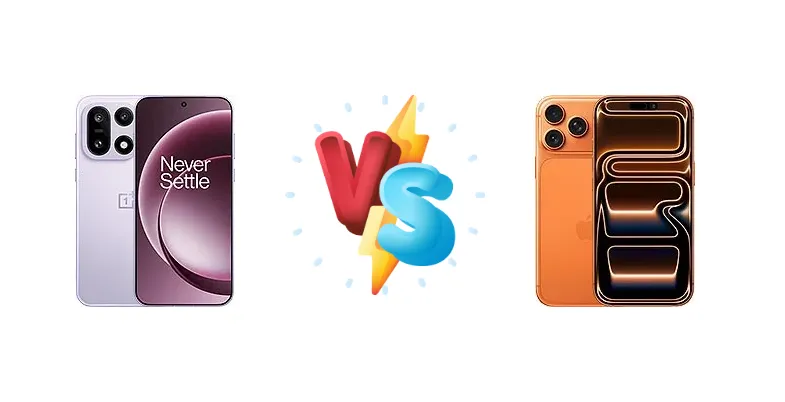
|
🏆 Quick Verdict
For the power user constantly on the move, the OnePlus 15 emerges as the winner. Its 74:25h battery endurance and blazing 120W charging significantly outperform the iPhone 17 Pro Max, making it ideal for those who demand all-day (and beyond) usage. However, Apple's ecosystem integration remains a strong draw for existing iOS users.
| PHONES | ||
|---|---|---|
| Phone Names | OnePlus 15 | Apple iPhone 17 Pro Max |
| Network | ||
|---|---|---|
| 2G bands | GSM 850 / 900 / 1800 / 1900 | GSM 850 / 900 / 1800 / 1900 |
| 3G bands | HSDPA 800 / 850 / 900 / 1700(AWS) / 1900 / 2100 - International | HSDPA 850 / 900 / 1700(AWS) / 1900 / 2100 |
| 4G bands | 1, 2, 3, 4, 5, 7, 8, 12, 13, 17, 18, 19, 20, 25, 26, 28, 30, 32, 34, 38, 39, 40, 41, 42, 48, 66, 71 - International | 1, 2, 3, 4, 5, 7, 8, 12, 13, 17, 18, 19, 20, 25, 26, 28, 30, 32, 34, 38, 39, 40, 41, 42, 48, 53, 66 - A3526 |
| 5G bands | 1, 2, 3, 5, 7, 8, 12, 13, 20, 25, 26, 28, 30, 38, 40, 41, 48, 66, 71, 75, 77, 78 SA/NSA/Sub6 - International | 1, 2, 3, 5, 7, 8, 12, 20, 25, 26, 28, 30, 38, 40, 41, 48, 53, 66, 70, 75, 77, 78, 79 SA/NSA/Sub6 - A3526 |
| Speed | HSPA, LTE, 5G | HSPA, LTE, 5G, EV-DO Rev.A 3.1 Mbps |
| Technology | GSM / HSPA / LTE / 5G | GSM / CDMA / HSPA / EVDO / LTE / 5G |
| Launch | ||
|---|---|---|
| Announced | 2025, October 27 | 2025, September 09 |
| Status | Available. Released 2025, October 28 | Available. Released 2025, September 19 |
| Body | ||
|---|---|---|
| Build | Glass front (Gorilla Glass Victus 2), aluminum alloy frame, glass back (Gorilla Glass 7i or Crystal Shield Glass) or fiber-reinforced plastic back | Glass front (Ceramic Shield 2), aluminum alloy frame, aluminum alloy back/ glass back (Ceramic Shield) |
| Dimensions | 161.4 x 76.7 x 8.1 mm (6.35 x 3.02 x 0.32 in) | 163.4 x 78 x 8.8 mm (6.43 x 3.07 x 0.35 in) |
| SIM | · Nano-SIM + Nano-SIM + eSIM (max 2 at a time)· Nano-SIM + Nano-SIM | · Nano-SIM + eSIM + eSIM (max 2 at a time; International)· eSIM + eSIM (8 or more, max 2 at a time; USA)· Nano-SIM + Nano-SIM (China) |
| Weight | 211 g or 215 g (7.44 oz) | 233 g (8.22 oz) |
| Display | ||
|---|---|---|
| Protection | Corning Gorilla Glass Victus 2, Mohs level 5 | Ceramic Shield 2, Mohs level 5 |
| Resolution | 1272 x 2772 pixels, 19.5:9 ratio (~450 ppi density) | 1320 x 2868 pixels, 19.5:9 ratio (~460 ppi density) |
| Size | 6.78 inches, 112.4 cm2 (~90.8% screen-to-body ratio) | 6.9 inches, 115.6 cm2 (~90.7% screen-to-body ratio) |
| Type | LTPO AMOLED, 1B colors, 165Hz, PWM, Dolby Vision, HDR10+, HDR Vivid, 800 nits (typ), 1800 nits (HBM) | LTPO Super Retina XDR OLED, 120Hz, HDR10, Dolby Vision, 1000 nits (typ), 1600 nits (HBM), 3000 nits (peak) |
| Platform | ||
|---|---|---|
| CPU | Octa-core (2x4.6 GHz Oryon V3 Phoenix L + 6x3.62 GHz Oryon V3 Phoenix M) | Hexa-core (2x4.26 GHz + 4xX.X GHz) |
| Chipset | Qualcomm SM8850-AC Snapdragon 8 Elite Gen 5 (3 nm) | Apple A19 Pro (3 nm) |
| GPU | Adreno 840 | Apple GPU (6-core graphics) |
| OS | Android 16, OxygenOS 16 (Global), ColorOS 16 (China) | iOS 26, upgradable to iOS 26.1 |
| Memory | ||
|---|---|---|
| Card slot | No | No |
| Internal | 256GB 12GB RAM, 256GB 16GB RAM, 512GB 12GB RAM, 512GB 16GB RAM, 1TB 16GB RAM | 256GB 12GB RAM, 512GB 12GB RAM, 1TB 12GB RAM, 2TB 12GB RAM |
| Main Camera | ||
|---|---|---|
| Features | Laser focus, color spectrum sensor, LED flash, HDR, panorama, LUT preview | Dual-LED dual-tone flash, HDR (photo/panorama) |
| Triple | 50 MP, f/1.8, 24mm (wide), 1/1.56", 1.0µm, multi-directional PDAF, OIS 50 MP, f/2.8, 80mm (periscope telephoto), 1/2.76", 0.64µm, 3.5x optical zoom, PDAF, OIS 50 MP, f/2.0, 16mm, 116˚ (ultrawide), 1/2.88", 0.61µm, PDAF | 48 MP, f/1.8, 24mm (wide), 1/1.28", 1.22µm, dual pixel PDAF, sensor-shift OIS 48 MP, f/2.8, 100mm (periscope telephoto), 1/2.55", 0.7µm, PDAF, 3D sensor‑shift OIS, 4x optical zoom 48 MP, f/2.2, 13mm, 120˚ (ultrawide), 1/2.55", 0.7µm, PDAF TOF 3D LiDAR scanner (depth) |
| Video | 8K@30fps, 4K@30/60/120fps, 1080p@30/60/240fps, Auto HDR, gyro-EIS, Dolby Vision, LUT | 4K@24/25/30/60/100/120fps, 1080p@25/30/60/120/240fps, 10-bit HDR, Dolby Vision HDR (up to 120fps), ProRes, ProRes RAW (up to 120fps), Apple Log 2, 3D (spatial) video/audio, stereo sound rec. |
| Selfie camera | ||
|---|---|---|
| Features | HDR, panorama | HDR, Dolby Vision HDR, 3D (spatial) audio, stereo sound rec., ProRes RAW, Apple Log 2 |
| Single | 32 MP, f/2.4, 21mm (wide), 1/2.74", 0.8µm, AF | 18 MP multi-aspect, f/1.9, 20mm (ultrawide), PDAF SL 3D, (depth/biometrics sensor) |
| Video | 4K@30/60fps, 1080p@30/60fps, gyro-EIS, HDR | 4K@24/25/30/60fps, 1080p@25/30/60/120fps, gyro-EIS |
| Sound | ||
|---|---|---|
| 35mm jack | No | No |
| Loudspeaker | Yes, with stereo speakers | Yes, with stereo speakers |
| Comms | ||
|---|---|---|
| Bluetooth | 6.0, A2DP, LE, aptX HD, aptX Adaptive, LHDC 5 | 6.0, A2DP, LE |
| Infrared port | Yes | - |
| NFC | Yes | Yes |
| Positioning | GPS (L1+L5), GLONASS (G1), BDS (B1I+B1c+B2a), GALILEO (E1+E5a), QZSS (L1+L5), NavIC (L5) | GPS (L1+L5), GLONASS, GALILEO, BDS, QZSS, NavIC |
| Radio | No | No |
| USB | USB Type-C 3.2, OTG | USB Type-C 3.2 Gen 2, DisplayPort |
| WLAN | Wi-Fi 802.11 a/b/g/n/ac/6/7, dual or tri-band, Wi-Fi Direct | Wi-Fi 802.11 a/b/g/n/ac/6e/7, tri-band, hotspot |
| Features | ||
|---|---|---|
| Sensors | Fingerprint (under display, ultrasonic), accelerometer, proximity, gyro (UAV-grade), compass, barometer (exc. China) | Face ID, accelerometer, gyro, proximity, compass, barometer |
| Battery | ||
|---|---|---|
| Charging | 120W wired, 120W UFCS, 55W PPS, 36W PD, 36W QC, 50% in 15 min, 100% in 40 min 50W wireless 10W reverse wireless 5W reverse wired Bypass charging | Wired, PD3.2, AVS, 50% in 20 min 25W wireless MagSafe/Qi2, 50% in 30 min (15W - China) 4.5W reverse wired |
| Type | Si/C Li-Ion 7300 mAh | Market-dependent versions:· Li-Ion 4823 mAh - Nano SIM model· Li-Ion 5088 mAh - eSIM only model |
| Misc | ||
|---|---|---|
| Colors | Infinite Black, Ultra Violet, Sand Storm | Silver, Cosmic Orange, Deep Blue |
| Models | CPH2747, CPH2745, PLK110 | iPhone18,2, A3526, A3257, A3527, A3525 |
| Price | £ 849.00 / € 949.00 / ₹ 72,999 | € 1,344.19 / $ 1,419.00 / £ 1,199.00 / ₹ 149,900 |
| SAR | 1.17 W/kg (head) 1.00 W/kg (body) | 1.19 W/kg (head) 1.19 W/kg (body) |
| SAR EU | - | 1.49 W/kg (head) 1.49 W/kg (body) |
| EU LABEL | ||
|---|---|---|
| Battery | 74:25h endurance, 1100 cycles | 53:00h endurance, 1000 cycles |
| Energy | Class A | Class A |
| Free fall | Class C (90 falls) | Class B (180 falls) |
| Repairability | Class B | Class C |
OnePlus 15
- Unmatched charging speed (120W)
- Exceptional battery endurance (74:25h)
- Brighter display (2187 nits)
- Potentially higher CPU performance
- Android fragmentation and update delays (potentially)
- Software experience may not appeal to all
Apple iPhone 17 Pro Max
- Seamless iOS ecosystem integration
- Optimized performance and efficiency
- Strong video recording capabilities
- Excellent build quality and design
- Slower charging speeds
- Lower battery endurance
- Less customizable software
- Higher price (typically)
Display Comparison
The OnePlus 15’s display immediately stands out with a measured peak brightness of 2187 nits, dwarfing the iPhone 17 Pro Max’s 1000 nits. This translates to significantly better outdoor visibility, especially in direct sunlight. While both utilize 3nm chipsets, the OnePlus 15’s brighter display will likely draw more power. We expect both to employ LTPO technology for variable refresh rates, but OnePlus’s higher peak brightness is a clear advantage for content consumption and HDR viewing. The iPhone 17 Pro Max will likely continue to prioritize color accuracy, while OnePlus may lean towards more vibrant, saturated colors.
Camera Comparison
Without specific camera specs, we can infer that both devices will feature advanced camera systems. Apple typically focuses on computational photography and natural-looking images, while OnePlus often emphasizes versatility and features. Given the trend towards larger sensors, we anticipate both phones will employ sizable main sensors with optical image stabilization (OIS). The iPhone 17 Pro Max will likely continue to excel in video recording, leveraging Apple’s ProRes codec. OnePlus may focus on innovative features like enhanced zoom capabilities or improved low-light performance. The absence of detailed camera specs makes a direct comparison difficult, but both are expected to deliver flagship-level image quality.
Performance
Both devices are powered by 3nm chipsets – the Qualcomm SM8850-AC Snapdragon 8 Elite Gen 5 in the OnePlus 15 and the Apple A19 Pro in the iPhone 17 Pro Max. The Snapdragon 8 Elite Gen 5 boasts an octa-core configuration (2x4.6 GHz Oryon V3 Phoenix L + 6x3.62 GHz Oryon V3 Phoenix M), while the A19 Pro utilizes a hexa-core setup (2x4.26 GHz + 4xX.X GHz). While core count isn’t everything, the Snapdragon’s higher clock speeds suggest a potential edge in raw processing power. However, Apple’s A-series chips are renowned for their efficiency and optimized software integration. The OnePlus 15 will likely benefit from faster LPDDR5x RAM, further enhancing its multitasking capabilities. Thermal management will be crucial; the Snapdragon’s potential for higher heat output will need to be carefully managed by OnePlus.
Battery Life
The OnePlus 15’s battery endurance of 74:25h significantly surpasses the iPhone 17 Pro Max’s 53:00h. This difference is further amplified by the active use scores: 23:07h for the OnePlus 15 versus 17:58h for the iPhone. The OnePlus 15’s charging capabilities are revolutionary, offering 120W wired charging, 120W UFCS, 55W PPS, 36W PD, 36W QC, and 50W wireless charging. This allows for a 50% charge in just 15 minutes and a full charge in 40 minutes. The iPhone 17 Pro Max, while supporting wired charging with PD3.2 and AVS, and 25W wireless MagSafe/Qi2, is considerably slower, taking 20 minutes for 50% wired and 30 minutes for 50% wireless (15W in China). The OnePlus 15 also offers 10W reverse wireless and 5W reverse wired charging, while the iPhone is limited to 4.5W reverse wired.
Buying Guide
Buy the OnePlus 15 if you need unparalleled battery life, the fastest charging speeds available, and a customizable Android experience. It’s the phone for digital nomads, heavy media consumers, and anyone who hates battery anxiety. Buy the Apple iPhone 17 Pro Max if you prioritize seamless ecosystem integration, a polished user experience, and are deeply invested in Apple’s services, even if it means compromising on charging speed and battery endurance.