
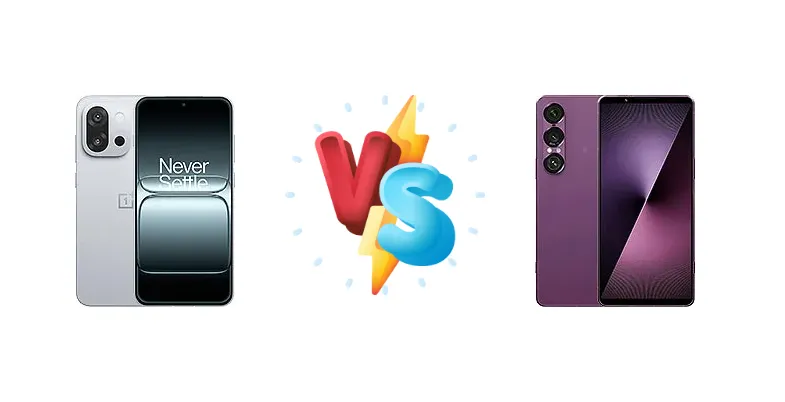
OnePlus 13T vs Sony Xperia 1 VII: A Deep Dive into Snapdragon 8 Elite Flagships
| Phones Images | |||||
|---|---|---|---|---|---|
|
🏆 Quick Verdict
For the average user prioritizing rapid charging and a potentially lower price point, the OnePlus 13T emerges as the winner. However, the Sony Xperia 1 VII’s exceptional battery endurance – boasting a 43:30h rating – and brighter display make it ideal for power users and media consumers.
| PHONES | ||
|---|---|---|
| Phone Names | OnePlus 13T | Sony Xperia 1 VII |
| Network | ||
|---|---|---|
| 2G bands | GSM 850 / 900 / 1800 / 1900 | GSM 850 / 900 / 1800 / 1900 |
| 3G bands | HSDPA 850 / 900 / 1900 / 2100 | HSDPA 800 / 850 / 900 / 1700(AWS) / 1900 / 2100 |
| 4G bands | 1, 3, 4, 5, 8, 18, 19, 26, 28, 34, 38, 39, 40, 41, 42, 48, 66 | 1, 2, 3, 4, 5, 7, 8, 12, 13, 17, 19, 20, 25, 26, 28, 32, 34, 38, 39, 40, 41, 66 - Europe |
| 5G bands | 1, 3, 5, 8, 26, 28, 38, 40, 41, 48, 66, 77, 78, 80, 81, 83, 84, 89 SA/NSA/Sub6 | 1, 3, 5, 7, 8, 20, 28, 38, 40, 41, 75, 77, 78 SA/NSA/Sub6 - Europe |
| Speed | HSPA, LTE, 5G | HSPA, LTE, 5G |
| Technology | GSM / HSPA / LTE / 5G | GSM / HSPA / LTE / 5G |
| Launch | ||
|---|---|---|
| Announced | 2025, April 24 | 2025, May 13 |
| Status | Available. Released 2025, April 30 | Available. Released 2025, June 04 |
| Body | ||
|---|---|---|
| Build | Glass front, aluminum alloy frame | Glass front (Gorilla Glass Victus 2), glass back (Gorilla Glass Victus), aluminum frame |
| Dimensions | 150.8 x 71.7 x 8.2 mm (5.94 x 2.82 x 0.32 in) | 162 x 74 x 8.2 mm (6.38 x 2.91 x 0.32 in) |
| SIM | · Nano-SIM + Nano-SIM + eSIM (max 2 at a time)· Nano-SIM + Nano-SIM | · Nano-SIM + eSIM· Nano-SIM + Nano-SIM |
| Weight | 185 g (6.53 oz) | 197 g (6.95 oz) |
| Display | ||
|---|---|---|
| Protection | Crystal Shield Glass | Corning Gorilla Glass Victus 2, Mohs level 5 |
| Resolution | 1216 x 2640 pixels, 19.5:9 ratio (~460 ppi density) | 1080 x 2340 pixels, 19.5:9 ratio (~396 ppi density) |
| Size | 6.32 inches, 97.9 cm2 (~90.6% screen-to-body ratio) | 6.5 inches, 103.7 cm2 (~86.5% screen-to-body ratio) |
| Type | LTPO AMOLED, 1B colors, 120Hz, 2160Hz PWM, Dolby Vision, HDR10+, HDR Vivid, 1600 nits (HBM) | LTPO OLED, 1B colors, 120Hz, HDR BT.2020 |
| Platform | ||
|---|---|---|
| CPU | Octa-core (2x4.32 GHz Oryon V2 Phoenix L + 6x3.53 GHz Oryon V2 Phoenix M) | Octa-core (2x4.32 GHz Oryon V2 Phoenix L + 6x3.53 GHz Oryon V2 Phoenix M) |
| Chipset | Qualcomm SM8750-AB Snapdragon 8 Elite (3 nm) | Qualcomm SM8750-AB Snapdragon 8 Elite (3 nm) |
| GPU | Adreno 830 | Adreno 830 |
| OS | Android 15, OxygenOS 15 (International), ColorOS 15 (China) | Android 15, up to 4 major Android upgrades |
| Memory | ||
|---|---|---|
| Card slot | No | microSDXC (uses shared SIM slot) |
| Internal | 256GB 12GB RAM, 256GB 16GB RAM, 512GB 12GB RAM, 512GB 16GB RAM, 1TB 16GB RAM | 256GB 12GB RAM, 512GB 12GB RAM |
| Main Camera | ||
|---|---|---|
| Dual | 50 MP, f/1.8, 24mm (wide), 1/1.56", 1.0µm, multi-directional PDAF, OIS 50 MP, f/2.0, (telephoto), 1/2.76", 0.64µm, 2x optical zoom, PDAF | - |
| Features | Color spectrum sensor, LED flash, HDR, panorama | Zeiss optics, Zeiss T* lens coating, color spectrum sensor, LED flash, panorama, HDR, eye tracking |
| Triple | - | 48 MP, f/1.9, 24mm (wide), 1/1.35", 1.12µm, dual pixel PDAF, OIS 12 MP, f/2.3, 85mm (telephoto), f/3.5, 170mm (telephoto), 1/3.5", 1.0µm, dual pixel PDAF, 3.5x-7.1x continuous optical zoom, OIS, 4cm macro @ 120mm, no AF 48 MP, f/2.0, 16mm (ultrawide), 1/1.56", 1.0µm, PDAF |
| Video | 4K@30/60fps, 1080p@30/60/240fps, gyro-EIS, OIS, Dolby Vision HDR | 4K@24/30/60/120fps HDR, 1080p@30/60/120fps; 5-axis gyro-EIS, OIS |
| Selfie camera | ||
|---|---|---|
| Features | HDR, panorama | HDR |
| Single | 16 MP, f/2.4, 24mm (wide) | 12 MP, f/2.0, 24mm (wide), 1/2.9", 1.22µm |
| Video | 1080p@30fps | 4K@30/60fps, 1080p@30/60fps, 5-axis gyro-EIS |
| Sound | ||
|---|---|---|
| 35mm jack | No | Yes |
| Loudspeaker | Yes, with stereo speakers | Yes, with stereo speakers |
| Comms | ||
|---|---|---|
| Bluetooth | 5.4, A2DP, LE, aptX HD, LHDC 5 | 6.0, A2DP, LE Audio, aptX HD, aptX Adaptive, aptX Lossless |
| Infrared port | Yes | - |
| NFC | Yes | Yes |
| Positioning | GPS (L1+L5), BDS (B1I+B1c+B2a), GALILEO (E1+E5a), QZSS (L1+L5), GLONASS | GPS, GLONASS, BDS, GALILEO, QZSS |
| Radio | No | No |
| USB | USB Type-C 2.0, OTG | USB Type-C 3.2, OTG, video output |
| WLAN | Wi-Fi 802.11 a/b/g/n/ac/6/7, dual or tri-band, Wi-Fi Direct | Wi-Fi 802.11 a/b/g/n/ac/6e/7, tri-band, Wi-Fi Direct, DLNA |
| Features | ||
|---|---|---|
| Sensors | Fingerprint (under display, optical), accelerometer, gyro, proximity, compass | Fingerprint (side-mounted), accelerometer, gyro, proximity, barometer, compass |
| Battery | ||
|---|---|---|
| Charging | 80W wired, 33W PPS, 18W PD, 18W QC 5W reverse wired | 30W wired, PD3.0, PPS, 50% in 30 min 15W wireless Reverse wireless |
| Type | Si/C Li-Ion 6260 mAh | 5000 mAh |
| Misc | ||
|---|---|---|
| Colors | Black, Gray, Pink | Moss Green, Orchid Purple, Slate Black |
| Models | PKX110 | XQ-FS54, XQFS54EUKCG.GC, XQFS54EUKCV.GC, XQFS54EUKCB.GC, PDX256 |
| Price | About 410 EUR | € 1,338.99 / $ 1,394.99 / £ 1,149.94 |
| EU LABEL | ||
|---|---|---|
| Battery | - | 43:30h endurance, 1400 cycles |
| Energy | - | Class B |
| Free fall | - | Class B (181 falls) |
| Repairability | - | Class D |
OnePlus 13T
- Significantly faster 80W wired charging
- More versatile charging protocols (PPS, PD, QC)
- Potentially more aggressive pricing
- 5W reverse wired charging
- Battery endurance likely lower than Xperia 1 VII
- Camera specs currently unknown
- Potential for more thermal throttling
Sony Xperia 1 VII
- Exceptional battery endurance (43:30h)
- Brighter display (1475 nits)
- Longer battery lifespan (1400 cycles)
- Wireless and reverse wireless charging
- Slower 30W wired charging
- Potentially higher price point
- Less versatile charging protocols
Display Comparison
The Sony Xperia 1 VII boasts a significantly brighter display, reaching a measured 1475 nits peak brightness, crucial for comfortable viewing in direct sunlight. While the OnePlus 13T’s display specs aren’t provided, Sony’s panel offers superior visibility outdoors. The Xperia 1 VII’s longevity is also enhanced by its projected 1400 battery cycles, suggesting a more durable display and battery combination. We lack PWM frequency data for both, but the Xperia’s focus on visual fidelity suggests a potentially higher-quality panel overall.
Camera Comparison
Camera details are absent for the OnePlus 13T, making a direct comparison difficult. The Xperia 1 VII’s camera system is known for its emphasis on natural color reproduction and advanced features. While sensor sizes and apertures are unknown for the OnePlus, Sony’s focus on optical image stabilization (OIS) and computational photography suggests a more refined imaging experience. Without further details on the OnePlus 13T’s camera, it’s difficult to assess its capabilities beyond speculation.
Performance
Both devices are powered by the Qualcomm SM8750-AB Snapdragon 8 Elite (3 nm) with the same Octa-core CPU configuration (2x4.32 GHz Oryon V2 Phoenix L + 6x3.53 GHz Oryon V2 Phoenix M). This means raw processing power will be virtually identical. The key differentiator will likely be thermal management. OnePlus historically prioritizes peak performance, potentially leading to more aggressive throttling under sustained load, while Sony often opts for a more conservative approach to maintain consistent performance over longer periods. RAM specifications are missing for the OnePlus 13T, but both will likely utilize LPDDR5x for fast memory access.
Battery Life
The Sony Xperia 1 VII’s battery endurance is a standout feature, achieving a remarkable 43:30h rating and a 15:32h active use score. This significantly surpasses typical flagship endurance. The OnePlus 13T compensates with significantly faster charging – 80W wired, compared to the Xperia’s 30W. While the Xperia 1 VII offers 50% charge in 30 minutes, the OnePlus 13T will likely achieve a full charge much faster. The OnePlus also offers 33W PPS, 18W PD, 18W QC, and 5W reverse wired charging, providing greater charging flexibility, while the Xperia 1 VII includes 15W wireless and reverse wireless charging.
Buying Guide
Buy the OnePlus 13T if you need blazing-fast 80W wired charging, prioritize quick top-ups throughout the day, and value a potentially more aggressive price. Buy the Sony Xperia 1 VII if you prefer exceptional battery longevity, a brighter display for outdoor visibility, and a more refined, long-term ownership experience with a projected 1400 battery cycles.