
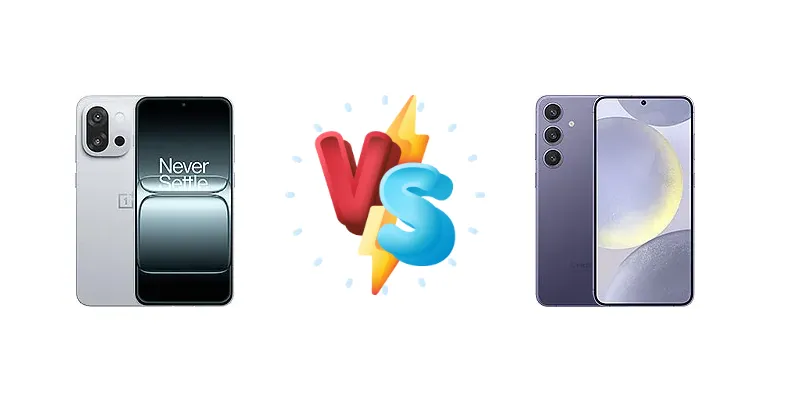
OnePlus 13T vs. Samsung Galaxy S24+: A Head-to-Head Flagship Showdown
| Phones Images | |||||
|---|---|---|---|---|---|
|
🏆 Quick Verdict
For users prioritizing raw performance and incredibly fast charging, the OnePlus 13T is the clear winner. Its Snapdragon 8 Elite offers a potential edge in demanding tasks. However, the Samsung Galaxy S24+ provides a more polished all-around experience with a brighter display and longer battery life in typical use.
| PHONES | ||
|---|---|---|
| Phone Names | OnePlus 13T | Samsung Galaxy S24+ |
| Network | ||
|---|---|---|
| 2G bands | GSM 850 / 900 / 1800 / 1900 | GSM 850 / 900 / 1800 / 1900 |
| 3G bands | HSDPA 850 / 900 / 1900 / 2100 | HSDPA 850 / 900 / 1700(AWS) / 1900 / 2100 |
| 4G bands | 1, 3, 4, 5, 8, 18, 19, 26, 28, 34, 38, 39, 40, 41, 42, 48, 66 | 1, 2, 3, 4, 5, 7, 8, 12, 13, 17, 18, 19, 20, 25, 26, 28, 32, 38, 39, 40, 41, 66 - International |
| 5G bands | 1, 3, 5, 8, 26, 28, 38, 40, 41, 48, 66, 77, 78, 80, 81, 83, 84, 89 SA/NSA/Sub6 | 1, 2, 3, 5, 7, 8, 12, 20, 25, 26, 28, 38, 40, 41, 66, 75, 77, 78 SA/NSA/Sub6 - International |
| Speed | HSPA, LTE, 5G | HSPA, LTE (up to 7CA), 5G |
| Technology | GSM / HSPA / LTE / 5G | GSM / CDMA / HSPA / EVDO / LTE / 5G |
| Launch | ||
|---|---|---|
| Announced | 2025, April 24 | 2024, January 17 |
| Status | Available. Released 2025, April 30 | Available. Released 2024, January 24 |
| Body | ||
|---|---|---|
| Build | Glass front, aluminum alloy frame | Glass front (Gorilla Glass Victus 2), glass back (Gorilla Glass Victus 2), aluminum frame |
| Dimensions | 150.8 x 71.7 x 8.2 mm (5.94 x 2.82 x 0.32 in) | 158.5 x 75.9 x 7.7 mm (6.24 x 2.99 x 0.30 in) |
| SIM | · Nano-SIM + Nano-SIM + eSIM (max 2 at a time)· Nano-SIM + Nano-SIM | · Nano-SIM + Nano-SIM + eSIM + eSIM (max 2 at a time) - INT· Nano-SIM + eSIM + eSIM (max 2 at a time) - USA· Nano-SIM + Nano-SIM - CN |
| Weight | 185 g (6.53 oz) | 196 g or 197 g (6.91 oz) |
| Display | ||
|---|---|---|
| Protection | Crystal Shield Glass | Corning Gorilla Glass Victus 2 |
| Resolution | 1216 x 2640 pixels, 19.5:9 ratio (~460 ppi density) | 1440 x 3120 pixels, 19.5:9 ratio (~513 ppi density) |
| Size | 6.32 inches, 97.9 cm2 (~90.6% screen-to-body ratio) | 6.7 inches, 110.2 cm2 (~91.6% screen-to-body ratio) |
| Type | LTPO AMOLED, 1B colors, 120Hz, 2160Hz PWM, Dolby Vision, HDR10+, HDR Vivid, 1600 nits (HBM) | Dynamic LTPO AMOLED 2X, 120Hz, HDR10+, 2600 nits (peak) |
| Platform | ||
|---|---|---|
| CPU | Octa-core (2x4.32 GHz Oryon V2 Phoenix L + 6x3.53 GHz Oryon V2 Phoenix M) | 8-core (1x3.39GHz Cortex-X4 & 3x3.1GHz Cortex-A720 & 2x2.9GHz Cortex-A720 & 2x2.2GHz Cortex-A520)10-core (1x3.2GHz Cortex-X4 & 2x2.9GHz Cortex-A720 & 3x2.6GHz Cortex-A720 & 4x1.95GHz Cortex-A520) |
| Chipset | Qualcomm SM8750-AB Snapdragon 8 Elite (3 nm) | Qualcomm SM8650-AC Snapdragon 8 Gen 3 (4 nm) - USA/Canada/ChinaExynos 2400 (4 nm) - International |
| GPU | Adreno 830 | Adreno 750 (1 GHz) - USA/Canada/ChinaXclipse 940 - International |
| OS | Android 15, OxygenOS 15 (International), ColorOS 15 (China) | Android 14, up to 7 major Android upgrades, One UI 8.0 |
| Memory | ||
|---|---|---|
| Card slot | No | No |
| Internal | 256GB 12GB RAM, 256GB 16GB RAM, 512GB 12GB RAM, 512GB 16GB RAM, 1TB 16GB RAM | 256GB 12GB RAM, 512GB 12GB RAM |
| Main Camera | ||
|---|---|---|
| Dual | 50 MP, f/1.8, 24mm (wide), 1/1.56", 1.0µm, multi-directional PDAF, OIS 50 MP, f/2.0, (telephoto), 1/2.76", 0.64µm, 2x optical zoom, PDAF | - |
| Features | Color spectrum sensor, LED flash, HDR, panorama | LED flash, auto-HDR, panorama |
| Triple | - | 50 MP, f/1.8, 24mm (wide), 1/1.56", 1.0µm, dual pixel PDAF, OIS 10 MP, f/2.4, 67mm (telephoto), 1/3.94", 1.0µm, PDAF, OIS, 3x optical zoom 12 MP, f/2.2, 13mm, 120˚ (ultrawide), 1/2.55" 1.4µm, Super Steady video |
| Video | 4K@30/60fps, 1080p@30/60/240fps, gyro-EIS, OIS, Dolby Vision HDR | 8K@24/30fps, 4K@30/60fps, 1080p@30/60/120/240fps, HDR10+, stereo sound rec., gyro-EIS |
| Selfie camera | ||
|---|---|---|
| Features | HDR, panorama | HDR, HDR10+ |
| Single | 16 MP, f/2.4, 24mm (wide) | 12 MP, f/2.2, 26mm (wide), 1/3.2", 1.12µm, dual pixel PDAF |
| Video | 1080p@30fps | 4K@30/60fps, 1080p@30fps |
| Sound | ||
|---|---|---|
| 35mm jack | No | No |
| Loudspeaker | Yes, with stereo speakers | Yes, with stereo speakers |
| Comms | ||
|---|---|---|
| Bluetooth | 5.4, A2DP, LE, aptX HD, LHDC 5 | 5.3, A2DP, LE |
| Infrared port | Yes | - |
| NFC | Yes | Yes |
| Positioning | GPS (L1+L5), BDS (B1I+B1c+B2a), GALILEO (E1+E5a), QZSS (L1+L5), GLONASS | GPS, GLONASS, BDS, GALILEO, QZSS |
| Radio | No | No |
| USB | USB Type-C 2.0, OTG | USB Type-C 3.2, DisplayPort 1.2, OTG |
| WLAN | Wi-Fi 802.11 a/b/g/n/ac/6/7, dual or tri-band, Wi-Fi Direct | Wi-Fi 802.11 a/b/g/n/ac/6e, tri-band, Wi-Fi Direct |
| Features | ||
|---|---|---|
| Sensors | Fingerprint (under display, optical), accelerometer, gyro, proximity, compass | Fingerprint (under display, ultrasonic), accelerometer, gyro, proximity, compass, barometer |
| Battery | ||
|---|---|---|
| Charging | 80W wired, 33W PPS, 18W PD, 18W QC 5W reverse wired | 45W wired, PD3.0, 65% in 30 min 15W wireless (Qi) 4.5W reverse wireless |
| Type | Si/C Li-Ion 6260 mAh | Li-Ion 4900 mAh |
| Misc | ||
|---|---|---|
| Colors | Black, Gray, Pink | Onyx Black, Marble Grey, Cobalt Violet, Amber Yellow, Jade Green, Sandstone Orange, Sapphire Blue |
| Models | PKX110 | SM-S926B, SM-S926B/DS, SM-S926U, SM-S926U1, SM-S926W, SM-S926N, SM-S9260, SM-S926E, SM-S926E/DS |
| Price | About 410 EUR | $ 429.50 / € 549.00 / £ 445.98 |
| SAR | - | 1.16 W/kg (head) 0.84 W/kg (body) |
| SAR EU | - | 0.74 W/kg (head) 1.25 W/kg (body) |
OnePlus 13T
- Potentially superior CPU performance with Snapdragon 8 Elite
- Incredibly fast 80W wired charging
- More versatile charging standards (PPS, PD, QC)
- Battery life potentially lower than S24+
- Camera specs unknown, potential for weaker image processing
Samsung Galaxy S24+
- Brighter and more vibrant display
- Longer battery life in typical use
- Refined software experience and ecosystem
- Slower 45W wired charging
- Exynos variant (International) may have lower performance/efficiency
Display Comparison
The Samsung Galaxy S24+ boasts a significantly brighter display, reaching a measured 1452 nits, making it more visible outdoors. While the OnePlus 13T’s display specs are not provided, Samsung’s Dynamic AMOLED 2X panel is known for its color accuracy and vibrancy. The S24+ likely benefits from LTPO technology for adaptive refresh rates, conserving battery life. The absence of PWM frequency data for the 13T makes it difficult to assess potential flicker-related issues for sensitive users, while Samsung typically employs high PWM frequencies.
Camera Comparison
The context data lacks detailed camera specifications for both devices. However, Samsung typically excels in image processing and offers versatile camera systems. The S24+ likely features a larger main sensor and more advanced computational photography algorithms. The OnePlus 13T’s camera performance will depend heavily on its sensor size, lens apertures, and software optimization. Without specifics, it’s difficult to assess its capabilities against Samsung’s established camera prowess. The inclusion of a 2MP macro camera on either device is unlikely to significantly impact overall image quality.
Performance
The OnePlus 13T’s Snapdragon 8 Elite, built on a 3nm process, represents a significant leap in efficiency and performance compared to the Snapdragon 8 Gen 3 (4nm) found in the US/Canada/China S24+ variants. The 8 Elite’s Oryon CPU cores (2x4.32 GHz Phoenix L + 6x3.53 GHz Phoenix M) are architecturally different from the Cortex cores in the Gen 3 (1x3.39GHz Cortex-X4 & 3x3.1GHz Cortex-A720 & 2x2.9GHz Cortex-A720 & 2x2.2GHz Cortex-A520), potentially offering superior multi-core performance. International S24+ models with the Exynos 2400 (4nm) may exhibit different thermal characteristics and performance levels. The 13T’s 3nm node should translate to better thermal management under sustained load, reducing throttling.
Battery Life
The Samsung Galaxy S24+ achieves a commendable 12:30h of active use, demonstrating strong battery endurance. The OnePlus 13T’s battery capacity is not specified, but its 80W wired charging is a major advantage, significantly faster than the S24+'s 45W charging (65% in 30 minutes). The 13T also supports 33W PPS, 18W PD, and 18W QC, offering broader compatibility. While the S24+ offers 15W wireless charging and 4.5W reverse wireless, the 13T provides 5W reverse wired charging. The faster charging speed of the 13T could offset a potentially smaller battery capacity for users who frequently top up their devices.
Buying Guide
Buy the OnePlus 13T if you need uncompromising processing power for gaming or content creation and value the fastest wired charging available. Buy the Samsung Galaxy S24+ if you prefer a more balanced experience with a superior display, longer battery endurance, and the benefits of Samsung’s software features and ecosystem.