
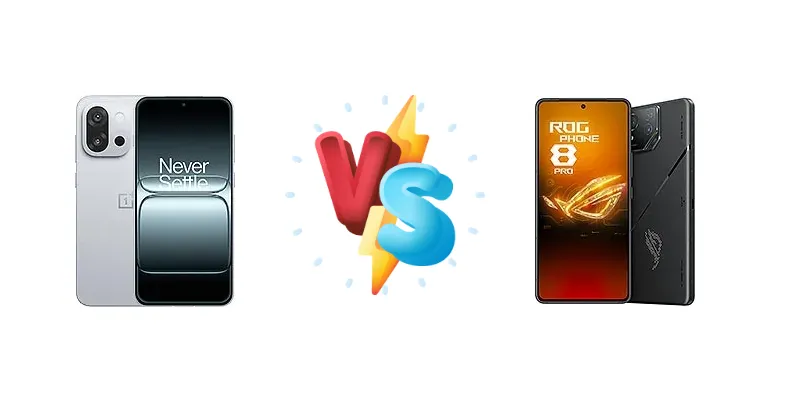
OnePlus 13T vs Asus ROG Phone 8 Pro: A Deep Dive into Performance and Gaming
| Phones Images | |||||
|---|---|---|---|---|---|
|
🏆 Quick Verdict
For the average user prioritizing raw speed and fast charging, the OnePlus 13T emerges as the winner. Its Snapdragon 8 Elite chipset delivers exceptional CPU performance. However, gamers who value long-term sustained performance and dedicated gaming features will find the Asus ROG Phone 8 Pro a more compelling choice.
| PHONES | ||
|---|---|---|
| Phone Names | OnePlus 13T | Asus ROG Phone 8 Pro |
| Network | ||
|---|---|---|
| 2G bands | GSM 850 / 900 / 1800 / 1900 | GSM 850 / 900 / 1800 / 1900 |
| 3G bands | HSDPA 850 / 900 / 1900 / 2100 | HSDPA 850 / 900 / 1700(AWS) / 1800 / 1900 / 2100 - International |
| 4G bands | 1, 3, 4, 5, 8, 18, 19, 26, 28, 34, 38, 39, 40, 41, 42, 48, 66 | 1, 2, 3, 4, 5, 7, 8, 12, 17, 18, 19, 20, 25, 26, 28, 32, 34, 38, 39, 40, 41, 42, 43, 48, 66 - International |
| 5G bands | 1, 3, 5, 8, 26, 28, 38, 40, 41, 48, 66, 77, 78, 80, 81, 83, 84, 89 SA/NSA/Sub6 | 1, 2, 3, 5, 7, 8, 12, 18, 20, 25, 26, 28, 38, 40, 41, 48, 66, 77, 78, 79 SA/NSA/Sub6 - International |
| Speed | HSPA, LTE, 5G | HSPA, LTE (Up to 7CA), 5G |
| Technology | GSM / HSPA / LTE / 5G | GSM / CDMA / HSPA / LTE / 5G |
| Launch | ||
|---|---|---|
| Announced | 2025, April 24 | 2024, January 08 |
| Status | Available. Released 2025, April 30 | Available. Released 2024, January 18 |
| Body | ||
|---|---|---|
| Build | Glass front, aluminum alloy frame | Glass front (Gorilla Glass Victus 2), glass back (Gorilla Glass), aluminum frame |
| Dimensions | 150.8 x 71.7 x 8.2 mm (5.94 x 2.82 x 0.32 in) | 163.8 x 76.8 x 8.9 mm (6.45 x 3.02 x 0.35 in) |
| SIM | · Nano-SIM + Nano-SIM + eSIM (max 2 at a time)· Nano-SIM + Nano-SIM | Nano-SIM + Nano-SIM |
| Weight | 185 g (6.53 oz) | 225 g (7.94 oz) |
| Display | ||
|---|---|---|
| Protection | Crystal Shield Glass | Corning Gorilla Glass Victus 2 |
| Resolution | 1216 x 2640 pixels, 19.5:9 ratio (~460 ppi density) | 1080 x 2400 pixels, 20:9 ratio (~388 ppi density) |
| Size | 6.32 inches, 97.9 cm2 (~90.6% screen-to-body ratio) | 6.78 inches, 111.0 cm2 (~88.2% screen-to-body ratio) |
| Type | LTPO AMOLED, 1B colors, 120Hz, 2160Hz PWM, Dolby Vision, HDR10+, HDR Vivid, 1600 nits (HBM) | LTPO AMOLED, 1B colors, 165Hz, HDR10, 1600 nits (HBM), 2500 nits (peak) |
| Platform | ||
|---|---|---|
| CPU | Octa-core (2x4.32 GHz Oryon V2 Phoenix L + 6x3.53 GHz Oryon V2 Phoenix M) | Octa-core (1x3.3 GHz Cortex-X4 & 3x3.2 GHz Cortex-A720 & 2x3.0 GHz Cortex-A720 & 2x2.3 GHz Cortex-A520) |
| Chipset | Qualcomm SM8750-AB Snapdragon 8 Elite (3 nm) | Qualcomm SM8650-AB Snapdragon 8 Gen 3 (4 nm) |
| GPU | Adreno 830 | Adreno 750 |
| OS | Android 15, OxygenOS 15 (International), ColorOS 15 (China) | Android 14, up to 2 major Android upgrades |
| Memory | ||
|---|---|---|
| Card slot | No | No |
| Internal | 256GB 12GB RAM, 256GB 16GB RAM, 512GB 12GB RAM, 512GB 16GB RAM, 1TB 16GB RAM | 512GB 16GB RAM, 1TB 24GB RAM |
| Main Camera | ||
|---|---|---|
| Dual | 50 MP, f/1.8, 24mm (wide), 1/1.56", 1.0µm, multi-directional PDAF, OIS 50 MP, f/2.0, (telephoto), 1/2.76", 0.64µm, 2x optical zoom, PDAF | - |
| Features | Color spectrum sensor, LED flash, HDR, panorama | LED flash, HDR, panorama |
| Triple | - | 50 MP, f/1.9, 24mm (wide), 1/1.56", 1.0µm, PDAF, gimbal OIS 32 MP, f/2.4, (telephoto), 1/3.2", 0.7µm, PDAF, OIS, 3x optical zoom 13 MP, f/2.2, 13mm, 120˚ (ultrawide) |
| Video | 4K@30/60fps, 1080p@30/60/240fps, gyro-EIS, OIS, Dolby Vision HDR | 8K@24fps, 4K@30/60fps, 1080p@30/60/120/240fps, 720p@480fps; gyro-EIS, HDR10+ |
| Selfie camera | ||
|---|---|---|
| Features | HDR, panorama | Panorama, HDR |
| Single | 16 MP, f/2.4, 24mm (wide) | 32 MP, f/2.5, 22mm (wide), 1/3.2", 0.7µm |
| Video | 1080p@30fps | 1080p@30fps |
| Sound | ||
|---|---|---|
| 35mm jack | No | Yes |
| Loudspeaker | Yes, with stereo speakers | Yes, with stereo speakers |
| Comms | ||
|---|---|---|
| Bluetooth | 5.4, A2DP, LE, aptX HD, LHDC 5 | 5.4, A2DP, LE, aptX HD, aptX Adaptive, aptX Lossless |
| Infrared port | Yes | - |
| NFC | Yes | Yes |
| Positioning | GPS (L1+L5), BDS (B1I+B1c+B2a), GALILEO (E1+E5a), QZSS (L1+L5), GLONASS | GPS (L1+L5), BDS (B1I+B1c+B2a), GALILEO (E1+E5a), QZSS (L1+L5), NavIC (L5), GLONASS |
| Radio | No | No |
| USB | USB Type-C 2.0, OTG | USB Type-C (side), DisplayPort 1.4; USB Type-C (bottom), OTG |
| WLAN | Wi-Fi 802.11 a/b/g/n/ac/6/7, dual or tri-band, Wi-Fi Direct | Wi-Fi 802.11 a/b/g/n/ac/6e/7, tri-band, Wi-Fi Direct |
| Features | ||
|---|---|---|
| Sensors | Fingerprint (under display, optical), accelerometer, gyro, proximity, compass | Fingerprint (under display, optical), accelerometer, gyro, proximity, compass |
| Battery | ||
|---|---|---|
| Charging | 80W wired, 33W PPS, 18W PD, 18W QC 5W reverse wired | 65W wired, PD3.0, PPS, QC5, 100% in 39 min - International 30W wired, PD3.0, PPS - India 15W wireless (Qi) 10W reverse wired |
| Type | Si/C Li-Ion 6260 mAh | 5500 mAh |
| Misc | ||
|---|---|---|
| Colors | Black, Gray, Pink | Phantom Black |
| Models | PKX110 | AI2401, AI2401_A, AI2401_D |
| Price | About 410 EUR | $ 1,157.98 / £ 1,693.75 / € 632.66 |
OnePlus 13T
- Blazing-fast CPU performance with Snapdragon 8 Elite
- Ultra-fast 80W wired charging
- Potentially better thermal efficiency due to 3nm process
- Missing display specifications limit comparison
- Battery life potentially lower than ROG Phone 8 Pro
Asus ROG Phone 8 Pro
- Exceptional battery life (14:43h active use)
- Brighter display (1765 nits)
- Dedicated gaming features (AirTriggers, optimized cooling)
- Slower wired charging speeds (65W/30W)
- Snapdragon 8 Gen 3 may throttle under sustained load
Display Comparison
The Asus ROG Phone 8 Pro boasts a significantly brighter display, reaching a measured 1765 nits, making it more visible outdoors. While the OnePlus 13T’s display specs are not provided, Asus’s panel likely offers superior HDR performance. Both are expected to utilize high refresh rate AMOLED panels, but the ROG Phone 8 Pro’s brightness advantage is a clear win for outdoor usability. The ROG Phone 8 Pro’s display is also likely to have a higher PWM dimming rate, potentially reducing eye strain for sensitive users.
Camera Comparison
Detailed camera specifications for the OnePlus 13T are missing, making a direct comparison difficult. However, the ROG Phone 8 Pro’s camera system is expected to focus on both photo and video capabilities. The ROG Phone 8 Pro likely features a larger main sensor and advanced image processing algorithms. Without specific details on the OnePlus 13T’s sensor size and aperture, it’s difficult to assess its low-light performance or dynamic range. The ROG Phone 8 Pro’s video capabilities are likely to be more robust, offering features like 8K recording and advanced stabilization.
Performance
The core difference lies in the chipsets. The OnePlus 13T features the Qualcomm SM8750-AB Snapdragon 8 Elite (3nm), utilizing Oryon V2 Phoenix cores clocked up to 4.32 GHz. This architecture prioritizes single-core performance, potentially leading to snappier app launches and faster processing in tasks that don’t fully utilize all cores. The Asus ROG Phone 8 Pro, however, employs the Snapdragon 8 Gen 3 (4nm) with a more traditional core configuration. While the Gen 3’s peak clock speed is lower at 3.3 GHz, its architecture is optimized for sustained multi-core performance, crucial for demanding games. The 3nm process of the Snapdragon 8 Elite *should* offer better thermal efficiency, but the ROG Phone 8 Pro’s larger chassis and advanced cooling solutions may mitigate the Gen 3’s higher power draw. The ROG Phone 8 Pro’s gaming-focused design likely includes optimized RAM configurations (LPDDR5x) and software tweaks for improved gaming performance.
Battery Life
The Asus ROG Phone 8 Pro demonstrates impressive battery life, achieving 14 hours and 43 minutes of active use. While the OnePlus 13T’s battery capacity is unknown, its 80W wired charging significantly surpasses the ROG Phone 8 Pro’s 65W (International) or 30W (India) charging speeds. The 13T can fully charge in a shorter timeframe, offering convenience for users who prioritize quick top-ups. The ROG Phone 8 Pro compensates with its larger battery and efficient chipset, resulting in longer overall usage. The ROG Phone 8 Pro also offers 15W wireless charging, a feature absent on the OnePlus 13T.
Buying Guide
Buy the OnePlus 13T if you need a phone that excels in everyday tasks, demanding applications, and benefits from incredibly fast 80W charging. It’s ideal for power users who want a responsive and versatile experience. Buy the Asus ROG Phone 8 Pro if you prioritize extended gaming sessions, appreciate gaming-specific features like AirTriggers, and need a phone that can maintain peak performance for longer periods, even at the expense of slightly slower charging.